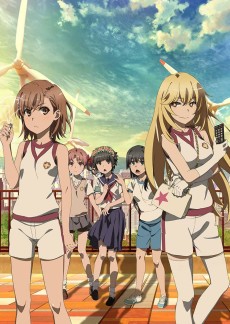
A Certain Scientific Railgun T
The third season of Toaru Kagaku no Railgun.
The Daihasei Festival has begun, and that of course means that Tokiwadai Middle School—a prestigious all-girls' middle school—is competing too. Despite the participation of the "Ace of Tokiwadai," Mikoto Misaka, the other students who are participating are still putting their utmost effort into winning, no matter how impossible the feat may seem against her might.
However, not all is fun and games. Due to the festival, Academy City opens to the outside world, and various factions have begun plotting ways to infiltrate the city. Misaka appears to be on their radar, and as the festival proceeds, people lurking from the shadows begin to emerge...
Toaru Kagaku no Railgun T brings back the Tokiwadai Ace and her friends as they dive deeper into the dark side of Academy City. From terrorist attacks to ruthless underground projects, anything is possible in this city.
(Source: MAL Rewrite)
📺Anime Details
📝Editorial Analysis
The scent of burnt sugar and ozone hangs thick over the Daihasei Festival grounds—Mikoto Misaka’s railgun crackles, blue-white and sharp as shattered glass, but it’s not her power that lingers. It’s the quiet after: the way a Tokiwadai first-year lowers her trembling hand after failing to deflect even a glancing spark, the hollow echo of her own breath inside her helmet, the sudden, startling warmth of a classmate’s hand pressing hers—not in praise, but in shared, wordless recognition. That moment isn’t about victory. It’s about standing shoulder-to-shoulder beneath the same impossible sky, knowing your name won’t be on the scoreboard, yet feeling your pulse sync with the rhythm of everyone else’s trying.
That’s the atmosphere: tender exhaustion. Not despair, not triumph—but the deep, resonant hum of effort that refuses to be erased by scale. A Certain Scientific Railgun T doesn’t ask you to believe in superpowers; it asks you to feel the weight of them—the friction between ambition and limitation, the quiet dignity in showing up when you know you’ll lose, the way memory manipulation doesn’t just erase facts but folds time into something fragile and personal. This is urban fantasy not as spectacle, but as texture: polished school corridors where every locker door clicks like a heartbeat, where a tsundere’s sharp retort carries the same emotional gravity as a clone’s whispered doubt, where “school” isn’t backdrop—it’s architecture for intimacy, pressure, and quiet, collective becoming.
The real kinship lies in how The Legend of Heroes: Trails through Daybreak II handles time & memory—not as plot devices, but as lived conditions. Player reviews cite its “slow-burn emotional resonance” and “moments where the past doesn’t resolve, it settles”—exactly like Railgun T’s handling of memory manipulation: no clean resets, only layered aftermaths, characters walking through rooms they’ve forgotten they’ve walked before, their gestures echoing older versions of themselves. The JRPG Narrative dimension mirrors Railgun T’s ensemble structure—not through exposition, but through accumulated presence: side characters don’t get “quests,” they get recurring silences, shared lunches, unspoken shifts in posture across episodes. You don’t learn their backstories in cutscenes—you notice how one girl stops adjusting her ribbon after a certain conversation, or how another’s laugh loses its edge during the festival’s final stretch. That’s the same narrative patience Daybreak II demands: trust that meaning accrues in the space between lines.
And it’s why the match isn’t just thematic—it’s structural. Railgun T’s “Primarily Female Cast” isn’t demographic shorthand; it’s world-building grammar. Relationships aren’t defined by romance arcs or rivalry tropes, but by overlapping responsibilities—training schedules, committee duties, the quiet labor of holding space for someone else’s fragility while managing your own. Daybreak II’s ensemble operates with similar granularity: party members debate logistics before battles, trade worn-out gear, interrupt each other mid-sentence with mundane concerns. One player review nails it: “It feels like living alongside people, not leading them.” That’s Tokiwadai’s locker room, that’s the cafeteria line during lunch break, that’s the exhausted, smiling group photo taken after the competition ends—not because they won, but because they endured together.
This pairing sings to the viewer who watches Mikoto’s railgun flash and immediately looks past her—to the girl tightening her grip on her controller, the one retying her shoelaces three times, the one whose voice cracks just once, softly, when she says “I’ll try again tomorrow.” It’s for the player who doesn’t skip dialogue, who saves before conversations not to avoid consequences, but to savor the weight of a pause, the hesitation before a confession, the way a character’s hand hovers near another’s shoulder—not to touch, but to remember what closeness feels like. They’re drawn to stories where power isn’t measured in volts or HP bars, but in how long someone holds eye contact after failure, how gently a memory is handed back, how fiercely ordinary people choose to stand in the same light, even when it burns.
🎮1 Games That Match the Vibe
Match Dimensions Explained
❓Frequently Asked Questions
Why does Trails through Daybreak II keep getting recommended for fans of A Certain Scientific Railgun T?
Because both lean hard into tightly woven urban sci-fi worlds where psychic powers (like Railgun’s esper abilities) are institutionalized—and Daybreak II mirrors that with its 'Criminal Investigation Division' tackling cases involving 'Mystic Arts' and memory-manipulating tech in the neon-drenched city of Loewe. You’ll spot clear echoes of Misaki’s leadership style in Van’s squad dynamics, and the 'Time & Memory' theme hits like Railgun’s Level 5 power debates—especially during the Chronos Lab arc where past choices physically reshape the present.
Is there a Railgun T anime-to-game adaptation?
No—there’s never been an official game adaptation of A Certain Scientific Railgun T. The closest you’ll get is fan-made mods or unofficial visual novel projects, but nothing licensed or canon. That’s why folks turn to narrative-rich JRPGs like Trails through Daybreak II (75 Metacritic), which nails the same vibe: grounded city life, moral gray zones around power usage, and ensemble casts where every side character feels like they could’ve walked out of Academy City.
Trails through Daybreak II vs. Steins;Gate: which is better for Railgun T fans who love science-as-plot-device?
Daybreak II—hands down—if you love how Railgun T uses real-world physics jargon as emotional shorthand (like Mikoto’s railgun acceleration calculations). Daybreak II’s 'Chronos Lab' missions force you to reconstruct timelines using fragmented memory logs and temporal resonance mechanics, mirroring Railgun T’s focus on cause/effect chains in power manifestation. Steins;Gate leans more into theoretical paradoxes than applied science, while Daybreak II drops you into lab reports, calibration minigames, and dialogue where characters debate entropy decay rates like it’s lunch talk.
What’s the best game like Railgun T if I want that ‘Academy City at night’ mood—lonely but electric, with hidden power humming under the surface?
Trails through Daybreak II nails that exact vibe: think Loewe’s rain-slicked alleys lit by holographic ads, where NPCs whisper about 'resonance surges' in subway tunnels—just like Railgun T’s quiet tension before a Level 5 showdown. The 'Time & Memory' dimension isn’t just lore—it’s baked into gameplay: your party’s flashbacks trigger environmental shifts (e.g., a café flickers between past/present states), making the city itself feel sentient and watchful, just like Academy City always does.