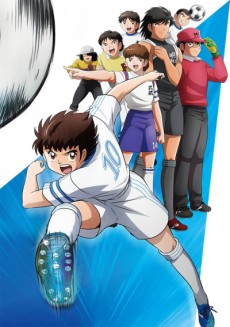
Captain Tsubasa (2018)
📺Anime Details
📝Editorial Analysis
The roar of the crowd isn’t just sound—it’s a physical pressure against your ribs, the kind that hits just as Tsubasa launches himself into the air, knee cocked, eyes locked on the ball mid-spin, sunlight catching the sweat on his temple—that suspended second before impact, where gravity feels optional and belief is the only physics that matters.
Captain Tsubasa (2018) doesn’t trade in realism—it trades in certainty. Not certainty of victory, but certainty of effort: the way a boy’s voice cracks shouting encouragement across a rain-slicked field, the raw scrape of cleats on gravel during a time skip’s abrupt cut to taller frames and deeper voices, the quiet weight of a school club room at dusk where dreams aren’t whispered—they’re measured, in meters run, passes completed, promises kept. It’s coming-of-age not as slow erosion, but as accumulation: every training session, every loss, every teammate’s hand clapped onto your shoulder becomes a brick in something unshakable. You don’t watch it wondering if they’ll make it—you watch wondering how far the shared will can bend reality. That’s the feeling: fervent, unbroken, collective.
Which makes F1® Manager 2024 vibrate with uncanny resonance—not because it’s about football, but because its core dimension is Competitive Spirit, Time & Memory. Player reviews call it “a love letter to long-term investment” and praise how “every decision echoes years later—hiring that junior engineer, sticking with an underperforming driver through three seasons, watching your rookie become world champion while you scroll through archived race notes.” That’s the same emotional architecture: the time skip isn’t a narrative shortcut here—it’s the engine. You feel the weight of seasons stacked like worn jerseys in a locker, the quiet pride when a strategy you planted in Year 2 blooms in Year 5, the way memory isn’t nostalgia—it’s data, fuel, identity. Just like Tsubasa’s team doesn’t win because they’re gifted—it wins because their history holds them upright when legs burn and scores are tied.
And yes—the cast is overwhelmingly male, the stakes are personal and institutional, the setting orbits schools and garages and pit walls alike. But more than demographics, it’s the texture of devotion: the way Tsubasa practices bicycle kicks until his shins bruise, and you mirror that in-game when you rewatch telemetry from a qualifying lap three times, adjusting tire pressure by 0.2 psi because last time, in Sector 3, the rear grip dipped just enough to cost you 0.17 seconds—and you remember exactly where you were sitting when that happened. That’s not simulation. That’s recognition.
Who lives for this? Not just sports fans—but people who build. The ones who keep spreadsheets tracking their own progress, who save voicemails from mentors, who name their first pet after a childhood coach. The ones who understand that fervent isn’t loud—it’s the hum beneath silence; that unbroken isn’t invincible—it’s the stitch holding together two seasons of setbacks; that collective isn’t crowds—it’s the shared breath before the whistle, the shared cursor hovering over “Confirm Contract,” the shared, wordless nod across a screen or a sideline that says: We remember what we promised. We’re still running.
🎮1 Games That Match the Vibe
Match Dimensions Explained
❓Frequently Asked Questions
Why does the Brazil vs Japan match in Captain Tsubasa (2018) feel so intense compared to other soccer games?
Because it leans hard into anime-style drama—like Tsubasa’s iconic 'Tiger Shot' colliding with Roberto’s 'Thunder Storm'—mirroring F1® Manager 2024’s high-stakes, narrative-driven races where every overtake feels like a cinematic showdown. Both tap into the 'Competitive Spirit' and 'Time & Memory' dimensions: you’re not just scoring goals or laps—you’re reliving iconic moments that anchor emotional investment.
Is there a Captain Tsubasa mobile game adaptation similar to the 2018 console version?
No—the 2018 game was exclusively on PS4, Switch, and PC, and while there are older mobile titles (like Captain Tsubasa: Dream Team), they’re arcadey team-builders with no story mode or tactical depth. F1® Manager 2024 is the closest in spirit: deep, season-long strategy with character-driven rivalries (think Verstappen vs. Leclerc mirroring Tsubasa vs. Hyuga), earning its 83 score for balancing realism and personality.
How does Captain Tsubasa (2018) compare to F1® Manager 2024 in terms of gameplay feel?
Captain Tsubasa is fast-paced, action-RPG style—dodging tackles as Misaki, then unleashing his 'Drive Shot' mid-sprint—while F1® Manager 2024 trades reflexes for real-time strategy: calling pit stops during rain at Spa, adjusting tire compounds while Alonso battles through traffic. Yet both nail the 'Time & Memory' vibe: replaying that one perfect lap or that last-minute Tsubasa header feels like unlocking a cherished memory.
What’s the best game like Captain Tsubasa (2018) if I want that hype, emotional underdog energy—not simulation?
F1® Manager 2024 delivers that exact rush: think rookie driver Yuki Tsunoda qualifying P2 at Suzuka against giants, or your custom engineer cracking a tire compound breakthrough before Monza—pure 'Competitive Spirit' adrenaline. It’s not about photorealism; it’s about heart-pounding stakes, legacy-building, and moments that make you fist-pump like you just scored the winning goal with Tsubasa’s 'Neo Tiger Shot'.