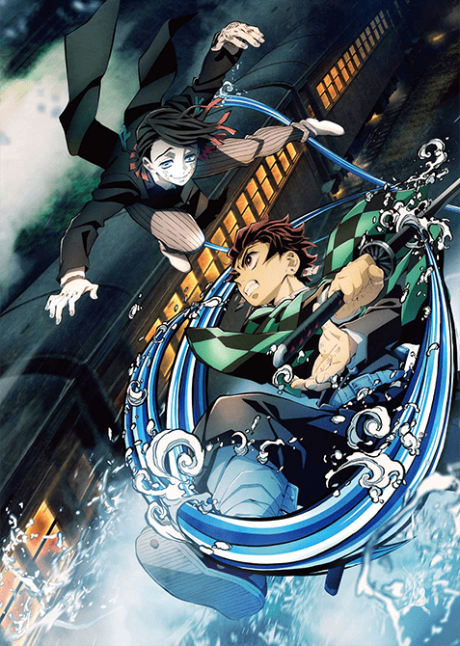
Demon Slayer -Kimetsu no Yaiba- The Movie: Mugen Train
This Demon Slayer movie sees Tanjiro Kamado and friends from the Demon Slayer corps board the Infinity Train on a new mission to investigate a mysterious series of disappearances, perpetrated by a demon who has been tormenting people and killing the demon slayers who oppose it.
📺Anime Details
📝Editorial Analysis
The lantern light flickers—too weak, too yellow—as Tanjiro stumbles down the narrow corridor of the Demon Slayer -Kimetsu no Yaiba- The Movie: Mugen Train, his breath ragged, sword trembling in hand. Outside the window, the landscape doesn’t move. It repeats: the same pine, the same curve of track, the same sliver of moon—over and over, like a wound refusing to scab. You don’t just watch this; you feel the train’s inertia pressing into your ribs, the quiet dread of time folding in on itself, the suffocating weight of a nightmare that won’t end—not because it’s loud or grotesque, but because it’s inescapable.
What makes Mugen Train’s atmosphere singular isn’t its demons or swordplay—it’s how deeply it weaponizes stillness. The Infinity Train isn’t haunted by jump scares or roaring monsters; it’s haunted by memory made physical, by grief given locomotive form. Every creak of the floorboard, every dimmed lantern, every reflection in a fogged window carries the residue of lives already lost—of children who vanished mid-laugh, of slayers whose last breaths dissolved into steam. This isn’t horror as spectacle. It’s horror as recognition: the slow, chilling realization that the most terrifying thing isn’t what’s outside the door—it’s what you carry inside, and how easily it can be unspooled, rewritten, buried under layers of illusion. You don’t just fear the demon—you fear the moment your own sorrow becomes the terrain the enemy walks on. That’s the ache it leaves: vulnerable, unmoored, tethered to loss.
That exact emotional resonance—the way trauma manifests not as blood but as architecture, as recursion, as a space where the self begins to fray—is why Amnesia: The Dark Descent lands with such brutal precision. Its description cites Body Horror & Occult, Emotional Narrative—and yes, the flesh-melting, the distorted limbs, the whispers from walls—but what players actually describe in reviews is the weight of forgotten pain, the way sanity erodes not with screams but with silences that grow longer, heavier, until even your own name feels borrowed. Like Tanjiro trapped in the dream-carriage, you walk corridors that loop not because the game glitches, but because your mind insists on returning to the wound.
Then there’s Outlast, also scoring 55 on those same dimensions. Its asylum isn’t just full of monsters—it’s built from institutional cruelty, from bodies broken and repurposed, from suffering made visible in twitching limbs and stitched mouths. But player reviews consistently fixate on something quieter: the helplessness of witnessing horror you cannot stop, cannot justify, cannot outrun—not because you’re weak, but because the system itself is rotten. That mirrors the Mugen Train’s core tragedy: the slayers aren’t defeated by strength, but by design. The train doesn’t fight them—it absorbs them, metabolizes their resolve into fuel for its endless cycle. Both demand you sit with powerlessness—not as failure, but as condition.
And SOMA, with its identical dimensional score, hits the deepest nerve: consciousness as fragile, identity as editable, memory as unstable ground. Its description flags Body Horror & Occult, Emotional Narrative, but players don’t talk about the monsters—they talk about the questions: What remains when your body is gone? When your voice is recorded, copied, erased? When love persists in a machine that no longer remembers your face? That’s the ghost haunting Mugen Train’s final act—not just the death of a friend, but the erasure of witness. Tanjiro doesn’t just mourn Nezuko’s brother—he mourns the fact that no one else saw what he saw, that the truth of that carriage exists only in his trembling hands, his raw throat, his untranslatable scream.
This pairing isn’t for fans of “cool fights” or “scary monsters.” It’s for the ones who pause the screen when a character closes their eyes—not to skip the sadness, but to hold it. For the player who lingers in River God: Enshrouded Current’s mist-choked riverbanks (another 55-score match, same dimensions), not hunting enemies, but tracing the way light catches on waterlogged wood, sensing how history settles in sediment. These are stories for people who understand that the most devastating battles aren’t fought with blades or bullets—they’re fought in the hollow between breaths, in the silence after a name is spoken wrong, in the terrible, beautiful certainty that some losses change the shape of reality itself. They want the ache—not to escape it, but to recognize it, honor it, and keep walking anyway.
🎮4 Games That Match the Vibe




Match Dimensions Explained
❓Frequently Asked Questions
Why does River God: Enshrouded Current feel so much like Mugen Train's emotional weight?
Because both hinge on quiet, devastating moments—like Tanjiro’s breakdown on the train—mirroring River God’s protagonist silently rowing through fog-choked rivers while flashbacks of lost family surface. Its hand-drawn ink-wash visuals and ambient silence during grief sequences (e.g., the drowned shrine scene) echo Mugen Train’s restrained yet crushing emotional pacing.
Is there a Demon Slayer: Mugen Train video game adaptation?
No official game adaptation exists—Bandai Namco hasn’t released one, and none are listed in major storefronts or press releases. Fans hoping for a direct retelling have turned to atmospheric matches like SOMA, which channels Mugen Train’s themes of sacrifice and fractured memory through its underwater facility’s haunting logs and the ‘consciousness transfer’ mechanic.
How accurate is Outlast compared to Mugen Train’s horror tone?
Outlast nails Mugen Train’s oppressive dread—not with demons, but through helplessness: like Tanjiro facing Upper Rank demons barehanded, you’re unarmed and hunted in Mount Massive Asylum, where flickering lights and sudden lurches mirror the train’s claustrophobic corridors and Akaza’s brutal, unpredictable attacks. Both rely on breathless evasion over combat, making every corner feel charged with inevitability.
What’s the best game like Mugen Train if I want that melancholy, rain-soaked atmosphere?
Amnesia: The Dark Descent—it’s soaked in that same heavy, sorrowful stillness: think of Tanjiro kneeling in the rain after Rengoku’s death, mirrored by Amnesia’s protagonist collapsing in flooded castle halls, journal entries crumbling as sanity drains. Its candle-lit gloom, distant whispers, and slow-burn despair hit the exact same wistful, elegiac vibe as Mugen Train’s quieter, rain-slicked interludes.