
Dr. STONE: STONE WARS
The second season of Dr. STONE
Armed with the power of science and a genius intellect, Senkuu is determined to save humanity. However, Tsukasa’s empire goes on the offensive to halt the progress of science. Bolder choices are made as these two start a war that rocks the Stone World.
(Source: Crunchyroll)
📺Anime Details
📝Editorial Analysis
The smell of wet clay and burning pine resin hangs thick in the air as Senkuu’s hands—grimed, trembling, impossibly precise—press a freshly fired ceramic crucible into the earth. A single drop of sulfuric acid sizzles where it meets damp soil. Nearby, a crude wooden catapult groans under tension, its ropes woven from boiled hemp, its counterweight a slab of quarried granite. No music swells. Just wind, distant hammering, and the low, urgent murmur of people calculating angles, calibrating ratios, believing—not in gods or fate, but in the next step. This isn’t triumph. It’s tension, coiled like a spring made of rusted iron and hope.
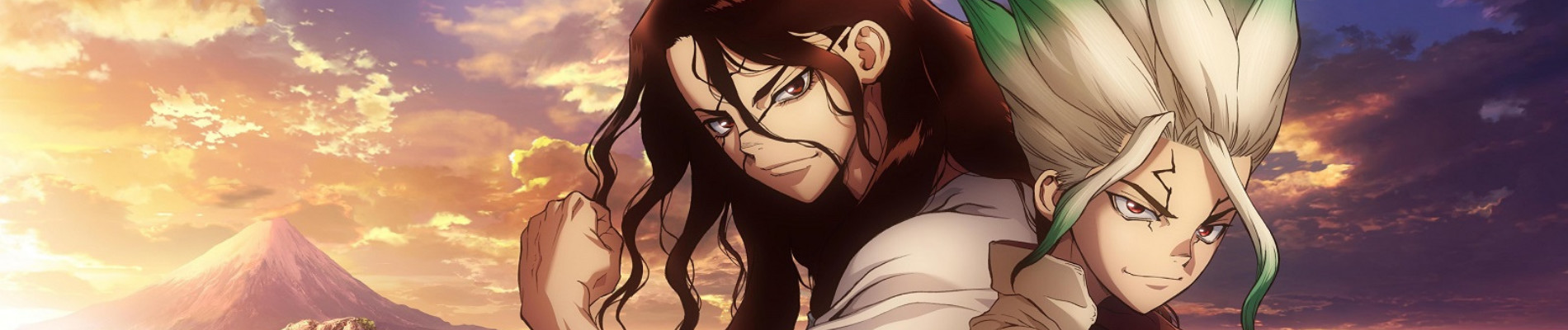
What makes Dr. STONE: STONE WARS vibrate at this frequency isn’t its post-apocalyptic setting or its shōnen structure—it’s the weight of reconstruction. Every bolt tightened, every schematic redrawn, every whispered strategy meeting carries the quiet gravity of civilization being reassembled by hand. There’s no magical reset button, no inherited infrastructure—just human ingenuity grinding against entropy, one experiment at a time. You feel the exhaustion in the characters’ shoulders, the exhilaration in their eyes when a battery finally sparks to life, the melancholy of knowing how much was lost—and how fragile what’s rebuilt truly is. It’s not optimism blind to ruin; it’s optimism forged in the ruins, sharp-edged and sweat-slicked. You think about time—not as a line, but as sediment: layers of knowledge buried, then painstakingly excavated, tested, and reassembled.
That same emotional DNA pulses through Valheim. Its description calls it “a brutal exploration and survival game… set in a procedurally-generated purgatory”—and that word purgatory lands like a stone in the gut. Like Senkuu’s Stone World, Valheim’s world isn’t just hostile; it’s indifferent, vast, and littered with the ghosts of past failures—crumbling megaliths, drowned longships, half-forgotten runes. You don’t conquer it. You negotiate with it. The player review nails it: “It’s like Minecraft but instead of punching trees you spend 40 minutes looking for the perfect tree, then a troll destroys your entire house…” That’s the rhythm of STONE WARS: the meticulous, almost sacred attention to material properties (oak vs. birch vs. blackwood), the devastating fragility of progress, the way victory feels less like domination and more like temporary reprieve. Both demand you learn the language of your environment—soil pH, ore veins, wind patterns—because ignorance isn’t just inconvenient; it’s extinction.
Then there’s the war—not as spectacle, but as logistical siege. Tsukasa’s empire doesn’t fall to a single duel; it fractures under pressure applied across supply lines, communication networks, and psychological thresholds. That mirrors the slow, systemic tension in games where conflict isn’t measured in headshots, but in resource flow and structural integrity. Valheim’s boss fights aren’t just battles—they’re engineering problems. Defeating Eikthyr means luring him into terrain you’ve shaped, exploiting his pathfinding, timing your dodges to the exact second his charge winds up—just like Senkuu’s team baiting Tsukasa’s forces into a canyon rigged with sulfur-laced smoke bombs. Victory emerges from layered preparation, not raw power. The melancholic exploration tag isn’t poetic fluff—it’s the ache of walking miles through fog-shrouded marshes, knowing every landmark could be a clue, every ruin a lesson, every decision carrying irreversible weight. That’s the same hush that falls over the Kingdom of Science when they first test gunpowder—not with cheers, but with held breath and chalk-marked blast zones.
This pairing sings to the person who gets chills not from explosions, but from the first successful distillation—the one who saves their game before smelting iron, not because they fear death, but because they respect the time it took to gather the charcoal, dig the clay, carve the mold. It’s for the reader who underlines footnotes in real textbooks, the player who names their base “Laboratory Gamma” and builds three separate compost pits “just in case.” They don’t crave ease—they crave agency earned, understanding deepened, and the profound, quiet thrill of watching something broken slowly, stubbornly, become whole again. Not perfect. Not eternal. But alive.
🎮8 Games That Match the Vibe



Match Dimensions Explained
❓Frequently Asked Questions
Why does Valheim keep coming up in Dr. STONE: STONE WARS discussions?
Because both lean hard into the 'rebuilding civilization from scratch' fantasy—Valheim’s entire loop is gathering flint, forging iron, and constructing longhouses while fending off trolls and skeletons, just like Senku’s crew scavenging rusted cars and reverse-engineering batteries. Players even report that ‘crafting a functional smelter in Valheim feels *exactly* like watching the Science Village episode where they make charcoal and clay furnaces.’
Is there a Dr. STONE anime or manga adaptation of STONE WARS?
No—STONE WARS is an original mobile game inspired by the franchise, not an adaptation. It features Senku, Chrome, and Ruri as playable characters running science-based combat missions (like defending the Lab from Tsukasa’s forces), but it doesn’t adapt any specific arc from the manga or anime. Think of it as ‘what if the Stone Wars arc had turn-based tactical battles and base-building?’
Valheim vs. Minecraft: which one captures Dr. STONE’s vibe better?
Valheim nails it harder—Minecraft’s playful sandbox energy clashes with Dr. STONE’s urgent, methodical tone, while Valheim’s melancholic exploration, resource-scarce world, and slow-burn progression (e.g., spending hours locating copper veins just to smelt your first bronze tools) mirror Senku’s trial-and-error realism. One player review even says: ‘Building my first mead hall felt like watching them forge their first steel blade—exhausting, precise, and weirdly sacred.’
What’s the best game like Dr. STONE: STONE WARS if I want that lonely, thoughtful rebuilding vibe?
Valheim is your top pick—it scores 69 on Metacritic for Survival & Crafting and leans into ‘Melancholic Exploration,’ where you’re often alone (or with 1–2 friends) deciphering biome logic, mapping ruins, and rebuilding after setbacks—just like Senku analyzing soil pH before planting rice. That ‘40 minutes hunting the perfect tree, then a troll wrecks your house’ moment? It’s the emotional cousin of Senku’s failed battery experiments: frustrating, human, and deeply satisfying when it finally works.