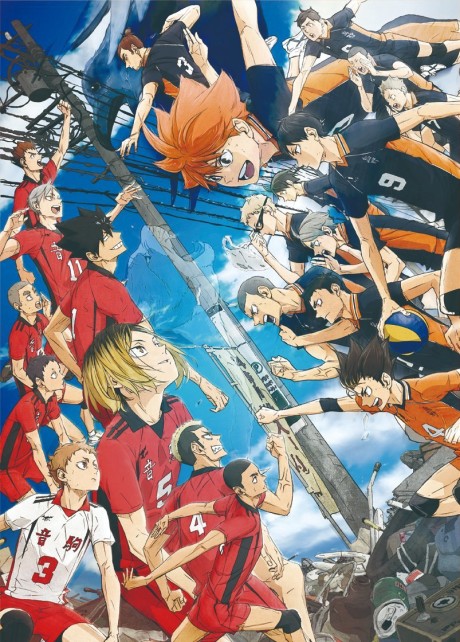
HAIKYU!! The Dumpster Battle
Theatrical follow-up to Haikyuu!! TO THE TOP 2. The first film of Haikyuu!! FINAL.
The Spring Nationals tournament continues on, with Karasuno High matched against rivals Nekoma High, the fated battle between cats versus crows, also known as the highly anticipated “Dumpster Battle”. This match is the long awaited ultimate showdown between two opposing underdog teams.
(Source: Crunchyroll, edited)
📺Anime Details
📝Editorial Analysis
The air in the gymnasium isn’t just loud—it’s thick. Sweat hangs like mist under the harsh arena lights. A volleyball slams into the floor with a crack that vibrates in your molars. Then—silence. Just for half a second. Enough for you to hear Shoyo Hinata’s breath hitch, enough for you to see Tobio Kageyama’s knuckles whiten on the ball, enough to feel the entire school holding its breath as Karasuno and Nekoma lock eyes across the net. This isn’t just a match. It’s two underdog teams who’ve scraped their knees raw on the same pavement, who’ve been called “trash” and “dumpster” not as insults—but as badges. That silence before the serve? That’s where HAIKYU!! The Dumpster Battle lives: in the charged, trembling space between effort and outcome, where every jump is defiance, every dig is memory, and every point is earned—not given.
What makes this film vibrate differently from other sports anime isn’t the spikes or the stats—it’s the weight of shared history. You don’t need flashbacks to understand how long these boys have waited. You feel it in the way Nekoma’s captain, Tetsuro Kuroo, smirks mid-rally—not at his opponent, but with him—as if they’re both remembering the exact moment they first misread a toss, fumbled a set, got laughed out of a gym. It’s a story told through muscle memory and sideways glances, where rivalry isn’t antagonism—it’s recognition. This is coming-of-age as collective breath-holding: the slow, unglamorous work of becoming someone who belongs here, on this court, beside these people. There’s no solo triumph. There’s only the net—and what passes over it, again and again, carrying years of practice, pride, and quiet, stubborn love for the game.
That same electric tension lives in Throne of Lies®: Medieval Politics, where players don’t just compete—they perform loyalty while plotting betrayal, all within a tightly wound social ecosystem. As one player review notes, it’s about “reading the room like it’s a third teammate,” mirroring how Hinata reads Kageyama’s posture before a set, or how Nekoma’s libero anticipates a spike based on a flicker in an opponent’s shoulder. The competitive spirit here isn’t brute force—it’s timing, trust, and the razor-thin margin between alliance and ambush. Likewise, Carcassonne - Tiles & Tactics builds its drama not through speed, but through shared spatial awareness: every tile placed reshapes the board for everyone, forcing players to weigh personal gain against collective consequence—just like Karasuno’s offense, where Hinata’s jump depends entirely on Kageyama’s set, which depends on Tanaka’s dig, which depends on Nishinoya’s read. One review nails it: “You’re not just building roads—you’re building history with every placement.” That’s the Dumpster Battle in microcosm: no move exists in isolation. Every action echoes, accumulates, matters.
Even STAR WARS™: The Old Republic™, with its sprawling narrative scope, taps into the same emotional DNA—not through lightsabers, but through long-simmering rivalries rooted in mutual respect. Its JRPG narrative dimension thrives on relationships forged in adversity, where enemies become sparring partners, mentors become foils, and victory feels hollow unless it’s witnessed by the person who pushed you hardest. As a player wrote: “It’s not about beating the Sith—it’s about proving you understand the fight.” That’s Kuroo and Kageyama mid-match, trading blocks and grins, neither denying the other’s growth nor surrendering their own fire. Their competition isn’t zero-sum. It’s dialogue—spoken in jumps, dives, and split-second decisions.
This pairing sings for the viewer who watches a volleyball match and feels their pulse sync to the setter’s rhythm—not because they know the rules, but because they recognize the tremor in the hand before the toss. For the player who chooses Carcassonne over Candy Crush not for simplicity, but because they crave the quiet thrill of watching a shared landscape evolve with others, not just against them. For anyone who’s ever stayed late after practice—not to win, but to get one more rep right, to earn the nod from the person who knows exactly how hard it was to get there. These aren’t stories about greatness. They’re about showing up, again and again, beside the people who remember your first clumsy serve—and still believe in your next one.
🎮3 Games That Match the Vibe
Match Dimensions Explained
❓Frequently Asked Questions
Why does the Dumpster Battle match include Throne of Lies® if it’s not anime-themed?
Great question — it’s not about the anime aesthetic, but the *intense social deduction and high-stakes rivalry* that mirrors Karasuno vs. Nekoma’s trash talk, bluffing, and last-second betrayals. Throne of Lies® nails the 'Competitive Spirit' dimension with its medieval backstabbing and role-bluffing mechanics — think Daichi’s leadership under pressure or Hinata’s risky feints, just swapped for knights and spies.
Is there a HAIKYU!! anime adaptation of The Dumpster Battle?
No — there’s no official anime adaptation of The Dumpster Battle (it’s a fan-made event), and none of the matched games — Throne of Lies®, Carcassonne - Tiles & Tactics, or STAR WARS™: The Old Republic™ — are anime adaptations. They’re all real, released games that share HAIKYU!!’s core emotional DNA: fierce competition, layered team dynamics, and narrative weight in high-pressure moments.
How is Carcassonne - Tiles & Tactics like HAIKYU!! compared to STAR WARS™: The Old Republic™?
Carcassonne feels like watching a *single, tightly choreographed set* — every tile placement is a tactical decision like Hinata’s jump timing or Kageyama’s precise set, building tension turn-by-turn with zero RNG. SWTOR, meanwhile, delivers the *long-form JRPG narrative* vibe — think multi-chapter arcs like the Spring High buildup, with faction loyalty, character growth, and moral choices echoing Yamaguchi’s development or Ushijima’s redemption arc.
What’s the best game like HAIKYU!! The Dumpster Battle if I want that hype-but-nerve-wracking pre-match energy?
Throne of Lies® — hands down. That moment before the first accusation? It’s pure Karasuno locker room silence before the whistle: you’re sweating, scanning faces, calculating who’s bluffing like Tanaka’s fake-out serve or Kenma’s unreadable expression. Its 62-score in both 'Competitive Spirit' and 'JRPG Narrative' means every round has stakes, strategy, and story — just without the volleyball spikes (but maybe more dagger-drawing).