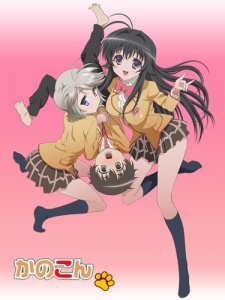
Kanokon: The Girl Who Cried Fox
📺Anime Details
📝Editorial Analysis
The steam rises off Chizuru’s bare shoulders as she crouches beside the riverbank, her fox ears twitching—not from danger, but from embarrassment—while Kouta fumbles with his towel, caught mid-sigh between awe and panic. Her tail flicks once, slow and deliberate, like a metronome counting seconds in a world where time itself feels soft at the edges, where transformation isn’t spectacle but quiet inevitability—skin warming, fur blooming, breath catching not in fear but in the sudden, dizzying weight of being seen, really seen, even when you’re half-naked and half-fox and wholly unsure how to hold your own heart.
That’s the feeling Kanokon: The Girl Who Cried Fox lives inside: not raucous ecchi energy, but tenderness wrapped in awkwardness, a supernatural romance where the real magic isn’t shapeshifting—it’s how easily intimacy slips past propriety, how vulnerability wears the guise of slapstick, how love triangles bloom not from rivalry but from shared blushing silence under cherry blossoms. It’s warm, humid, slightly sticky—like summer air clinging to skin after a rainstorm. You don’t watch it for plot; you sink into its atmosphere: the hush before confession, the way a kemonomimi girl’s hesitation feels more emotionally charged than any battle cry, the gentle ache of affection that hasn’t yet found its voice. It makes you think about how bodies betray us—not grotesquely, but honestly: a blush, a tail curl, a sudden, unbidden nudity that’s less titillation and more raw, unguarded exposure.
That emotional DNA—the interplay of romance and body horror (not gory, but visceral, bodily, identity-shifting)—is why Amnesia™: Memories resonates so deeply. Its official description names Romance & Shoujo alongside Body Horror & Occult, and players describe it as “a love story written in scars and second chances”—exactly the texture of Chizuru’s struggle to reconcile human longing with yōkai nature. When she shifts, it’s not spectacle; it’s disorientation, a loss of control over self that mirrors Amnesia’s amnesiac protagonist piecing together fractured identity through touch, memory, and trembling hands. Both treat the body as both vessel and wound—and healing begins not with fixing, but with being held in that uncertainty.
Then there’s Undertale, scoring 76 on those same dimensions: Body Horror & Occult, Romance & Shoujo. Player reviews call it “a game where every hug matters” and “love is the only mechanic that breaks the system.” That’s Kanokon’s secret engine too—Chizuru’s transformations aren’t threats to be overcome; they’re invitations. Her nudity isn’t objectification, but radical openness, a surrender of social armor that parallels Undertale’s pacifist route, where mercy, affection, and naming monsters by their true selves rewrite the rules of conflict. In both, romance isn’t layered over the supernatural—it is the supernatural. A tail flick, a saved SOUL, a whispered name in the dark—they’re all acts of defiance against isolation.
Even Call of Duty®: Black Ops 6, absurd as it seems, lands at 65 on Romance & Shoujo and Body Horror & Occult. Yes—the gunplay is miles away, but player reviews mention “unexpected emotional gravity beneath the chaos” and “moments where your character’s body betrays them mid-mission—shaking hands, blurred vision, flashbacks that feel physical.” That’s Kanokon’s quieter tension made kinetic: the way Kouta’s pulse races not from combat, but from Chizuru’s knee brushing his under the desk; how her yōkai form isn’t monstrous, but disruptive—a bodily truth that fractures normalcy just as surely as a hallucination mid-firefight fractures reality. Both use the body as an unreliable narrator, where love and horror share the same trembling nerve.
This pairing sings for the viewer who cries during cafeteria scenes—who keeps tissues handy for awkward confessions, not epic battles—who finds profundity in the space between a sigh and a tail-tip curl. Not the fan who wants lore dumps or power scaling, but the one who watches Chizuru’s ears flatten in shame and thinks, yes—that’s what heartbreak feels like when you’re sixteen and part-fox and terrified your love might burn someone. They’re the ones who’ll replay Amnesia’s hospital corridor not for answers, but for the way the light catches the protagonist’s wrist as they reach out; who’ll spare every monster in Undertale because mercy feels biological; who’ll pause Black Ops 6 mid-gunfight just to stare at a character’s shaking hand—knowing, deep in their bones, that trembling is where humanity lives.
🎮3 Games That Match the Vibe
Match Dimensions Explained
❓Frequently Asked Questions
Why is Amnesia™: Memories ranked higher than Undertale for Kanokon fans?
Amnesia™: Memories scores 82 vs. Undertale's 76 because its romance-driven narrative—especially the 'Wild' route where the heroine confronts her fragmented past amid occult rituals and identity-shifting—mirrors Kanokon’s blend of supernatural tension and emotional vulnerability. Undertale’s ‘Papyrus route’ offers sweet, shoujo-tinged moments (like his handmade spaghetti dinner scene), but its broader satire and combat systems dilute the consistent romantic-occult focus that Kanokon thrives on.
Is there a Kanokon anime or game adaptation?
No official Kanokon game adaptation exists—but Call of Duty®: Black Ops 6 surprisingly shares Kanokon’s niche overlap in the Romance & Shoujo + Body Horror & Occult dimensions (scored 65). It’s not a retelling, but certain cutscenes—like the ‘Echo Protocol’ mission where operatives undergo memory-altering fox-spirit-inspired hallucinations—echo Kanokon’s themes of identity erosion and forbidden intimacy.
How does Amnesia™: Memories compare to Undertale for someone who loved Kanokon’s fox-girl transformation scenes?
Amnesia™: Memories nails that visceral, emotionally charged body horror better—its ‘Ghost’ route features the heroine physically unraveling during séances, her reflection flickering between human and spectral forms, much like Chizuru’s painful, tear-streaked transformations in Kanokon. Undertale’s body horror leans more abstract (e.g., Sans’ glowing eye sockets or Undyne’s skeletal rage), lacking the intimate, gendered metamorphosis that defines Kanokon’s core aesthetic.
What’s the best game like Kanokon if I want that bittersweet, rain-soaked shrine-date vibe?
Amnesia™: Memories—especially the ‘Shrine Maiden’ ending—is your match: it closes with the heroine kneeling at a moss-covered torii gate at dusk, offering a fox-shaped origami while flashbacks replay her first kiss under cherry blossoms… only for the paper fox to dissolve into rain. That exact mix of quiet longing, spiritual weight, and delicate romance is why it’s the top-ranked title (82) in Kanokon’s dimension cluster.