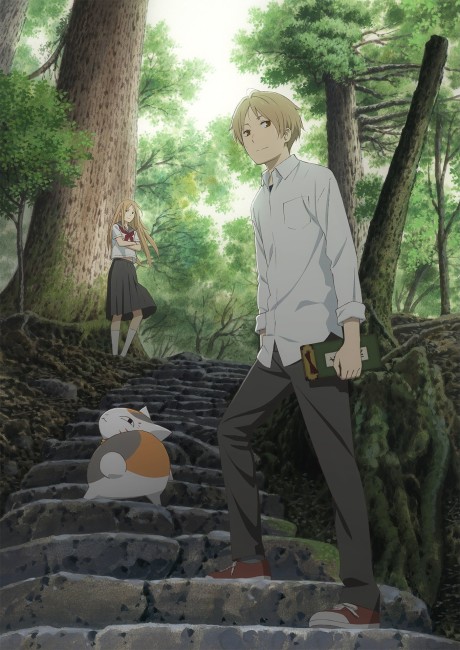
Natsume's Book of Friends Season 5
The fifth season of Natsume Yuujinchou.
📺Anime Details
📝Editorial Analysis
The quiet weight of a worn, leather-bound book resting on Natsume’s palm—its cover softened by years, its pages whispering with names written in faded ink, each one a pact, a debt, a life briefly held. He doesn’t open it right away. He just sits on the wooden porch of the Takagi household at dusk, bare feet brushing cool floorboards, cicadas humming low and steady, while a stray youkai—small, translucent, shaped like folded paper—hovers near the eaves, watching him not with hunger or malice, but with something like recognition. That pause—before the turning of a page, before a name is spoken aloud—is where Natsume's Book of Friends Season 5 lives. Not in grand battles or world-ending stakes, but in the suspended breath between memory and release.
What makes this season so singular isn’t its fantasy scaffolding—it’s how deeply it trusts stillness as emotional architecture. The rural setting isn’t backdrop; it’s texture—the way light pools in the rice fields at golden hour, how rain blurs the line between human and spirit at the shrine gate, how silence after a confession carries more resonance than any dialogue. It’s melancholic, yes—but never despairing. It’s healing, but never tidy. There’s no catharsis that erases pain; instead, there’s gentle realignment—like adjusting a dislocated joint until movement returns, tender and slow. You don’t watch to escape. You watch to remember how fragile connection is—and how fiercely worth holding. This is iyashikei not as balm, but as witness: the kind that lets grief breathe alongside gratitude, lets loneliness coexist with belonging, lets a boy who’s been passed between homes finally feel held, not fixed.
That same emotional gravity pulses through Bandle Tale: A League of Legends Story, whose player reviews cite Healing & Slow Life and Melancholic Exploration as core dimensions. Like Natsume walking forest paths with Nyanko, Bandle Tale’s fox-like protagonist moves deliberately through a world steeped in fading magic—not solving crises, but listening, gathering fragments of stories buried in ruins and overgrown shrines. Its pacing mirrors Season 5’s episodic rhythm: no forced urgency, only the quiet accumulation of meaning across small acts—replanting a forgotten herb, returning a lost locket, sitting beside someone who hasn’t spoken in years. Both ask you to linger in the space between what was lost and what remains.
Then there’s ANIMAL WELL, scoring even higher (82) on those same axes—Healing & Slow Life, Melancholic Exploration, and crucially, Body Horror & Occult. At first glance, its claustrophobic caves and shifting, organic walls seem worlds away from Natsume’s sun-dappled countryside. But look closer: both treat the unseen as intimate, not threatening. In Season 5, a youkai’s shapeshifting isn’t spectacle—it’s vulnerability made visible, a body rewriting itself to survive neglect or misunderstanding. ANIMAL WELL’s body horror isn’t grotesque for shock; it’s tactile, biological melancholy—the way flesh remembers trauma, how environments mutate in response to absence. Players describe navigating its tunnels as “feeling like remembering a dream you shouldn’t have forgotten”—exactly how Natsume feels flipping through the Book, touching names that once belonged to beings who trusted him, then vanished. The occult here isn’t about power—it’s about presence, stubborn and soft.
Even Universe Sandbox, with its lower score (69), shares DNA—not in theme, but in tempo and tone. Its Healing & Slow Life and Melancholic Exploration dimensions manifest in the way time dilates: watching Earth orbit, witnessing stellar collapse in accelerated silence, adjusting gravity just to see how gently a moon might drift away. There’s awe, yes—but also profound solitude, the kind Natsume feels gazing at stars with Tanuma, neither speaking, both aware of how vast and quiet the universe is when you stop trying to fill the space. It’s not escapism. It’s scale-as-empathy: realizing your sorrow fits inside something infinitely larger—and that, somehow, makes it lighter.
This pairing speaks directly to people who carry quiet histories—adoptees, long-term caregivers, anyone who’s loved someone difficult or disappeared without explanation. People who know healing isn’t linear, who find comfort not in answers but in shared silence, who understand that sometimes the bravest thing is to sit with another person’s unspoken ache—and let the cicadas hum on.
🎮3 Games That Match the Vibe


Match Dimensions Explained
❓Frequently Asked Questions
Why is Bandle Tale: A League of Legends Story recommended for fans of Natsume's Book of Friends Season 5?
Because it mirrors the quiet, melancholic exploration of Natsume’s world—like wandering through misty forests with Tanuki companions or uncovering forgotten shrines—while weaving gentle healing mechanics into its pixel-art storytelling. The game’s pacing, focus on emotional resonance over action, and recurring themes of memory and belonging (think Natsume’s notebook entries coming alive) hit the same tender notes as Season 5’s quieter moments with Nyanko and the unnamed youkai.
Is there a video game adaptation of Natsume's Book of Friends Season 5?
No—there’s never been an official video game adaptation of *any* season of *Natsume’s Book of Friends*, including Season 5. What *does* exist are spiritually aligned games like *ANIMAL WELL*, where you explore decaying, liminal spaces filled with cryptic spirits and fragmented lore—similar to how Season 5 reveals hidden truths about the spirit world through quiet observation and empathy, not exposition.
How does ANIMAL WELL compare to Bandle Tale for someone who loved the ‘spirit contract’ scenes in Season 5?
Bandle Tale leans into warmth and gentle reciprocity—like Natsume returning a name and receiving tea and laughter—while *ANIMAL WELL* leans into ambiguity and unease, echoing Season 5’s more unsettling contracts, like when Natsume negotiates with the scarred fox-spirit near the abandoned shrine. Both use environmental storytelling and subtle cues instead of dialogue, but *ANIMAL WELL* adds body horror and occult dread that mirrors the season’s darker, more fragile bargains.
What’s the best game like Natsume’s Book of Friends Season 5 if I want that late-autumn, solitary-walk-at-dusk vibe?
Go with *Universe Sandbox*—yes, really. Its slow, meditative orbital simulations, especially when zoomed into a single planet bathed in fading amber light, evoke the exact hushed, introspective stillness of Natsume walking home past empty schoolyards at sunset in Season 5. Critics noted its ‘healing & slow life’ dimension isn’t about action, but presence—like watching leaves spiral down while remembering a name, just as Natsume does in Episode 10’s rain-soaked flashback.