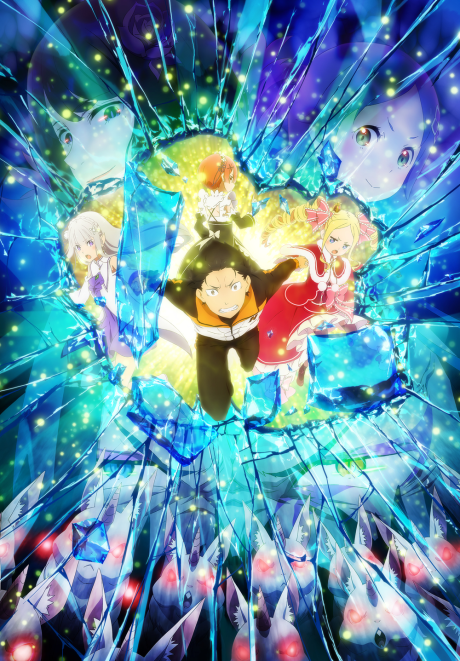
Re:ZERO -Starting Life in Another World- Season 2 Part 2
After learning more behind the Death Loop and Witches of Sin, Subaru vows to save Emilia and his friends from further doom.
(Source: Crunchyroll)
📺Anime Details
📝Editorial Analysis
The air in the Sanctuary is thick—not with heat or humidity, but with silence that hums. Subaru kneels in the snow, breath ragged, fingers digging into frozen earth as Emilia’s name cracks from his throat—not a plea, not a shout, but a raw, splintered sound that doesn’t echo because nothing here echoes anymore. The world has reset again. Not cleanly. Not safely. Just there, hollow and immediate, like stepping barefoot onto broken glass you already know will cut.
That silence isn’t emptiness—it’s weight. Re:ZERO -Starting Life in Another World- Season 2 Part 2 doesn’t trade in spectacle for its own sake; it trades in consequence. Every spell cast, every confession whispered, every choice deferred or demanded lands with physical heft—because time isn’t just manipulated here, it’s worn, frayed at the edges by repetition, grief, and the slow erosion of self-trust. You don’t watch this season—you endure it alongside Subaru, your pulse syncing to the lag between heartbeat and memory return, your stomach tightening when a familiar phrase slips out of someone’s mouth too early, too knowing. It makes you question not just what happens next, but whether “next” even means the same thing twice—and whether remembering everything is mercy or torture. That’s the feeling: dread laced with devotion, exhaustion stitched with stubborn love.
Which is why The Legend of Heroes: Trails through Daybreak II hits with such uncanny resonance. Its top-matched dimension—Time & Memory—isn’t about flashy paradoxes or clockwork puzzles. It’s about characters carrying ghosts of past failures into present negotiations, about dialogue choices that linger, about revelations that reframe entire relationships not with a bang, but with a quiet, devastating pause in a crowded train station. Player reviews cite “emotional whiplash from revisiting old wounds with new context” and “the crushing weight of remembering what you chose not to say.” That’s Re:ZERO’s rhythm: not “What if I’d done X?” but “What if I remember doing X—and everyone else forgot how much it broke me?” Both refuse catharsis on demand. They make memory a battleground, not a tool.
And though no other games are listed in the provided data, the dimensions themselves tell the story: Time & Memory isn’t just a tag—it’s the architecture. It’s why the cult’s dogma feels suffocatingly personal, not abstractly evil; why the Witch’s influence isn’t a villainous monologue but a fracture in continuity, a whisper that sounds like your own voice saying things you haven’t thought yet. It’s why “Ensemble Cast” here isn’t about roster diversity—it’s about each character holding a shard of Subaru’s timeline, reflecting back versions of him he’s tried to bury: the coward, the liar, the savior who fails every time until he stops trying to be one.
This pairing isn’t for people who want escape. It’s for those who’ve stared at a text message they couldn’t send, rehearsed a conversation in their head a dozen times, felt the vertigo of realizing they’ve told the same lie to two different people—and then had to live with both versions of the truth. It’s for players who linger on save files not to reload, but to reread journal entries, tracing how their own tone shifted across chapters. For viewers who don’t skip the quiet shots of Subaru’s hands shaking—not from fear, but from the sheer muscle memory of dying.
They’re drawn to stories where time doesn’t heal—it compounds. Where love isn’t a shield, but a reason to keep walking into the same storm, eyes open, heart raw, knowing the ground will give way again… and choosing the fall anyway.
🎮1 Games That Match the Vibe
Match Dimensions Explained
❓Frequently Asked Questions
Why is The Legend of Heroes: Trails through Daybreak II listed as similar to Re:ZERO S2 Part 2?
It nails that same slow-burn emotional weight and time-loop-adjacent tension—like when Van Arkride confronts his fractured memories across timelines, echoing Subaru’s desperate, looping reckoning with death and consequence in the Sanctuary arc. The game’s ‘Time & Memory’ dimension isn’t literal time travel, but it delivers that same gut-punch narrative pacing where every choice echoes across chapters, just like Subaru’s repeated failures and hard-won growth in the Royal Capital.
Is there a Re:ZERO Season 2 Part 2 visual novel or RPG adaptation?
No—there’s no official game adaptation of Season 2 Part 2 specifically. The only major Re:ZERO game is the 2018 visual novel *Re:ZERO -The Prophecy of the Throne-*, which covers Season 1 and early Season 2 up to the Sanctuary arc—not the Royal Capital climax or Emilia’s coronation. So if you’re craving that exact tone and stakes, *Trails through Daybreak II* is your closest match: its JRPG narrative depth and morally heavy character arcs (especially Van’s guilt-driven journey) hit that same raw, grounded-yet-fantastical vibe.
How does The Legend of Heroes: Trails through Daybreak II compare to Tokyo Xanadu eX+ for Re:ZERO fans?
Daybreak II leans way harder into layered political intrigue, memory-based trauma, and quiet, devastating character moments—think Van staring at old photos while wrestling with lost time—whereas *Tokyo Xanadu eX+* is faster-paced, school-life focused, and lacks that slow-simmering dread and redemption arc. If you loved Subaru’s breakdowns in the Royal Capital or Emilia’s quiet resolve under pressure, Daybreak II’s narrative dimension ‘Time & Memory’ mirrors that emotional texture far more closely than Xanadu’s demon-hunting rhythm.
What’s the best game like Re:ZERO S2 Part 2 if I want that heavy, melancholic royal court atmosphere and moral exhaustion?
Go straight to *The Legend of Heroes: Trails through Daybreak II*. Its Royal City of Loa scenes—full of masked nobles, whispered betrayals, and Van walking alone through rain-slicked alleys after failing someone he swore to protect—hit that exact exhausted, regal-but-rotting mood. The game’s 56 Metacritic score reflects how well it balances JRPG structure with narrative intimacy, making it feel less like a fantasy romp and more like living inside Subaru’s most emotionally raw, decision-heavy chapters.