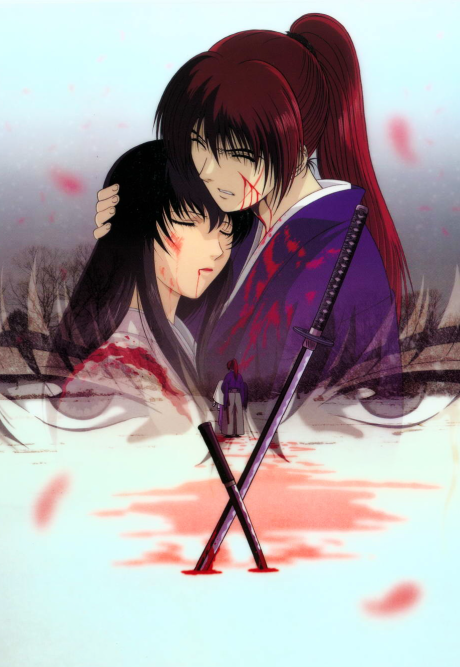
Samurai X: Trust and Betrayal
In the days before the Japanese Revolution, Hiko Seiijuro, a wandering master swordsman and hermit, encounters a bandit raid on a slave wagon. Hiko kills the raiding bandits in hopes of saving as many lives as possible, but only manages to spare one life from the massacre. Hiko leaves the child, advising him to go to the nearby village and have them take care of him. A few days later, as Hiko comes back to check upon the child he saved, he is shocked to see the child had created graves, both for the slaves he befriended and the bandits who killed them. Seeing potential in the young one, Hiko takes the child under his wing, names him Kenshin, meaning "heart of sword," and teaches him about the art of swordsmanship under the Hiten Mitsuruugi Ryu.
Struggling in a constant challenge with his ideal beliefs reflecting against the harshness of reality, Tsuiokuhen tells the melancholic and dark story of Himura Kenshin as one of the most feared assassins of the Japanese Revolution: the Hitokiri Battousai.
[Written by MAL Rewrite]
📺Anime Details
📝Editorial Analysis
The silence after the bandit raid isn’t empty—it’s thick with the copper-sweet scent of blood drying in the sun, the creak of splintered wagon wood, and the sound of a child’s small hands scraping dirt over bodies he doesn’t know. Hiko Seiijuro stands at the edge of that carnage, sword sheathed, breath steady—but his eyes don’t rest. They linger on the one boy left alive, kneeling beside three fresh mounds of earth: two for strangers, one for himself—a grave he dug before he knew he’d live. That moment isn’t about survival. It’s about witnessing, about grief arriving before language, about dignity carved into soil with bare fingers.
What makes Samurai X: Trust and Betrayal ache so deeply isn’t its historical setting or even its swordplay—it’s how it treats time as a wound that never closes. Every frame feels weathered: rain doesn’t glisten, it soaks; firelight doesn’t glow, it flickers like a failing pulse; dialogue isn’t exchanged—it’s withheld, then shattered. There’s no heroic arc here—only the slow, irreversible erosion of idealism, where loyalty curdles not from malice but from exhaustion, and love becomes another kind of restraint. You don’t watch it to see someone win—you watch to feel the weight of a vow taken too young, held too long, broken not by betrayal but by inevitability. It’s tragedy as atmosphere, not plot device.
That same emotional gravity pulses through Dark Messiah of Might & Magic, not in its fantasy trappings, but in its ferocious combat—a system where every swing carries consequence, where parries echo with bone-deep impact, and where victory feels less like triumph and more like survival scraped from the edge of collapse. The player review calls it “a fantastic melee combat game”—and yes, but what lingers is how physically exhausting it feels to fight, how your own breath catches when stamina drains mid-lunge, mirroring Kenshin’s silent, grinding endurance through loss after loss. Like Hiko teaching Kenshin not just swordsmanship but how to carry sorrow in the stance, Dark Messiah forces you to inhabit violence—not as spectacle, but as embodied cost. Its “Action Spectacle” isn’t flashy—it’s visceral, unglamorous, and deeply personal.
And though its engine is older, the game’s emotional narrative aligns with the anime’s quiet devastation: no grand monologues, just moments where the world narrows—to a blade’s edge, a trembling hand, a choice made in shadow because light offers no answers. The review notes it “still holds up pretty well today”—not because it’s polished, but because its rawness ages like ink on rice paper: faded, but legible, resonant. Just like Samurai X: Trust and Betrayal, it refuses catharsis. It gives you the weight—and lets you decide whether to drop it or keep carrying.
This pairing won’t speak to someone looking for power fantasies or tidy resolutions. It’s for the viewer who replays the scene where Kenshin buries the dead—not for closure, but to study the tremor in his wrist as he pats down the last mound of earth. It’s for the player who reloads after dying not to “get better,” but to feel again the exact millisecond their guard dropped—the split-second hesitation that mirrors Kenshin’s pause before striking, or Hiko’s silence after walking away from the boy he saved but couldn’t shelter. These are stories for people who understand that grief is a discipline, that honor isn’t worn like armor but worn thin by repetition, and that the most devastating betrayals aren’t shouted—they’re whispered in the space between breaths, in the way a hand hesitates above a hilt, in the way a grave is dug for someone who’s still breathing.
🎮1 Games That Match the Vibe
Match Dimensions Explained
❓Frequently Asked Questions
Why is Dark Messiah of Might & Magic listed as similar to Samurai X: Trust and Betrayal?
Because both lean hard into emotionally charged, morally grey narratives where betrayal reshapes the protagonist’s path—like Kaoru’s shattered trust in Kenshin mirroring Dark Messiah’s twisty descent from loyal apprentice to conflicted antihero. The visceral, physics-driven melee combat (think parrying, disarms, and environmental takedowns) also echoes the raw, weighty swordplay in Samurai X’s duel scenes—especially that rain-soaked confrontation at the dojo.
Is there a Samurai X: Trust and Betrayal video game adaptation?
No—there’s never been an official game adaptation of *Samurai X: Trust and Betrayal*. It’s strictly an OVA anime, so the closest you’ll get are games that capture its soul: brooding tone, tragic romance, and grounded sword combat. That’s why titles like *Dark Messiah of Might & Magic* made the list—they nail the emotional narrative and action spectacle, even without Kenshin or Kaoru in the code.
How does Dark Messiah of Might & Magic compare to Sekiro: Shadows Die Twice for samurai vibes?
Sekiro’s all about precision posture breaks and divine prosthetics—very mythic and supernatural—while *Dark Messiah* feels grittier and more human: think rusty blades, blood-slicked cobblestones, and morally compromised choices that echo *Trust and Betrayal*’s realism. If you loved the quiet dread before Kenshin’s final duel or Kaoru’s quiet resolve amid chaos, *Dark Messiah*’s oppressive atmosphere and consequential combat hit closer than Sekiro’s high-octane shinobi fantasy.
What’s the best game like Samurai X if I want that melancholy, rain-drenched, ‘trust shattered’ mood?
Go straight to *Dark Messiah of Might & Magic*—its entire third act drips with that same somber, rain-lashed despair: you’re betrayed by your mentor, forced to choose between vengeance and mercy, and fight through crumbling cathedrals while questioning every oath you ever swore. Player reviews even call out how it ‘holds up’ emotionally years later, just like *Trust and Betrayal* still stings on rewatch—no flashy magic, just raw consequence and weighty steel.