
The Promised Neverland
Emma, Norman and Ray are the brightest kids at the Grace Field House orphanage. And under the care of the woman they refer to as “Mom,” all the kids have enjoyed a comfortable life. Good food, clean clothes and the perfect environment to learn—what more could an orphan ask for? One day, though, Emma and Norman uncover the dark truth of the outside world they are forbidden from seeing.
(Source: VIZ Media)
📺Anime Details
📝Editorial Analysis
The floorboards creak—not from weight, but from silence. Emma stands frozen in the hallway outside Mom’s office, her bare feet cold on the polished wood, the scent of lavender soap still clinging to the air. She’s just seen the ledger. Not the cheerful tally of birthdays or reading levels, but rows of names, dates, and destinations marked with a single, chilling word: Adopted. Her breath hitches—not in sorrow yet, but in the slow, sickening unspooling of certainty. This isn’t abandonment. It’s accounting. And she’s been counted.
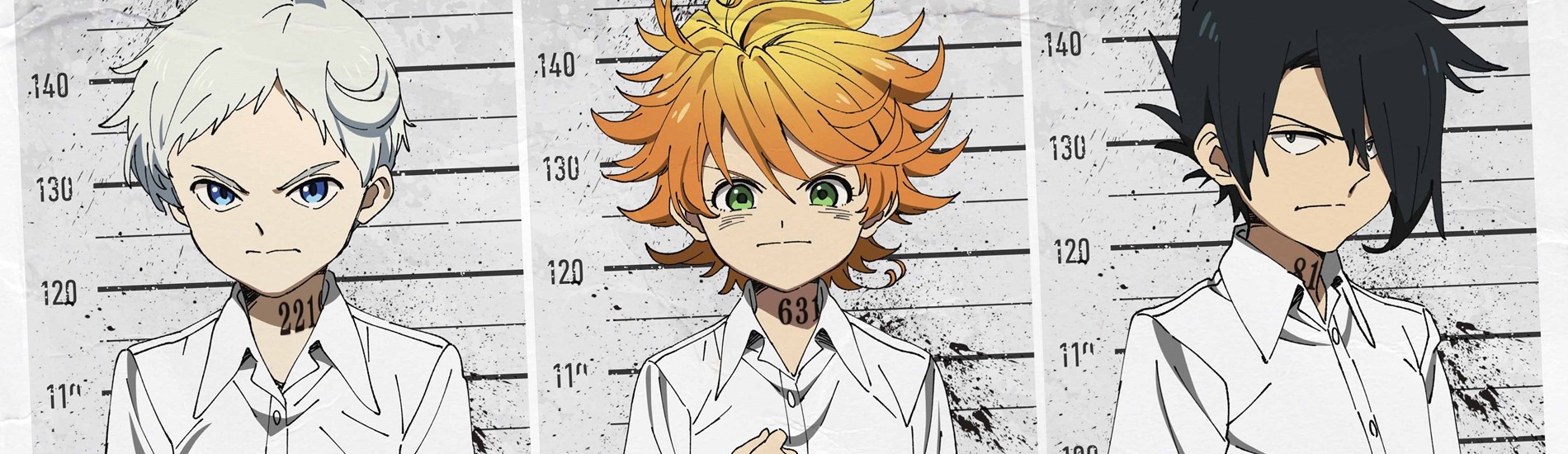
That moment isn’t horror as jump-scare or gore—it’s horror as recognition. The Promised Neverland doesn’t scream at you; it tightens its grip around your ribs until you feel the architecture of safety itself begin to crack. Its atmosphere is built on violation of trust, not just by Mom, but by the very grammar of childhood—clean sheets, shared meals, bedtime stories—all weaponized as camouflage. You don’t just watch children survive. You relearn how to read a smile, parse a lullaby, interpret the angle of a glance. It makes you feel hyper-vigilant, then grief-stricken, then fiercely tender—all before breakfast. It forces you to hold two truths at once: these kids are brilliant strategists, and they’re also eleven years old, terrified of the dark, clutching stuffed animals they shouldn’t need to hide.
Which is why S.T.A.L.K.E.R.: Shadow of Chernobyl resonates so deeply—not because of demons or orphans, but because of the Zone. Like Grace Field House, the Zone masquerades as neutral ground: mist hangs soft over abandoned villages, birds sing near rusted tanks, and the map promises exploration, not entrapment. But the player review nails it: “you fear not only the radiation, anomalies and deadly creatures, but other S.T.A.L.K.E.R.s.” That layered dread—environmental, biological, human—mirrors the orphanage’s triple threat: the invisible rules, the ever-present surveillance, and the quiet, devastating betrayal of those who raised you. Survival here isn’t about stamina bars—it’s about reading micro-expressions in flickering light, knowing when silence is safer than speech, and realizing too late that the safest path was never yours to choose.
Then there’s Dreamfall: The Longest Journey, where the player review cuts straight to the emotional core: “It's less a long journey than a long drama. And somehow, the drama is compelling enough that you keep watching scene after scene…” That’s The Promised Neverland in a sentence. Neither story hinges on spectacle—it lives in the weight of a pause, the tremor in a voice trying to sound steady, the way a child rehearses courage like lines before a play. Both refuse easy catharsis. Emma doesn’t win by outfighting; she wins by holding space for grief while planning the next move. April Ryan doesn’t save worlds with lasers—she saves them by listening, remembering, refusing to let trauma erase identity. The shared DNA isn’t plot—it’s emotional pacing: long, quiet stretches where every glance carries consequence, every choice echoes in the hollows left by loss.
And Nikopol: Secrets of the Immortals, with its iron-fist religious dictatorship and sudden pyramid ship hovering over Paris, shares something quieter but sharper: the aesthetic of controlled decay. The anime’s orphanage gleams—but the polish feels thin, the symmetry too precise, the garden roses unnervingly perfect. Nikopol’s Paris is similarly curated dystopia: grand architecture draped in propaganda, beauty weaponized as obedience. The player review notes “the whole cyberpunk atmosphere gives it a nice vibe”—but what makes it resonate isn’t the neon or the tech. It’s the suffocating orderliness of oppression. Like Grace Field House, Nikopol’s world doesn’t roar chaos—it hums with bureaucratic menace, where dissent is measured in decibels of silence, and rebellion begins not with a shout, but with a single, unblinking stare at the ceiling.
This pairing isn’t for fans of “dark stories.” It’s for people who’ve ever sat very still in a room full of adults, calculating the cost of asking one more question. For those who find catharsis not in victory, but in the exact moment a child chooses to hold another’s hand while walking toward the unknown. For players who replay dialogue trees not to optimize outcomes, but to hear again how someone says “I’ll protect you”—not as a promise, but as a lifeline thrown across an abyss they’re both too young, and too brave, to name.
🎮2 Games That Match the Vibe
Match Dimensions Explained
❓Frequently Asked Questions
Why does S.T.A.L.K.E.R.: Shadow of Chernobyl match The Promised Neverland’s vibe despite being a shooter?
Because both hinge on constant, low-grade dread—like when Emma and the kids navigate the forest in Episode 12, you’re always watching your back for anomalies, mutants, or hostile stalkers in the Zone. Its oppressive atmosphere, moral ambiguity (e.g., choosing whether to betray fellow survivors), and survival-crafting loop (scavenging artifacts, filtering water, managing radiation) mirror the kids’ resourcefulness and emotional exhaustion under surveillance.
Is there a visual novel adaptation of The Promised Neverland like Dreamfall: The Longest Journey?
No official visual novel exists—but Dreamfall nails that exact tone: slow-burn tension, morally gray adult choices, and cinematic cutscenes where characters like Zoë and April wrestle with betrayal and sacrifice. Its dual-world structure (Arcadia vs. Stark) even echoes the farm’s illusion vs. the real world, and player reviews call out how 'the drama is compelling enough that you keep watching scene after scene'—just like binging TNW episodes.
How does Nikopol: Secrets of the Immortals compare to Dreamfall for dark, political dystopia?
Nikopol leans harder into religious authoritarianism and body horror—think the Ministry’s propaganda posters and the pyramid ship’s eerie presence—while Dreamfall balances satire and sorrow across its two worlds. Both feature adult, Seinen-style writing (Nikopol’s protagonist wakes up after 30 years to find Paris ruled by fanatics; Dreamfall’s April uncovers systemic lies), but Nikopol’s point-and-click pacing and stark cyberpunk visuals make it feel more like reading a Moebius graphic novel than Dreamfall’s lush, dialogue-driven drama.
What’s the best game like The Promised Neverland if I want that quiet, trapped-but-brilliant-kid energy—not action, just cleverness under pressure?
Chains is surprisingly spot-on: it’s not about combat, but about spotting patterns, planning chains under time/physics constraints (like Emma calculating escape routes), and clearing obstacles step-by-step until you ‘unlock’ the next stage. Players say it feels like 'connect 4 in a nutshell'—simple rules, high stakes—and its Emotional Narrative dimension shines through subtle UI shifts and escalating tension, mirroring how the kids’ intelligence becomes their only weapon.