
The Wind Rises
Although Jirou Horikoshi's nearsightedness prevents him from ever becoming a pilot, he leaves his hometown to study aeronautical engineering at Tokyo Imperial University for one simple purpose: to design and build planes just like his hero, Italian aircraft pioneer Giovanni Battista Caproni. His arrival in the capital coincides with the Great Kanto Earthquake of 1923, during which he saves a maid serving the family of a young girl named Naoko Satomi; this disastrous event marks the beginning of over two decades of social unrest and malaise leading up to Japan's eventual surrender in World War II.
📺Anime Details
📝Editorial Analysis
The scent of wet ash and burnt cedar hangs thick in the air—not from fire, but from the Great Kanto Earthquake’s aftermath, as Jirou Horikoshi stumbles through the rubble with a young girl in his arms, her kimono torn, her breath shallow. He doesn’t speak her name yet—Naoko Satomi—just holds her tighter as the ground still trembles beneath cracked pavement and splintered wood. There is no music, only wind, distant cries, and the low groan of collapsing buildings. In that moment, fragility isn’t metaphorical. It’s physical. It’s the weight of a child’s body, the grit in his throat, the way his glasses slip—blurring both ruin and hope at once.
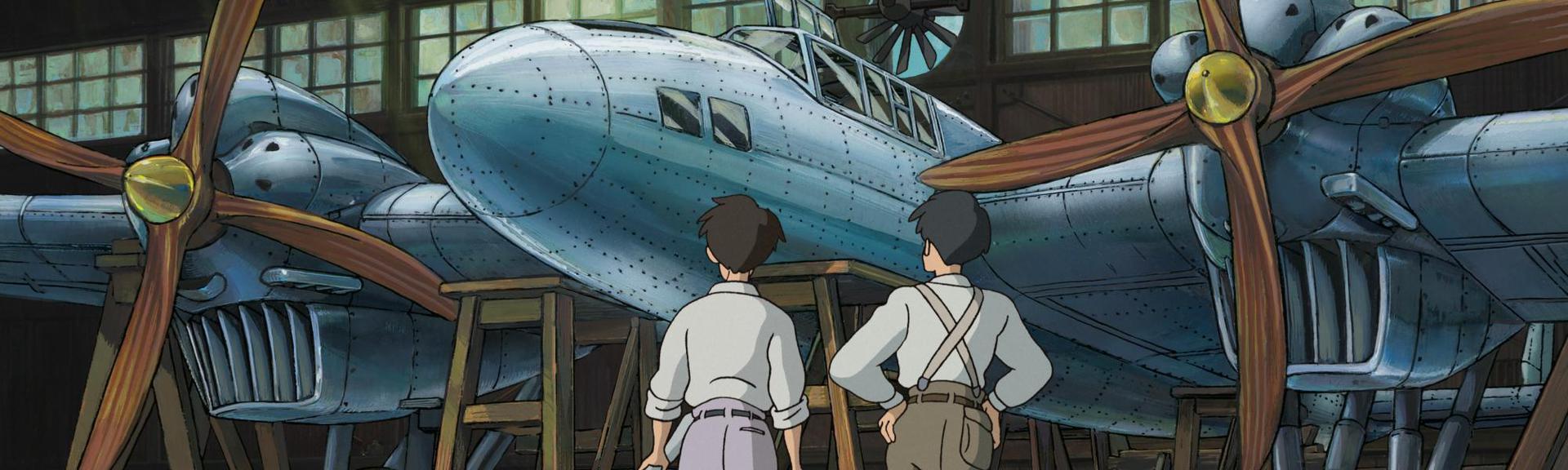
That’s the atmosphere of The Wind Rises: not grand spectacle, but quiet gravity. It makes you feel time pressing inward—not rushing forward, but settling, like dust on blueprints left open on a drafting table. You think about how beauty and destruction are engineered in the same workshop: one plane lifts skyward on elegant curves; another drops incendiaries onto cities built by hands just like Jirou’s. There’s no villain, no battle cry—just the slow, dignified ache of creation entangled with consequence. The war isn’t shown in trenches or explosions, but in the hollow pause before a test flight, in the way Jirou’s hand hovers over a sketch of wings he knows will carry bombs. His love for Naoko isn’t swept up in passion—it’s measured in stolen afternoons, in shared silence on a mountain path, in the tenderness of choosing to stay near someone whose breath grows shallower each season. This is adulthood rendered in watercolor and graphite: soft-edged, deeply serious, achingly restrained.
Among games, Dragon Age: Origins resonates with startling precision—not because it’s about aviation or 1930s Japan, but because it shares that same emotional architecture. Its description asks: “When history tells the story of the Fifth Blight, what will be said about the hero who turned the tide against the darkspawn?” That question mirrors Jirou’s quiet reckoning: What does legacy mean when your life’s work becomes inseparable from suffering? Like Jirou, the Warden doesn’t choose war—they inherit it, refine it, lead within it, all while knowing their choices will echo long after they’re gone. And the player review nails the tonal kinship: “the story is great and its pause attack mechanic is amazing… help a lot to strategist your tactic.” That “pause”—that deliberate, breathing-space interruption in combat—is the game’s analog to Jirou’s drafting pauses, his walks with Naoko, his moments staring at clouds while calculating lift coefficients. Both ask you to think inside feeling, to weigh action against consequence with the same solemn care.
No other matches are listed—but that’s enough. Because Dragon Age: Origins, like The Wind Rises, refuses easy binaries. Heroism isn’t triumph—it’s endurance. Love isn’t escape—it’s witness. Work isn’t vocation alone—it’s moral geography. Jirou sketches fuselages while Naoko coughs softly beside him; the Warden rallies allies while knowing some will fall, some betrayals will cut deeper than any blade. Neither story flinches from weight, yet neither drowns in it. They hold space—for grief, yes, but also for wonder: the curve of a wing, the glow of a campfire, the way light catches dust motes midair.
This pairing sings to people who keep notebooks with pressed flowers and margin notes in pencil—who’ve cried not at weddings or funerals, but at the sight of an old typewriter still working, or a letter folded three times and never sent. It’s for those who understand that longing can be quieter than sorrow, that devotion often looks like showing up with tea and silence, and that the most devastating tragedies aren’t sudden collapses—but slow, inevitable landings.
🎮6 Games That Match the Vibe




Match Dimensions Explained
❓Frequently Asked Questions
Why does Dragon Age: Origins keep coming up in 'Games Like The Wind Rises' lists?
Because both lean hard into quiet, emotionally weighted character arcs—like Alistair’s conflicted nobility or Morrigan’s guarded vulnerability—mirroring the film’s tender, melancholic focus on ambition and loss. The pause-and-plan combat isn’t flashy, but it creates that same reflective, deliberate pacing as Jiro’s plane sketches: thoughtful, intimate, and deeply human.
Is there a video game adaptation of The Wind Rises?
No—there’s never been an official game adaptation of the film. But fans who love its tone often land on Dragon Age: Origins, especially for how it handles legacy, sacrifice, and quiet heroism (think: the Warden’s final choice at the end of Origins, echoing Jiro’s bittersweet triumph).
Dragon Age: Origins vs. Final Fantasy XII — which is closer to The Wind Rises’ vibe?
Origins wins on emotional intimacy and grounded stakes: its personal story beats—like Leliana’s past haunting her present, or the slow build of trust in the party—mirror the film’s restrained, character-first storytelling. FFXII leans more into grand politics and spectacle, while Origins gives you time to *breathe* with your characters, just like watching Jiro sketch in silence.
What’s the best game like The Wind Rises if I want something meditative and emotionally resonant?
Dragon Age: Origins—it’s got that rare combo of tactical depth (pause mid-battle to adjust positioning like Jiro adjusts wing angles) and soulful writing. Players consistently mention how scenes like the Landsmeet or the final confrontation land with weight because you’ve lived alongside these people, not just controlled them.