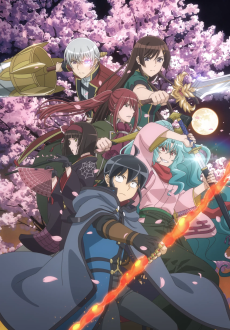
TSUKIMICHI -Moonlit Fantasy- Season 2
The second season of Tsuki ga Michibiku Isekai Douchuu.
After Makoto Misumi defeats Mitsurugi and Sofia Bulga, humanity is saved from the attacking demon army—for the time being. The goddess is aware of Makoto’s growing power, and she sees him as less of a nuisance and more of a rival. Makoto continues his journey to further expand his community of outcasts and connect with more hyumans. But will he be strong enough to hold off the coming storm?
(Source: Crunchyroll)
📺Anime Details
📝Editorial Analysis
The scent of burnt earth and ozone hangs thick after Makoto’s lightning tears through the battlefield—not clean, not heroic, but heavy, like the air before a god’s judgment. You feel it in your molars: that low thrum of divine awareness pressing down as the goddess recalibrates her gaze, no longer amused, no longer dismissive—just calculating. This isn’t triumph. It’s the quiet before tectonic plates shift.
What makes TSUKIMICHI -Moonlit Fantasy- Season 2 ache with such particular weight isn’t its isekai setup or monster-girl charm—it’s the loneliness of scale. Makoto doesn’t just gain power; he accrues consequence. Every hyuman he shelters, every creature he tames, every language barrier he bridges adds another thread to a tapestry too vast for any single hand to hold. There’s no triumphant fanfare when Sofia Bulga falls—just exhaustion, silence, and the unsettling clarity that salvation is temporary, that gods don’t negotiate—they assess. You don’t root for victory here so much as you hold your breath waiting for the next tremor in the foundation. It’s quietly monumental, emotionally dense in ways most shounen gloss over—the weight of being seen by something older, colder, and infinitely more patient than you.
That same resonance pulses through Black Myth: Wukong, where myth isn’t backdrop—it’s architecture. The game’s Dark Fantasy and Mythology & Folklore dimensions mirror TSUKIMICHI’s tonal gravity: both treat divinity not as benevolent authority but as indifferent, ancient systems that reassert themselves without warning. Player reviews note how Wukong’s journey feels less like conquest and more like reckoning—a slow, painful alignment with forces that predate morality. Like Makoto standing beneath the goddess’s gaze, Wukong doesn’t earn respect—he survives scrutiny. And the benchmark tool? Its identical score and dimensions aren’t accidental—it reflects how deeply the feeling of mythic pressure is baked into the experience, not just visuals or lore, but in the way time itself seems to warp under divine attention.
Then there’s Hellblade II: Senua’s Saga, also scoring 72 in Mythology & Folklore and Dark Fantasy. Here, the connection isn’t about power escalation—it’s about translation. Senua doesn’t speak Norse myth; she lives inside its grammar, hearing voices, parsing visions, wrestling meaning from chaos. That’s TSUKIMICHI’s language barrier writ metaphysical: Makoto doesn’t just learn hyuman speech—he deciphers intent, history, trauma embedded in gesture, silence, even the way a beast lowers its head. Player reviews emphasize how Hellblade II refuses exposition, trusting you to feel your way through belief structures that resist easy translation—exactly how TSUKIMICHI makes you sit with the discomfort of not knowing what a hyuman’s trembling hand means until after Makoto chooses trust over caution. Both works treat understanding as an act of courage, not convenience.
This pairing sings to the viewer who watches anime not for catharsis, but for resonance—someone who remembers how it felt to be the only one who noticed the flicker in a side character’s eyes, who lingers on the pause before a vow is spoken, who feels the weight of unspoken oaths more than shouted declarations. They’re the player who replays Hellblade II’s river crossing not for combat flow, but to hear Senua’s breath sync with the current; the one who walks slowly through Wukong’s ruined temples, tracing cracks in stone like fault lines in memory. They don’t want heroes—they want witnesses. And they recognize Makoto not as a chosen one, but as someone who keeps showing up, again and again, at the edge of what’s known—tired, determined, unflinchingly present—holding space for others long after the battle smoke clears.
🎮3 Games That Match the Vibe
Match Dimensions Explained
❓Frequently Asked Questions
Why is Black Myth: Wukong listed as similar to TSUKIMICHI Season 2?
Because both lean hard into mythic worldbuilding where gods, celestial bureaucracy, and divine politics drive the plot—like when Makoto negotiates with the Moon God or navigates the Heavenly Court’s layered hierarchies. Wukong’s combat against celestial generals (e.g., Erlang Shen’s trial) and its emphasis on lore-locked abilities mirror how TSUKIMICHI uses divine contracts and spiritual cultivation mechanics to shape progression.
Is there a game adaptation of TSUKIMICHI Season 2?
No official game adaptation exists yet—only fan mods and unofficial visual novel demos floating around niche forums. But Hellblade II: Senua’s Saga comes closest in tone: its hallucinatory visions of Norse myth, like Senua confronting Hel’s realm or hearing fragmented god-voices during ritual trials, echo Makoto’s surreal divine encounters and psychological weight in Season 2’s ‘Trial of the Moon’ arc.
Black Myth: Wukong vs. Hellblade II: which is better for TSUKIMICHI fans who love slow-burn divine politics over action?
Hellblade II wins hands-down if you’re here for quiet, oppressive divinity—think Senua whispering prayers to stone idols while her psyche fractures under Odin’s gaze, mirroring Makoto’s tense, dialogue-heavy negotiations with the Moon Goddess. Wukong’s more about spectacle: epic boss fights with Sun Wukong’s staff transformations, whereas Hellblade II mirrors TSUKIMICHI’s intimate, dread-laced theology.
What’s the best game like TSUKIMICHI Season 2 if I want that lonely, awe-struck vibe of walking through divine ruins at night?
Black Myth: Wukong nails it—especially the mist-shrouded Lingxiao Palace ruins at dusk, where you hear distant celestial chants and spot faded murals of fallen star deities. That same hushed reverence, where every crumbling pillar feels sacred and watched, is exactly what TSUKIMICHI Season 2 evokes in Makoto’s solo ascent up the Moon’s silver staircase—no combat, just scale, silence, and ancient power.