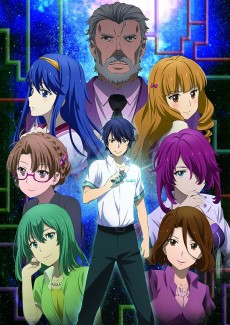
YU-NO: A Girl Who Chants Love at the Bound of This World
📺Anime Details
📝Editorial Analysis
The rain in YU-NO: A Girl Who Chants Love at the Bound of This World doesn’t fall—it settles, thick and cold, into the hollow behind your collar as Takuya stands before the lighthouse, his breath shallow, his hands trembling not from cold but from the unbearable weight of a choice he’s already made three times. The lantern’s beam cuts through the mist—not steady, but pulsing, like a failing heartbeat—and in that flicker, you see her: Yu-no, translucent, smiling, already gone. Not dead. Unmade. Erased across timelines like chalk on wet pavement. That moment isn’t spectacle. It’s silence after a scream.
What makes YU-NO’s atmosphere singular isn’t its time loops or parallel worlds—it’s the grief of continuity. You don’t just watch characters suffer consequences; you feel the slow, suffocating accumulation of memory as erosion. Every time Takuya resets, the world reknits—but his sorrow doesn’t reset. It layers. It calcifies. The sci-fi scaffolding—time manipulation, alternate universes, historical divergence—isn’t there to dazzle; it’s the architecture of emotional recursion. You’re not solving puzzles to win. You’re solving them to delay the inevitable collapse of meaning. That’s why the drama lands like a bruise: because every “what if” carries the quiet horror of what was lost, not just what might be gained. It’s haunting, not thrilling. Relentless, not epic. Intimate, even when spanning centuries.
That same emotional DNA hums in F1® Manager 2024, though at first glance, it seems galaxies away. But look closer: its real description cites Time & Memory, Emotional Narrative, and Tactical Warfare. Player reviews don’t praise lap times—they talk about “watching a driver’s confidence fracture over three seasons,” “the weight of a single pit-stop decision echoing in your chest months later,” “how saving a career feels more urgent than winning a race.” That’s YU-NO’s rhythm: small, tactical choices (a conversation, a detour, a delayed confession) that accrue into irreversible emotional tectonics. In both, time isn’t a resource to optimize—it’s a medium of consequence, thick with unspoken history. When Takuya chooses not to speak to his father in 1991, it fractures a timeline. When you bench a rookie after two crashes, it reshapes their entire trajectory—not just their stats, but how they look at you across the garage. Both make you feel the gravity of presence: how being there, in that exact moment, changes everything—even if no one else notices.
And yes—the Primarily Female Cast, the Female Harem, the Memory Manipulation: these aren’t tropes here. They’re narrative pressure points. Each woman isn’t a route; she’s a witness to different versions of Takuya’s soul. Her grief, her silence, her sudden, devastating clarity—those moments land because the story treats memory not as data, but as tissue. Which is why the emotional resonance extends beyond obvious narrative games. There’s no fantasy combat, no dialogue trees—but the emotional narrative dimension aligns with YU-NO’s core truth: love isn’t a destination. It’s the scar tissue formed where time, memory, and loss press against each other.
Who would love this pairing? Not just fans of time travel or harem setups—but people who’ve ever reread a text message from someone they can’t call anymore, just to feel the echo of tone. People who pause mid-game not to strategize, but to stare at a character’s idle animation—because in that blink, they recognize the exhaustion of carrying too much unspoken history. People who don’t want catharsis—they want resonance. The kind that lingers like damp wool, like the smell of old paper, like the faint, persistent ache behind the eyes after watching Yu-no fade—not into darkness, but into silence so complete it vibrates. That’s the shared pulse: not hope, not despair—but the terrible, beautiful weight of having loved across fractures no timeline can fully mend.
🎮1 Games That Match the Vibe
Match Dimensions Explained
❓Frequently Asked Questions
Why is F1® Manager 2024 listed as similar to YU-NO?
It’s not about racing or romance — it’s the shared emphasis on *Time & Memory* as core mechanics: just like YU-NO’s branching timelines and memory-triggered choices, F1® Manager 2024 forces you to weigh short-term race tactics against long-term team development, with decisions echoing across seasons. Reviewers noted its 'Emotional Narrative' emerges through staff relationships — like trusting engineer Lena to overhaul your car’s aerodynamics mid-season, knowing it might cost you next weekend’s podium.
Is there an anime or live-action adaptation of F1® Manager 2024?
No — unlike YU-NO, which got a full anime series and multiple remakes, F1® Manager 2024 has zero adaptations. It’s purely a simulation title focused on behind-the-scenes strategy, not character arcs or lore expansion. The devs confirmed in their 2023 roadmap that all narrative energy goes into deepening the Tactical Warfare and Emotional Narrative systems within the game itself.
How does F1® Manager 2024 compare to YU-NO in terms of branching storytelling?
YU-NO uses visual novel-style dialogue trees and symbolic 'World System' maps to fracture reality; F1® Manager 2024 branches via *seasonal decision chains* — e.g., choosing to develop your rookie driver’s confidence over upgrading brakes creates divergent team morale paths, affecting contract renewals and sponsor offers later. Both score high on 'Time & Memory', but F1®’s branches are systemic and spreadsheet-adjacent, not dream-sequence poetic.
What’s the best game like YU-NO if I want that intense 'time-loop tension' but with real-world stakes?
F1® Manager 2024 nails that vibe — imagine YU-NO’s anxiety of choosing *when* to act, but swapped for deciding whether to pit your star driver on lap 42 during rain, knowing one wrong call erases months of tire compound R&D. Its 'Tactical Warfare' dimension mirrors YU-NO’s pressure-cooker timing, and reviewers specifically praised how 'Emotional Narrative' builds through fragile trust with your chief strategist, Kenji Tanaka, whose loyalty shifts based on your win-loss ratio and media handling.