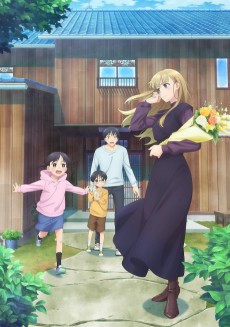
A Galaxy Next Door
Ever since their father died, Ichirou Kuga has struggled to support his two younger siblings on nothing but a small inheritance and his passion for drawing manga. But it’s becoming harder to keep up with his growing responsibilities and deadlines, especially after his last two assistants quit to follow their dreams.
Just as he’s nearing his breaking point, the beautiful and scarily competent Shiori Goshiki applies to become his new assistant. But there’s something almost otherworldly about Goshiki, and soon Kuga finds his reality turned upside down when she suddenly declares them engaged to marry!
(Source: Crunchyroll)
📺Anime Details
📝Editorial Analysis
The smell of instant coffee gone lukewarm, the soft thump of a toddler’s head dropping onto a manga manuscript mid-nap, the faint, rhythmic scratch of pen on paper as Ichirou Kuga draws one more panel—his shoulder aching, his eyes burning—while Shiori quietly folds laundry in the next room. Not romance as fireworks. Not drama as shouting matches. Just presence. The quiet weight of shared exhaustion, the unspoken pact that says: I see you holding everything—and I’ll hold part of it too.

That’s the atmosphere of A Galaxy Next Door: not escape, but anchoring. It’s the feeling of breath returning after holding it for months—the slow, deliberate unfurling of tension in your jaw when someone finally shows up, not with grand gestures, but with boiled eggs and a firm hand on your back while you cry silently over a rejected chapter. It’s iyashikei not as passive comfort, but as active, embodied care—grown-up, weary, tender. This isn’t about finding love; it’s about learning how to receive care without collapsing under the shame of needing it. Every frame hums with the dignity of ordinary resilience—the kind that lives in mismatched socks, overdue bills, and the way Shiori doesn’t ask if Ichirou slept, she just slides a thermos of miso soup beside his drawing desk at 2 a.m.
Which is why Prince of Persia (2023) lands with such startling resonance. Its description names “Healing & Slow Life” and “Adult & Dark Seinen”—not flashy action, but a world where time itself feels thick, where movement is deliberate, breath matters, and every leap carries the weight of consequence. A player review calls it “a new prince, new lands and a brand new story completely separate from the sands…”—and that separation is key. Like Ichirou stepping away from manga’s mythic expectations into the grounded reality of diapers and deadlines, this Prince isn’t chasing legacy or vengeance; he’s navigating grief, responsibility, and the quiet labor of rebuilding something real. Both works treat adulthood not as a finish line, but as terrain—uneven, demanding, softened only by small, consistent acts: a hand offered mid-fall, a meal left warm on the counter.
Then there’s the emotional echo in how both withhold spectacle to honor interiority. In A Galaxy Next Door, Shiori’s competence isn’t magical—it’s practical: she calculates rent splits, calms tantrums with zero theatrics, knows exactly how much soy sauce to add to Ichirou’s rice because she’s watched him eat it three nights straight. Her “otherworldly” quality isn’t fantasy—it’s the rare, grounding force of someone who sees systems, not just symptoms. Likewise, Prince of Persia’s “Healing & Slow Life” dimension isn’t spa music and cherry blossoms—it’s the tactile slowness of climbing a crumbling wall with tired muscles, the pause before a decision that alters not kingdoms, but relationships. That same gravity lives in Ichirou’s hesitation before asking Shiori to stay for dinner—not as flirtation, but as surrender to the terrifying relief of not being alone in the load.
This pairing speaks directly to people who’ve ever cried in a parking lot after a pediatrician appointment, who measure success in “made it through the week without breaking,” who find poetry in a shared grocery list or the way light hits a half-unpacked box in a new apartment. It’s for the 30-something illustrator who redraws panels while rocking a baby, the game dev who ships a patch at 4 a.m. then texts their partner “coffee’s on,” the parent who forgets their own birthday but remembers the exact shade of blue their kid likes on cereal boxes. These aren’t stories about becoming extraordinary. They’re about the radical, quiet courage of staying tender while carrying weight—of choosing, again and again, to meet life not with armor, but with open hands, warm soup, and the stubborn, beautiful belief that this, right here—exhausted, imperfect, deeply human—is enough.
🎮4 Games That Match the Vibe


Match Dimensions Explained
❓Frequently Asked Questions
Why is Prince of Persia listed as similar to A Galaxy Next Door?
Because both lean hard into 'Healing & Slow Life' pacing with quiet, emotionally resonant moments—like when the Prince tends to injured villagers in dusty desert towns, mirroring how A Galaxy Next Door lingers on small gestures (e.g., sharing tea with Ruri under the nebula-lit balcony). The 'Adult & Dark Seinen' tag fits too: Prince of Persia’s morally gray choices and weighty silences echo the show’s mature handling of grief and connection.
Is there an anime or manga adaptation of Prince of Persia?
No—Prince of Persia remains a video game franchise only, with no official anime or manga. Unlike A Galaxy Next Door (which *is* an anime), Ubisoft Montreal’s reboot stays grounded in interactive storytelling: think time-rewind mechanics during tense rooftop chases, not episodic slice-of-life arcs. Fans hoping for animated expansions will have to wait—or lean into games like it that nail the same reflective, character-first vibe.
How does Prince of Persia compare to A Galaxy Next Door in terms of tone and pacing?
They’re surprisingly aligned: both avoid frantic action in favor of deliberate, atmospheric storytelling—like Prince of Persia’s slow walks through crumbling ziggurats at dusk, where every creak of stone feels intentional, much like A Galaxy Next Door’s lingering shots of Ruri sketching stars while soft synth music swells. Neither rushes its emotional beats; both let silence speak volumes between characters.
What’s the best game like A Galaxy Next Door if I want something calming but with subtle emotional depth?
Prince of Persia is your top pick—it scores 83 and lives squarely in the 'Healing & Slow Life' lane. You’ll get meditative exploration (e.g., gliding across sun-baked ruins at golden hour), tender NPC interactions (like healing a wounded storyteller who shares lore about lost constellations), and that same gentle melancholy as Ruri gazing out her window. It’s not flashy—but it *feels*, deeply and quietly.