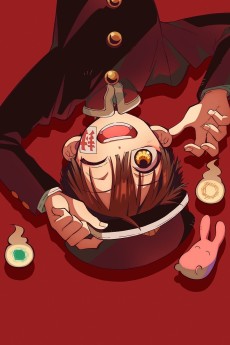
After-school Hanako-kun
The ghostly Hanako-kun and his mortal assistant, Nene Yashiro, usually have their hands full resolving various supernatural incidents in Kamome Academy, but how do they spend their time when they get a break from all that?
(Source: Yen Press)
Note: The episodes were streamed two days ahead of the Japanese broadcast on Crunchyroll beginning on Oct 11, 2023 at 3:00 JST. The regular TV broadcast started on Oct 13, 2023 at 1:58 JST.
📺Anime Details
📝Editorial Analysis
The bell rings—not the sharp, metallic chime of dismissal, but the soft, hollow thunk of a rusted locker door swinging shut in an empty hallway at Kamome Academy. Sunlight slants through high windows, catching dust motes above Hanako-kun’s translucent shoulder as he leans against the frame, arms crossed, watching Nene Yashiro fumble with a juice box. She spills some on her skirt. He doesn’t offer a handkerchief. Doesn’t sigh. Just blinks—slow, amber, present—and says, “You’re louder than a paper charm in a typhoon.” That quiet, unforced intimacy is the heartbeat of After-school Hanako-kun: not the exorcisms or mythic stakes, but the way the supernatural breathes alongside the mundane, like steam rising off hot pavement after rain.





What makes this anime vibrate with such rare warmth isn’t its ghost lore or school setting—it’s how it treats presence as sacred. Every episode lingers in the afterglow of resolution: Hanako-kun folding origami cranes from old exam papers; Nene sharing melon soda with a minor youkai who just wanted to be seen; the custodian sweeping under the shrine stairs while humming off-key. There’s no urgency to move on. No trauma to unpack in montage. Just bodies—mortal and spectral—occupying shared space without performance. It makes you feel safe, not because danger is absent, but because care is non-transactional. You think about how mythology isn’t carved in stone—it’s whispered in lunchroom corners, folded into napkins, kept alive by someone remembering to leave rice at the base of a ginkgo tree. It’s gentle, grounded, and fiercely tender.
That emotional DNA pulses strongest in games where the occult isn’t spectacle—but texture. Take Legendary, whose description declares: “All creatures of ancient myth, legend and lore are real — they’ve just been sealed away for thousands of years inside Pandora’s Box, waiting…” Not unleashed. Not weaponized. Waiting. Like Hanako-kun in his bathroom stall, or the kudan in the library stacks—neither hostile nor heroic, just there, folded into the architecture of the world. The player review notes “The animations in this game are incredible. Better than most games of the more modern era,” and that tactile, almost analog quality mirrors the anime’s hand-drawn warmth—the way Hanako-kun’s hair catches light like ink on rice paper, or how Nene’s socks slide down her ankles when she sits cross-legged on the floor. Both prize physicality: the weight of a sealed box, the grain of old wood, the slight drag of a ghost’s bare feet on linoleum.
Then there’s the quiet reverence for folklore itself—how After-school Hanako-kun treats urban legends not as jump-scare fodder, but as fragile, living things that need tending, like potted plants. That aligns precisely with Legendary’s second tag: Mythology & Folklore. Not as academic footnotes, but as breathing systems—rules, taboos, small courtesies—that govern coexistence. When Nene learns to bow before entering the janitor’s closet shrine, it’s not ritual for ritual’s sake; it’s respect for the grammar of the unseen. Same with Legendary’s sealed beings—they aren’t monsters to be slain, but entities bound by logic older than cities. Their containment feels less like imprisonment and more like custodianship, echoing how Hanako-kun doesn’t erase spirits—he mediates, redirects, sometimes just listens. The jank the player mentions—“definitely has some ‘jank’ as many games of the PS3/X360 era”—isn’t a flaw here. It’s kinship. That slight awkwardness in movement, the imperfect collision of worlds, mirrors the anime’s own gentle imperfection: Hanako-kun’s voice cracking mid-sentence, Nene’s hairclip snapping, the way a shikigami flickers when the fluorescent lights buzz too loud.
Who loves this pairing? Not the person chasing lore dumps or power fantasies. It’s the one who saves screenshots of rain falling on empty train platforms. The player who pauses mid-fight to watch a stray cat pad across cracked pavement in Legendary, then rewinds just to see the animation loop again. The viewer who re-watches the scene where Hanako-kun teaches Nene how to fold a paper boat—not for magic, but because it floats better when the crease is sharp. They’re drawn to stories where the supernatural isn’t a plot device, but a lens—soft, slightly warped, letting you see how deeply kind the world can be when no one’s watching the clock. They don’t want to conquer myth. They want to sit beside it, share a snack, and let the silence settle like dust in sunbeams.
🎮21 Games That Match the Vibe














Match Dimensions Explained
❓Frequently Asked Questions
Why is Legendary listed as similar to After-school Hanako-kun?
Because both lean hard into Japanese folklore and occult mystery — Legendary’s Pandora’s Box seals yokai-like entities drawn from global myth (think a blood-eyed Kappa variant or a twisted Nue), just like Hanako-kun’s school bathroom spirits. The eerie, slow-burn tension before a creature emerges? That’s straight out of Legendary’s ambush mechanics and its atmospheric, fog-draped temple levels.
Is there a mobile game adaptation of After-school Hanako-kun?
No — and that’s why fans often pivot to Legendary on PS3 or PC: it’s the closest officially released game with that same blend of body horror and folklore reverence. You won’t find Hanako, Nene, or the bathroom stall jump-scares anywhere else, but Legendary’s Deckard does face similarly unsettling, lore-rooted entities in confined, ritualistic spaces — like the cracked shrine hallway where a multi-limbed Jinn bursts through paper screens.
Legendary vs. Spirit Island — which one captures the Hanako-kun vibe better?
Legendary wins for Hanako-kun energy — Spirit Island is strategic and godlike, while Legendary mirrors the show’s intimate dread: you’re a single human (Deckard) stumbling into ancient, personal horrors, not commanding spirits from afar. The way Legendary’s camera lingers on distorted faces mid-transformation — like the ‘Weeping Miko’ boss shedding ink-tears before her jaw unhinges — feels ripped from a Hanako-kun cold open.
What’s the best game like After-school Hanako-kun if I want quiet, melancholic folklore with sudden body horror?
Legendary — hands down. Its dimly lit catacombs and rain-slicked shrine grounds echo Hanako-kun’s liminal school halls, and moments like the ‘Bone Weaver’ sequence — where your character’s arm slowly twists into antler-like bone while whispering old prayers — nail that exact mix of sorrowful beauty and visceral unease. Reviewers even call out how its ‘jank’ somehow enhances the raw, unpredictable horror — like Hanako’s own unstable form.