
Another: The Other
Episode 0 bundled with the 0th limited-edition volume of Kiyohara Hiro's manga adaptation of Ayatsuji Yukito's horror novel Another.
Shortly before the start of a new semester, Misaki Fujioka visits her twin sister Mei Misaki in Yomiyama City. The girls make full use of the last days of summer, roaming around a heat-weary town and visiting various places including a shopping center and shooting stall. When they prowl around her basement, Mei expresses uneasiness about her new class, which is said to be cursed.
Craving more entertainment, the twins decide to pay a visit to the local amusement park. But the leisure of a sleepy summer day could soon turn woeful as Mei sees the color of death on her sister—an unmistakable omen that a tragedy is bound to strike.
📺Anime Details
📝Editorial Analysis
The cicadas scream. Not the gentle hum of late summer, but a shrill, unrelenting drone pressing down on Misaki Fujioka’s shoulders as she walks beside her twin Mei through Yomiyama City’s sun-baked streets — the air thick and still, the pavement shimmering, the shopping center’s glass doors reflecting their identical faces like warped mirrors. They laugh at the shooting stall, Mei’s hand steady on the rifle, Misaki watching her sister’s profile with quiet, unspoken tenderness — then, later, in the basement’s cool dimness, Mei’s voice drops: “I’m uneasy about my new class.” That single line lands like a stone in water — no jump scare, no blood, just the sudden, chilling weight of something unsaid, something already known but not yet named.
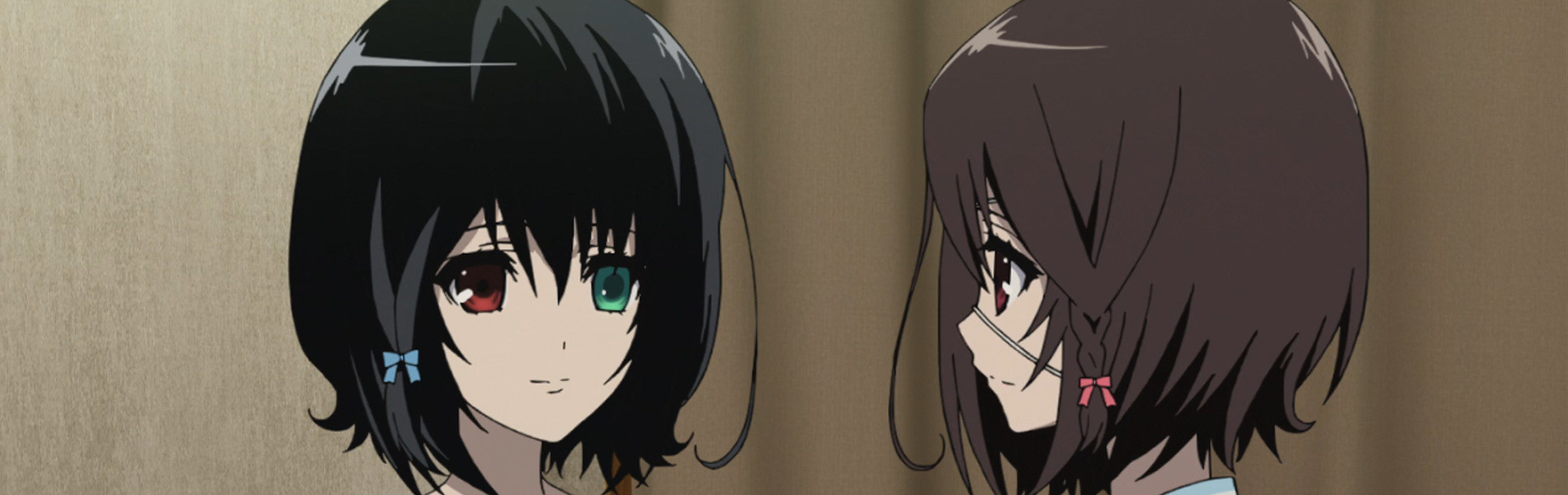
That’s the atmosphere of Another: The Other: not dread as spectacle, but dread as proximity. It’s the feeling of standing too close to a photograph where one face is slightly blurred — familiar, yet off-kilter. It’s the hush after laughter fades in an empty hallway. It’s the way warmth and unease coexist — the sticky sweetness of shaved ice, the chill of a basement stairwell, the softness of twin hands holding the same paper cup. This isn’t horror that shouts; it’s horror that breathes beside you, calm and certain, making you hyper-aware of your own pulse, your own breath, the fragile, temporary safety of ordinary moments. It makes you think about memory’s elasticity — how love can blur identity, how grief hides in routine, how tragedy doesn’t announce itself with sirens but settles, quietly, like dust on a forgotten shelf.
Chains resonates with this emotional DNA in a startlingly precise way. Its description calls it “a relaxing arcade match 3 casual game” built on linking adjacent bubbles — simple, tactile, almost meditative. But the player review nails the quiet tension: “Reminds me of connect 4 in nutshell… link 3 or more… clear enough till you can proceed.” That’s the rhythm of Another: The Other — not frantic escalation, but the slow, deliberate accumulation of small, linked actions: two sisters sharing a walk, a glance held too long, a hesitation before descending stairs. Each bubble cleared is like a moment passed — peaceful, controlled — until the physics shift, the board tilts, and what felt stable suddenly threatens to collapse. The game’s “Healing & Slow Life” dimension mirrors the anime’s insistence on savoring summer’s last light even as Mei’s unease deepens — both ask you to move gently, attentively, aware that every connection carries quiet consequence.
There’s also the profound resonance in shared stillness. Another: The Other lingers in pauses — the silence between shots at the stall, the way Misaki watches Mei without speaking, the suspended air in that basement. Chains, with its unhurried physics and deliberate linking, demands that same stillness. You don’t rush; you observe, you wait for alignment, you feel the subtle pull of color and proximity. That’s the emotional core: the intimacy of attention — how truly seeing someone, especially someone who mirrors you, becomes its own kind of vulnerability. The “Primarily Female Cast” and “Twins” tags aren’t just demographic notes; they’re structural. The story lives in the space between Mei and Misaki — in mirrored gestures, unspoken understandings, the weight of a shared name. Chains operates in that same relational space: meaning emerges not from grand gestures, but from adjacency, from alignment, from the quiet significance of what touches what.
This pairing speaks directly to the viewer who keeps a notebook beside their bed not for to-do lists, but for overheard fragments — a phrase from a stranger, the exact shade of light on a wall at 4:17 p.m., the way someone’s voice cracks when they say “it’s fine.” It’s for the player who replays a puzzle not to win faster, but to feel the satisfying click of three bubbles dissolving into light — a tiny, controlled release. It’s for those who find horror not in monsters, but in the unbearable tenderness of time passing, in the ache of loving someone so much you forget where they end and you begin. They don’t seek adrenaline — they seek resonance. The kind that hums in your ribs long after the screen goes dark, long after the last bubble clears — that soft, persistent, unforgettable vibration of being deeply, quietly seen.
🎮2 Games That Match the Vibe

Match Dimensions Explained
❓Frequently Asked Questions
Why is Chains recommended for fans of Another: The Other?
Because both lean hard into quiet, emotionally resonant storytelling with slow-burn tension—not jump scares, but the weight of unspoken grief, like when you’re replaying that rain-soaked hospital corridor scene in Another and then find yourself pausing mid-chain in Chains to absorb a character’s letter about loss. Chains’ Healing & Slow Life dimension mirrors Another’s focus on emotional aftermath, and players consistently note how its gentle match-3 rhythm (linking 3+ bubbles with physics-driven bounce) creates the same reflective headspace.
Is there a TV adaptation of Another: The Other?
No—there’s no official TV show, anime, or film adaptation of Another: The Other. It’s a standalone narrative experience, which is why fans often seek out games like Chains (84-scored, Healing & Slow Life focus) that replicate its mood through mechanics instead: think clearing color chains while reading fragmented journal entries that slowly reveal a sister’s illness, just like Another’s layered, non-linear reveals.
Chains vs. Another: The Other—which is better for melancholy rainy-day vibes?
Chains wins hands-down for that specific vibe: imagine sitting by a fogged-up window, matching soft pastel bubbles that pop with a muted *plink*, while voiceover reads a line like 'I still set two mugs down at breakfast'—exactly the kind of tender, low-stakes sorrow Another cultivates in scenes like the empty classroom desk or the half-packed suitcase. Its Healing & Slow Life design isn’t just thematic—it’s baked into the physics, where bubbles drift and settle like thoughts you can’t quite shake.
What if I love Another’s emotional pacing but hate puzzle mechanics?
Then Chains might surprise you—it’s not about speed or pressure; it’s about deliberate, almost meditative linking (3+ same-color bubbles), where the real 'puzzle' is emotional resonance, not logic. Players describe it as 'connect 4 in a nutshell' but with the narrative weight of Another’s quieter moments, like rereading a text message from a vanished friend while waiting for bubbles to settle into place.