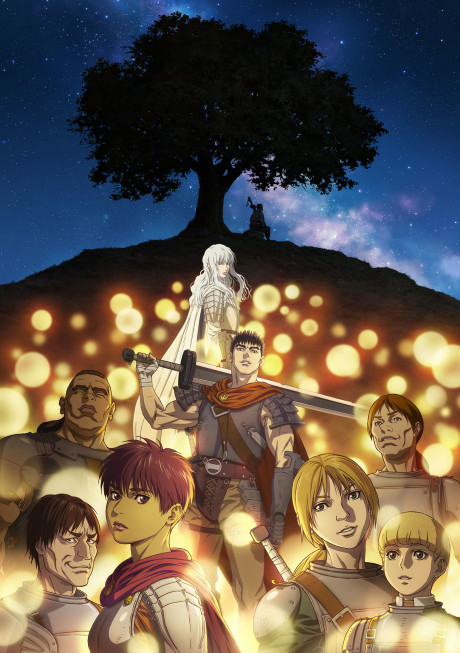
Berserk: The Golden Age Arc - Memorial Edition
Kentaro Miura's legendary series returns in Berserk: The Golden Age Arc - Memorial Edition.
The lone mercenary Guts travels a land where a century-old war is raging. His ferocity and skill in battle attract the attention of Griffith, the leader of a group of mercenaries called the Band of the Hawk. Guts becomes Griffith’s closest ally and confidant, but despite all their victories, Guts begins to question why he fights for another man’s dream of ruling his own kingdom. Unknown to Guts, Griffith’s unyielding ambition is about to bestow a horrible fate on them both.
(Source: Crunchyroll, Viz Media)
Note: This is a TV broadcast of the Golden Age film trilogy, with hundreds of new cuts including the "Bonfire of Dreams" scene and new music by Susumu Hirasawa and Shiro Sagisu.
📺Anime Details
📝Editorial Analysis
The rain in Doldrey doesn’t fall—it clings. It soaks the cracked stone of the fortress walls, slicks the blood-slicked cobblestones where Guts drags his sword after the siege, and hangs in the air like a held breath before Griffith’s final, quiet smile. That moment—Guts standing alone in the downpour, armor dented, knuckles split, eyes fixed on a man who just handed him victory like a gift wrapped in barbed wire—that’s not spectacle. That’s the first crack in the world’s foundation.

What makes Berserk: The Golden Age Arc - Memorial Edition ache so deeply isn’t its gore or demons—it’s the weight of loyalty forged in mud and iron, the slow, suffocating realization that dreams don’t lift men up; they consume them. This isn’t fantasy escapism. It’s psychological gravity: every cheer in the campfire scenes carries the echo of future silence, every shared laugh between Guts and Casca tastes faintly of ash. You don’t watch it—you endure it. And in that endurance, you start questioning your own allegiances, your own definitions of freedom, your own willingness to trade autonomy for belonging. It’s philosophical exhaustion, dressed in chainmail.
That same gut-level tension lives in Act of War: Direct Action, not because it has demons or swords, but because it shares the same moral vertigo. Its description calls it “a frightening tale of suspense, international intrigue and geopolitical military conflict”—a war where motives blur, alliances shift like sand, and victory feels less like triumph and more like delayed collapse. Just like Guts fighting under Griffith’s banner while sensing something off in the idealism, players in Act of War: Direct Action move units across maps where no faction is clean, no objective fully justified—“Tomorrow's War Is NOW,” the tagline insists, and that immediacy mirrors the Golden Age Arc’s dread: the horror isn’t coming—it’s already here, wearing the face of your commander. A player review nails it: “the dialogue for the campaign is dumb and a bit cringe but it's like C&C 3…”—that tonal dissonance, that jarring gap between heroic posturing and grim operational reality? That’s exactly the emotional friction Guts feels when Griffith recites poetry about kingship while ordering a village burned for tactical advantage. The cringe isn’t bad writing—it’s recognition.
None of this lands without context—and that’s why the real-world grounding matters. Act of War: Direct Action isn’t mythic. It’s tactical, procedural, rooted in today’s headlines. So is the Golden Age Arc: its war isn’t magical—it’s a century-old grind of conscription, supply lines, scorched earth, and soldiers whose names vanish from muster rolls before their bodies cool. When Guts fights in the mud outside Doldrey, he’s not dueling destiny—he’s choking on dust, reloading a crossbow with numb fingers, watching friends die from infection more than steel. That’s the texture the anime refuses to gloss over. And that texture is what makes the tragedy inescapable, not theatrical.
This pairing isn’t for fans of “cool fights” or “epic lore dumps.” It’s for the person who watches Guts carve his way through an enemy battalion—not to cheer, but to count how many times his shoulder joint clicks mid-swing. It’s for the player who pauses Act of War: Direct Action, not to strategize flanking maneuvers, but to stare at the HUD’s casualty counter blinking beside a mission success flag. It’s for those who feel philosophical exhaustion as a physical sensation—the kind that settles behind the eyes after reading Nietzsche on a train, or after realizing your favorite character just made a choice that can’t be undone, not by strength, not by love, not even by time. They’re drawn to stories where hope isn’t radiant—it’s fragile, frayed at the edges, and always one decision away from snapping. Where loyalty isn’t noble—it’s complicated, costly, and sometimes the heaviest armor you’ll ever wear.
🎮5 Games That Match the Vibe


Match Dimensions Explained
❓Frequently Asked Questions
Why is Act of War: Direct Action listed as similar to Berserk: The Golden Age Arc - Memorial Edition?
It's not about tone or story—it's the *cinematic intensity* during key moments: like when Guts charges through hordes in the Eclipse, Act of War drops you into tight, high-stakes tactical set-pieces (e.g., the Dubai oil refinery assault) with real-time command, quick-cut cutscenes, and visceral camera work that mirrors Berserk’s dramatic framing. Fans of the Memorial Edition’s oppressive atmosphere and sudden, brutal escalation often cite Act of War’s ‘C&C 3-style’ pacing and political thriller tension as an unexpected but fitting vibe match.
Is there a Berserk game adaptation that actually covers the Golden Age Arc?
No—Berserk: The Golden Age Arc - Memorial Edition *is* the only official game adaptation covering that arc, and it’s a remastered re-release of the 2012 PS3 title. It features playable Guts and Casca in key battles like the Doldrey siege and the Eclipse, with mechanics focused on weighty swordplay and scripted cinematic sequences—not open-world exploration or RPG progression.
How does Act of War: Direct Action compare to Berserk: The Golden Age Arc - Memorial Edition in terms of combat feel?
Totally different: Berserk’s combat is slow, deliberate, and grounded—Guts swings his Dragonslayer with bone-jarring heft, especially against Apostles like Nosferatu. Act of War is squad-based RTS with fast-paced, tactical firefights (think M4s and UAVs), where you issue commands rather than swing swords—but both nail *moment-to-moment intensity*, like the sudden ambush in Berserk’s fortress breach versus Act of War’s chaotic embassy raid.
What’s the best game like Berserk: The Golden Age Arc - Memorial Edition if I want that grim, politically charged wartime dread?
Act of War: Direct Action is your closest match for that specific vibe—its campaign dives into oil wars, black ops, and morally gray military decisions, mirroring the Golden Age Arc’s themes of power, betrayal, and empire collapse. The Dubai and Caspian Sea missions hit that same oppressive, 'no clean victories' weight—even if it swaps swords for sniper rifles and cutscenes for tense radio chatter.