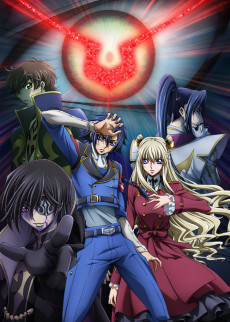
Code Geass: Akito the Exiled - The Brightness Falls
After discovering the face of their true enemy—someone who is related to Akito and responsible for the Geass placed upon him—W-0 attempts to return to their base at Castle Weisswolf. However, stranded in Warsaw due to a complication involving their military identification, they are forced to accept the help of local gypsies, allowing the squad to take some time to deepen their bonds.
Meanwhile, Britannian advisor Julius Kingsley and his guard Suzaku Kururugi begin working together with the Knights of St. Michael in order to crush the European resistance once and for all, armed with the destructive power of a giant weapon known as the Ark Fleet.
(Source: MAL Rewrite)
📺Anime Details
📝Editorial Analysis
Rain slicks the cobblestones of Warsaw like spilled ink. Akito’s breath hitches—not from exertion, but from the weight of recognition: the face on the Britannian dossier isn’t just an enemy. It’s blood. A name whispered in childhood lullabies now twisted into a Geass command—cold, surgical, inescapable. His knuckles whiten on the rifle stock as the W-0 squad moves through alley shadows, not as soldiers, but as children holding each other upright in a world that’s already decided they’re broken.
That’s the core feeling—not war as spectacle, but war as inheritance. Not mecha as tools, but as extensions of trauma made metallic and loud. Code Geass: Akito the Exiled - The Brightness Falls doesn’t thrill with scale; it presses—with the claustrophobia of military ID checkpoints, the quiet dread of gypsy campfires where trust is measured in shared silence, not speeches. You don’t feel heroic. You feel exposed: a teen whose power isn’t liberation—it’s a curse stitched into his nervous system by someone who once held him as a baby. Politics here aren’t debates—they’re inheritance papers signed in blood. Royal affairs aren’t pageantry—they’re execution warrants disguised as family portraits. And every “super power” lands like a violation, not a gift.
Which is why Act of War: Direct Action hits with such unnerving fidelity. Its description names Tactical Warfare, Political Thriller, and—crucially—Body Horror & Occult. That last pairing isn’t flavor text. It’s the same gut-punch logic: your body isn’t yours to command when Geass rewires your synapses, just as Act of War’s operatives suffer biological sabotage mid-mission—veins blackening, reflexes hijacked, loyalty overwritten. The player review calls it “frightening… ripped from today’s headlines”—and yes, but more precisely: ripped from the same moral vertigo as Akito realizing his own father weaponized his childhood. Both refuse catharsis. Both treat power as contamination. When Suzaku and Julius Kingsley begin working together in the anime, it’s not alliance—it’s two men stepping into the same contaminated room, knowing the air itself is compromised. That’s the tension Act of War replicates: not “who wins,” but “what remains human after the protocol executes?”
The gypsy interlude in Warsaw isn’t downtime—it’s the only moment the squad breathes without orders, without Geass static humming behind their eyes. They share stories, mend gear, watch smoke curl from a pot over open flame. There’s no exposition dump. Just hands moving, voices low, the unspoken understanding that tomorrow might erase all this. That intimacy under siege—the fragile warmth before the next deployment—is echoed in how players describe the campaign’s dialogue: “dumb and a bit cringe,” yet they keep playing. Why? Because the texture of duty—gritty, unglamorous, threaded with exhaustion and sudden, startling loyalty—is realer than any monologue. Like watching Akito hesitate before handing his rifle to Leila, not because he trusts her, but because he’s too tired to hold it alone anymore.
This isn’t about matching mecha to tanks or curses to spells. It’s about recognizing the same ache: the horror of being young, gifted, and utterly claimed—by empire, by bloodline, by something buried so deep in your skull you can’t tell if it’s memory or command. Who lives for this? Not the casual viewer. Not the player chasing loot drops or leaderboard ranks. It’s the one who rewatched the Warsaw campfire scene three times—not for plot, but to hear the rustle of canvas, the scrape of a boot on wet stone, the way Akito’s voice cracks just once when he says “We go home.” It’s the player who paused Act of War: Direct Action mid-mission not to strategize—but to stare at the trembling hand animation on their soldier’s HUD, thinking, Yeah. That’s how it feels when your own nerves betray you. They don’t want escape. They want resonance—raw, uncomfortable, true. The kind that leaves your throat tight and your controller cold long after the screen goes black.
🎮1 Games That Match the Vibe

Match Dimensions Explained
❓Frequently Asked Questions
Why is Act of War: Direct Action listed as similar to Code Geass: Akito the Exiled?
Because both lean hard into geopolitical tension and morally gray military ops—like when Akito’s squad raids a Euro-British facility under cover of snowstorm, Act of War mirrors that with its covert NATO vs. shadowy Black Hand missions in Eastern Europe. The tactical pause-and-plan RTS mechanics (think issuing flanking orders mid-firefight) echo how Akito’s squad coordinates precise, high-stakes strikes—not just mindless combat.
Is there a video game adaptation of Code Geass: Akito the Exiled?
No—there’s no official game based on *Akito the Exiled*. The closest thing fans get is *Act of War: Direct Action*, which shares its gritty, politically charged wartime tone and elite-squad focus (e.g., Akito’s ‘Mordred’ unit vs. Act of War’s Delta Force-style ‘Task Force Talon’). It’s not canon, but reviewers call it ‘C&C 3 meets real-world spycraft’—exactly the vibe Akito’s cold-war-in-the-snow aesthetic nails.
How does Act of War: Direct Action compare to Command & Conquer 3 in terms of Code Geass vibes?
Both have that tense, near-future realism—but *Act of War* dials up the political thriller angle way more, like when Akito confronts betrayal inside his own command structure; *Act of War* does the same with its Black Hand conspiracies and UN-backed ops gone sideways. Its body horror/occult undertones (think mutated soldiers in cutscenes) add a layer of unease C&C 3 avoids—closer to Lelouch’s ‘Geass-induced moral collapse’ than Tiberium’s sci-fi spectacle.
What’s the best game like Akito the Exiled if I want that brooding, snow-covered tactical despair?
Go straight to *Act of War: Direct Action*—its Eastern European winter maps (like the frozen Chernobyl Exclusion Zone mission) mirror Akito’s icy battlefields, and its emphasis on small-unit precision—ordering snipers to suppress while engineers breach—feels like directing Akito’s Mordred team mid-blizzard. Player reviews even note how the ‘dumb but intense’ dialogue lands like Lelouch’s monologues: cringe-y at times, but weirdly gripping when stakes are life-or-death.