
Diary of Our Days at the Breakwater
Introverted Hina Tsurugi is trying to adjust to her new school since moving from the countryside. And in spite of her unease around sea life, classmate Yuuki Kuroiwa somehow convinces her to join the Breakwater Fishing Club. She wants to be open to these new friends and experiences, but some of them are as strange as the fish they’re supposed to hook. Is she biting off more than she can chew?
(Source: Crunchyroll)
📺Anime Details
📝Editorial Analysis
The salt hangs in the air—not sharp, not briny, but soft, like breath fogging a window on a cool morning. Hina sits cross-legged on the breakwater’s sun-warmed concrete, knees drawn tight, fingers tracing the rough edge of her borrowed fishing rod. A small wave sighs against the pilings below. Yuuki kneels beside her, laughing at something absurd—maybe the way the bait wobbles, maybe Hina’s expression when a tiny crab scuttles over her sneaker—and the sound doesn’t pierce the quiet; it settles into it, like pebbles dropped one by one into still water. No punchline lands hard. No crisis erupts. Just this: the weight of the rod, the warmth of shared silence, the slow, unforced unfurling of trust.
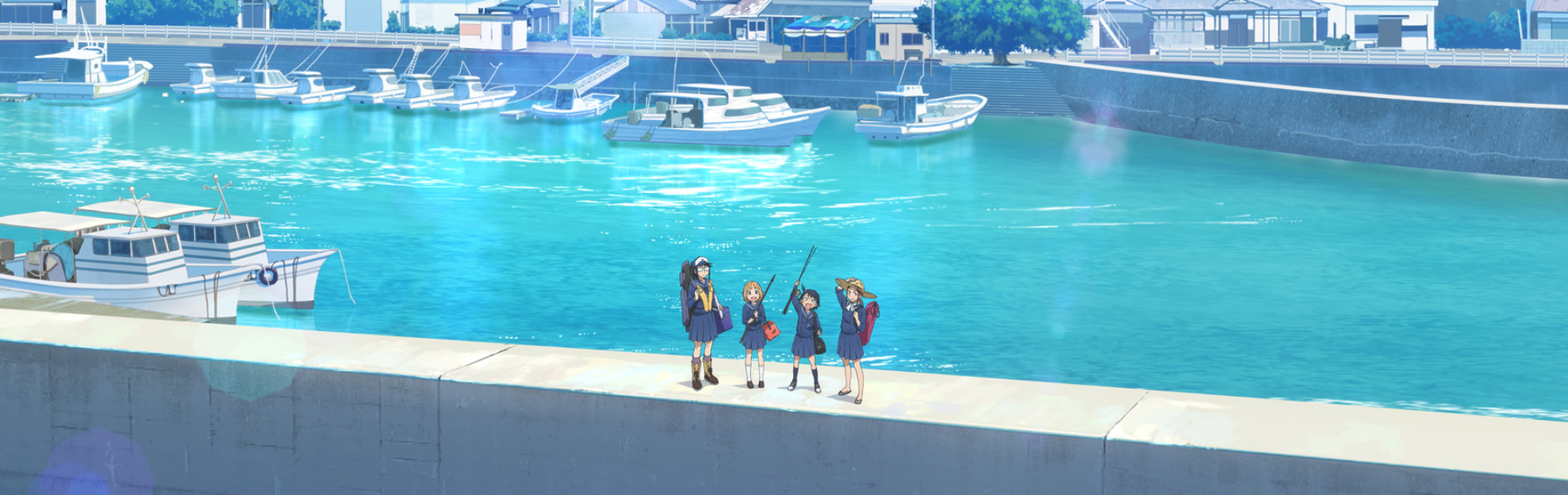
That’s the feeling Diary of Our Days at the Breakwater cultivates—not calm as absence, but calm as presence. It’s the hush after a deep exhale, the relief of shoulders dropping when no one demands performance. This isn’t escapism that erases reality; it’s iyashikei that gently reorients you within it—tuning your attention to the grain of weathered wood, the particular shimmer of light on wet sand, the quiet pride in finally threading a hook without fumbling. It asks nothing of Hina except to stay present—to watch the float dip, to taste the onigiri Yuuki packed, to feel the wind shift—and in doing so, it makes space for something tender and rare: the dignity of small, unremarkable adjustments. You don’t achieve belonging here. You breathe into it.
Which is why AudioSurf, with its deeply personal, music-shaped rhythms, resonates so quietly but unmistakably. Its description says: “Ride your music. Audiosurf is a music-adapting puzzle racer where you use your own music to create your own experience. The shape, the speed, and the mood of each ride is determined by the song you choose.” That’s the core alignment—not competition, not narrative, but embodied attunement. Like Hina learning the cadence of casting, or the club members reading the tide’s subtle language, AudioSurf asks you to sync your movement—not to a rigid system, but to the organic swell and retreat of your own soundtrack. A gentle acoustic piece becomes a slow glide; a mellow jazz standard pulses with warm, unhurried flow. And the player review nails the emotional kinship: “I, personally, find Audiosurf 1 to be superior to the second game. Despite its godawful UI, unskippable menu animations, crashing, and flashbanging wh...”—the imperfections aren’t flaws to be polished away; they’re part of the texture, like the slightly-too-big club jacket Hina wears, or the lopsided bento she tries to make. Both ask you to meet them as they are, and in that meeting, find a kind of soft, resilient harmony.
This same resonance lives in the quiet ritual of tending to things that grow at their own pace—like the coastal setting of Diary of Our Days at the Breakwater, where seasons shift in the color of the water and the fish that appear, not on a schedule, but in response to unseen currents. There’s no XP bar filling, no quest log ticking. Just the patient observation of change: the way Hina’s hands stop trembling when she holds the rod, the way laughter comes easier near the water’s edge. It’s the same feeling found in games that prioritize presence over progress, where healing isn’t a stat boost but the act of sitting still long enough to hear your own heartbeat match the rhythm of the waves.
Who would love these pairings? Not just fans of “cute girls doing cute things,” but people who carry quiet exhaustion—the ones who’ve spent weeks navigating new offices, new cities, new versions of themselves, and need permission to move slowly. The person who finds solace not in grand victories, but in the precise, grounding sensation of a fishing line humming faintly in the breeze—or the way a familiar melody reshapes the world into something softer, slower, theirs. They’re the ones who understand that healing isn’t always loud, that connection isn’t always verbal, and that sometimes, the bravest thing you can do is sit on a sun-warmed breakwater, holding a rod you’re still learning how to trust—and simply wait, open, for whatever comes next.
🎮1 Games That Match the Vibe

Match Dimensions Explained
❓Frequently Asked Questions
Why is AudioSurf listed as similar to Diary of Our Days at the Breakwater?
Because both lean hard into quiet, reflective healing vibes—like drifting through sunlit water or replaying a tender memory. AudioSurf’s slow-life dimension shines when you load a gentle acoustic track and just glide through pastel-colored blocks, mirroring Breakwater’s unhurried pacing and emotional resonance (e.g., the lighthouse scene where Yuki sits silently watching the tide). It’s not about winning—it’s about presence, much like re-reading a journal entry you’ve highlighted three times.
Is there an anime or manga adaptation of Diary of Our Days at the Breakwater?
No—there isn’t, and that’s part of why fans love it. Unlike many visual novels with anime tie-ins (think Clannad), Breakwater stays rooted in its intimate, text-and-art-driven storytelling—similar to how AudioSurf stays purely experiential, no cutscenes or voice acting, just *you*, your music, and the rhythm of your own breath. That intentional minimalism is rare, and honestly? It’s why both titles feel so personal.
How does AudioSurf compare to Diary of Our Days at the Breakwater in terms of mood and pacing?
They’re surprisingly aligned: both prioritize slowness as a form of care. Breakwater’s quiet moments—like walking home with Aya after class, listening to cicadas—match AudioSurf’s ‘Healing & Slow Life’ dimension when you pick a mellow song (think Sufjan Stevens or Marisa Monte) and let the rails unfold without pressure. Neither punishes you for pausing, lingering, or replaying—just like how AudioSurf lets you restart a track mid-ride if you miss a block, no penalty, no judgment.
What’s the best game like Diary of Our Days at the Breakwater if I want something soothing but with subtle interactivity?
AudioSurf is your answer—especially if you crave tactile calm. Instead of clicking dialogue choices, you *steer* through waves of color synced to your own playlist, which creates that same meditative flow as rereading Breakwater’s journal entries under soft lamplight. One player put it perfectly: ‘It’s like turning your favorite melancholy song into a walk along the breakwater at dusk—no story beats, just feeling, and it *works*.’