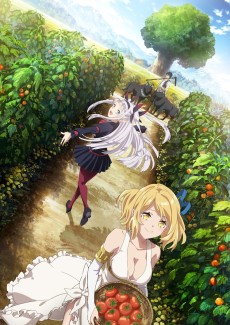
Farming Life in Another World
Life cut short by illness at just 39 years old, Machio Hiraku knows not to take simple blessings for granted. When a godlike figure gives him given a chance to live again, Hiraku has only the simplest of wishes for his new life: to be healthy, to live peacefully, to speak the local language, and to spend his days on an idyllic farm. Fresh air, sunshine, honest work, and good company combine to form the happy, peaceful existence Hiraku has always dreamed of.
(Source: HIDIVE)
📺Anime Details
📝Editorial Analysis
Sunlight pools like warm honey across freshly turned soil. Hiraku kneels, bare hands sinking into loam that smells damp and sweet—alive—not sterile, not urgent. His breath steadies. A breeze stirs the wheat stalks behind him; somewhere, a goat bleats softly. No battle cries. No ticking clock. Just the quiet shush of soil falling back into place as he smooths a seedbed. This isn’t the start of an adventure. It’s the middle of one—slow, unremarkable, deeply enough.

What makes Farming Life in Another World vibrate at this particular frequency isn’t its isekai setup or harem framing—it’s how relentlessly it honors presence. Not achievement, not escalation, but the weight of a watering can in your palm, the rhythm of hoeing rows under open sky, the way language slowly stops being a barrier and becomes shared laughter over mispronounced vegetable names. It doesn’t soothe by removing tension—it dissolves urgency itself. You feel time soften at the edges. You think about how rare it is to be unhurried without guilt. How healing it is to witness growth you didn’t force—just tended, trusted, waited for. This isn’t escapism. It’s re-rooting.
That same emotional resonance hums in Chains, a match-3 game where physics—not timers or combos—govern every link. The description calls it “relaxing,” and players confirm it: “Reminds me of connect 4 in nutshell… link 3 or more of the same color and clear enough till you can proceed.” There’s no penalty for pausing. No lives lost. Just the gentle pop of bubbles yielding, the soft cascade of color settling—no rush, no consequence, only the quiet satisfaction of alignment. Like Hiraku watching seeds swell in moist earth, Chains rewards attention, not speed. Its challenge is spatial patience, not reflexes—mirroring how the anime measures progress in harvest cycles, not plot beats.
The emotional DNA isn’t about genre mimicry—it’s about temporal texture. Both honor slowness as substance, not absence. You don’t “win” farming life—you inhabit it. You don’t “beat” Chains—you settle into its gentle cause-and-effect, where each chain feels earned because it asked you to notice, to lean in, to wait for the right angle. That’s why the player review doesn’t praise difficulty or leaderboard rank—it anchors itself in tactile simplicity: “link,” “clear,” “proceed.” Same as Hiraku: plant, water, wait, harvest. No grand pronouncements. Just continuity.
This pairing sings for people who’ve carried exhaustion like a second coat—those whose shoulders remember the weight of deadlines, whose wrists still ache from typing past midnight, whose idea of rest used to involve scrolling away from feeling. It’s for the person who once thought peace meant silence, then learned it’s actually the sound of wind through leaves and the low murmur of friends sharing tea on a porch built with their own hands. It’s for anyone who’s ever stared at a blank page or an empty field and felt not panic—but possibility, quiet and deep. Not because everything is solved, but because for now, the air is clean, the light is golden, and the next small thing—watering the radishes, linking three blue bubbles—is enough. Not a step toward something else. The thing itself. Warm. Real. Held.
🎮1 Games That Match the Vibe
Match Dimensions Explained
❓Frequently Asked Questions
Why does Chains keep coming up when I search for games like Farming Life in Another World?
Because Chains nails the 'Healing & Slow Life' vibe—just like Farming Life’s quiet mornings with Ruri tending crops, Chains gives you unhurried bubble-linking with gentle physics and no timers. Players love how its emotional narrative unfolds between levels, much like the heartfelt character moments with Lute and the village elders in Farming Life.
Is there an anime or manga adaptation of Chains?
No—Chains is an original game with no anime or manga adaptation. Unlike Farming Life in Another World (which has both a light novel and anime), Chains stands on its own as a self-contained slow-life experience, focused entirely on its soothing match-3 mechanics and subtle storytelling between stages.
Chains vs. Story of Seasons: which is better if I want that cozy, low-stress farming fantasy without actual farming?
Chains is the better pick—it swaps plowing fields for chaining colorful bubbles, but keeps the same warm, unhurried rhythm: think Ruri’s peaceful herb-gathering scenes, but translated into soft ‘pop’ sounds and gentle gravity puzzles. Story of Seasons demands crop cycles and stamina management; Chains asks only that you breathe, link, and move on—exactly what fans of Farming Life’s downtime crave.
What’s the best game like Farming Life in Another World if I just want to unwind after work with zero pressure?
Chains is your go-to—it’s got a 77 Metacritic score for good reason, with no fail states, no energy bars, and no rush. One player put it perfectly: 'Reminds me of connect 4 in a nutshell'—simple, tactile, and deeply calming, like sipping tea with Lute while watching the sunset over the valley.