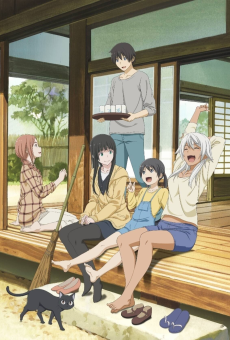
Flying Witch
Traditionally, when a witch turns 15, she's supposed to go out into the world alone to study magic. Makoto's parents, however, believe that their directionally-challenged daughter should get a high school degree. Instead of being sent out on her own, Makoto and her cat Chito find themselves traveling from the bustling city of Yokohama to Aomori Prefecture, where they'll stay with relatives until Makoto finishes school. It's going to be a big adjustment, and it only gets more complicated since "normal" people aren't supposed to know that witches exist… something that she tends to forget.
(Source: Sentai Filmworks)
📺Anime Details
📝Editorial Analysis
The steam rises in slow, lazy curls from Makoto’s teacup as she sits on the wooden porch of her aunt’s house in Aomori—bare feet brushing cool tatami, Chito curled like a comma beside her knee. Outside, a breeze stirs the rice paddies into rippling silver, and somewhere beyond the bamboo grove, a cicada pulses its low, steady thrum. There’s no urgency here. No countdown. Just the quiet weight of afternoon light thickening as it slants across the garden—and the soft, unspoken understanding that magic isn’t cast; it’s noticed: in the way mist gathers at dawn, how herbs bloom just before rain, how a cat’s tail flicks exactly when a spell settles into place.

That’s the heart of Flying Witch—not spells as spectacle, but as continuity. It doesn’t ask you to believe in witches so much as to remember how it feels to be twelve minutes late for school and still feel safe, how a shared meal with family can hold more gravity than any incantation, how time expands when you’re watching clouds drift over an orchard instead of checking your phone. Its atmosphere is rooted, not escapist—less about leaving the world behind and more about sinking deeper into it: soil, season, silence. You don’t achieve calm in Flying Witch; you inherit it, like a well-worn apron or a recipe passed down without notes. It’s healing not because it fixes anything—but because it refuses to pathologize slowness, wonder, or gentle disorientation.
Which brings us to Prince of Persia, a game whose own emotional DNA hums at the same frequency—though dressed in sandstone and swordplay. The official description calls it “an all-new epic journey” built by Ubisoft Montreal, yet player reviews zero in on something quieter: “Healing & Slow Life, Melancholic Exploration.” That phrase—Melancholic Exploration—is the key. Not frantic platforming, not combat-as-catharsis, but the prince moving through ruins where time itself feels porous, where every crumbling archway invites pause, every sun-drenched courtyard asks you to breathe before leaping. Like Makoto learning to read wind patterns before flying, the prince learns magic not through mastery, but through attunement: listening to echoes, tracing water’s memory in dry stone, feeling history settle into his bones. Both works treat movement as meditation—not progress toward a goal, but presence within a rhythm older than plot.
And yes, it’s startling at first—this pairing of a rural Japanese witch-in-training and a mythic Persian prince—but the resonance isn’t in lore or setting. It’s in tempo. In how both refuse the tyranny of the urgent. When Makoto misplaces her broomstick again, and spends twenty minutes searching not with panic but with quiet curiosity—peering under the kotatsu, checking the herb garden, asking Chito with gentle patience—that’s the same energy as the prince walking backward through a sandstorm in slow motion, not to undo time, but to feel its grain. Player reviews mention “a new prince, new lands and a brand new story completely separate from the sands”—but what they feel, beneath the reboot, is something ancient: the relief of being allowed to wander without destination, to fail softly, to let magic arrive not as power, but as permission—to linger.
Who loves this? Not just fans of “witches” or “platformers.” It’s the person who replays the opening ten minutes of Flying Witch just to watch Makoto unpack her suitcase while Chito bats at a falling maple leaf. It’s the player who saves mid-climb in Prince of Persia, not to avoid death, but to sit on a ledge and watch the sun bleed gold over dunes—because the game lets them. It’s someone who craves stillness with texture, who finds awe in the mundane (a steaming cup, a sunlit ruin), who trusts that meaning lives not in climax, but in the space between breaths. They don’t want to conquer the world—they want to know it, leaf by leaf, stone by stone, cup by warm cup. And in both Flying Witch and Prince of Persia, that knowing is the only spell that matters.
🎮5 Games That Match the Vibe




Match Dimensions Explained
❓Frequently Asked Questions
Why does Prince of Persia keep coming up when I search for games like Flying Witch?
Because both lean into 'Melancholic Exploration' and 'Slow Life'—like when the Prince quietly tends to his injured companion in the garden courtyard, or wanders sun-dappled ruins at dawn, mirroring Masa’s quiet walks through rural Aomori. It’s not about action—it’s that same hushed, healing rhythm and reverence for small, grounded moments.
Is there a Flying Witch video game adaptation?
No—there’s never been an official Flying Witch game, anime tie-in or otherwise. But fans who love its gentle magic often find comfort in Prince of Persia (2024), especially its 'Healing & Slow Life' vibe: think brewing herbal tonics, restoring crumbling shrines, and conversations that linger like steam off a teacup.
How is Prince of Persia similar to Flying Witch if one has combat and the other doesn’t?
Great question—the combat in Prince of Persia (2024) is deliberately minimal and rhythmic, almost meditative, like Masa’s spellcasting: you pause, breathe, and flow into motion. And just as Flying Witch centers on tending gardens and caring for others, the Prince restores ancient wells, heals villagers with poultices, and shares quiet meals—both prioritize care over conquest.
What’s the best game like Flying Witch if I just want to feel calm and grounded?
Prince of Persia (2024) is your best bet—it scores 84 and nails 'Healing & Slow Life' with scenes like sitting beside a hearth in the palace library, sketching herbs in a journal, or watching fireflies rise over misty cliffs. No timers, no fail states—just presence, like sipping matcha with Masa while listening to cicadas.