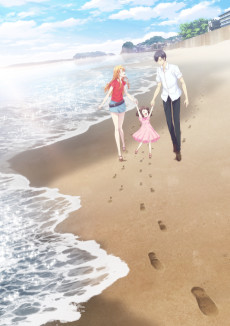
Fruits Basket -prelude-
Before there was Tooru and Kyou – there was Katsuya and Kyouko. Discover the turbulent beginning of Tooru’s mom’s dark past, and the man who breathed new hope into her. Watch the evolution of their love story and the birth of the Honda family, as this chapter completes the full adaptation of the heartwarming Fruits Basket story.
(Source: Crunchyroll)
📺Anime Details
📝Editorial Analysis
Rain slicks the pavement outside the old apartment building—cold, silver, relentless. Kyouko Honda sits on the cracked concrete step, knees drawn up, staring at her own hands as if they belong to someone else. Her knuckles are split. Her hair is damp and tangled. And then Katsuya Honda appears—not with grand gestures, not with speeches—but holding two steaming paper cups, handing one to her without a word. She doesn’t take it at first. He waits. The silence isn’t empty. It’s heavy, tender, full of unspoken permission—to be broken, to be seen, to stay.

That quiet, suspended breath before connection—that’s the atmosphere of Fruits Basket -prelude-. Not hopelessness, not despair, but something more precise: the tremor before healing begins. It’s the weight of inherited pain settling into new hands—and the startling lightness of being met, truly met, by someone who refuses to look away. This isn’t shoujo romance as fantasy escape; it’s shoujo as emotional archaeology—digging through layers of shame, poverty, delinquency, and parental failure—not to erase them, but to name them, hold them, and build something real on top. You don’t feel uplifted here. You feel witnessed. You think about how love isn’t always soft—it can be stubborn, practical, even awkward—and how parenthood begins long before a child is born, in the choices we make when no one’s watching.
Jade Empire™: Special Edition shares that same grounded, tactile ache. Its description frames you as “an aspiring martial-arts master” walking “the path of the open palm or the closed fist”—a duality echoing Katsuya’s quiet strength and Kyouko’s raw, defensive edges. The player review mentions needing technical workarounds just to launch the game (copy and paste "steam.dll"), which mirrors how both characters must patch themselves together—improvised, imperfect, functional. Their love story isn’t polished; it’s forged in daily acts: shared tea, a steadying hand, showing up again. Like Jade Empire’s moral system, their bond isn’t defined by absolutes—it’s tested in small, irreversible choices.
Dragon Age: Origins resonates in its legacy-building urgency. Its description asks: “When history tells the story of the Fifth Blight, what will be said about the hero who turned the tide?” That’s Kyouko and Katsuya—not mythic saviors, but ordinary people trying to rewrite a family’s ending before it begins. The player review notes the “pause attack mechanic” helping “strategist your tactic”—and yes, love in Fruits Basket -prelude- is deeply tactical: choosing patience over judgment, silence over correction, presence over solution. They don’t defeat trauma with spectacle—they outlast it, moment by deliberate moment, like a warrior pausing mid-battle to assess, breathe, recalibrate.
Persona 5 Royal, too, pulses with this same rhythm. Its description highlights “building relations” while exploring Tokyo—a city that, like Kyouko’s world, feels both suffocating and electric with possibility. The player review praises the “seamless transition between daily life” and the “stunning soundtrack,” and that’s precisely the anime’s texture: school corridors humming with unspoken tension, cramped apartments vibrating with unvoiced fears, the sound of rain, of a kettle boiling, of a heartbeat slowing just enough to let trust in. Romance here isn’t confession scenes—it’s shared meals, overlapping routines, the slow dissolve of isolation into we.
This isn’t for viewers who want catharsis served neat. It’s for the ones who recognize love in the way someone remembers how you take your tea. For players who replay dialogue trees not for optimal outcomes, but to hear that one line again—the one where the guard drops, just for a second. For people who’ve ever held their breath waiting to see if kindness would land—or if it would shatter on impact. These pairings speak to those who know healing isn’t linear, who find poetry in resilience that looks like showing up with two paper cups in the rain—and who understand that the most radical act in a broken world is choosing, every day, to believe in after.
🎮8 Games That Match the Vibe






Match Dimensions Explained
❓Frequently Asked Questions
Why is Jade Empire listed as similar to Fruits Basket -prelude- when it's a martial arts game?
Great question — it’s not about the kung fu! Jade Empire earns its spot because of its deeply emotional, character-driven narrative and quiet, tender romance arcs (like your slow-burn bond with Dawn Star or the heartbreaking choices around Master Li), which mirror -prelude-’s focus on healing, vulnerability, and unspoken feelings. The 'Romance & Shoujo' dimension in its match profile isn’t about dating sims — it’s about how relationships shape identity and growth, just like Tohru’s impact on Yuki and Kyo in the film.
Is there a visual novel or anime-style game adaptation of Fruits Basket -prelude-?
No — there’s no official game adaptation of -prelude- itself. But if you’re craving that same gentle, emotionally resonant storytelling *in game form*, Persona 5 Royal nails it: think late-night confessions in Shibuya alleyways, building trust through daily hangouts (like your Confidant with Ann or Ryuji), and that same bittersweet warmth as Tohru quietly holding space for others. It’s not an adaptation — but tonally, it’s the closest thing we’ve got.
How does Dragon Age: Origins compare to Persona 5 Royal for Fruits Basket fans?
Both deliver rich emotional narratives and meaningful romance — but DA:O leans into weighty, morally grey choices (like sacrificing Alistair or Loghain) and party banter that feels like found family, much like the Sohma household’s layered tensions. Persona 5 Royal, meanwhile, mirrors -prelude-’s intimate pacing: school life rhythms, soft character moments (e.g., Futaba opening up at the shrine), and that signature shoujo-esque emotional clarity. If you loved -prelude-’s tenderness over tragedy, P5R edges ahead — but DA:O’s pause-and-plan combat makes deep relationship-building feel just as deliberate.
What’s the best game like Fruits Basket -prelude- if I want something calming and heartfelt, not action-heavy?
Go straight to Disco Elysium — yes, really! Don’t let the gritty art or political monologues fool you: its heart lives in quiet, human moments — like talking down a grieving widow in the Whirling-in-Rags bar, or choosing empathy over cynicism during a simple park bench conversation. That raw, compassionate intimacy — where dialogue *is* the action — matches -prelude-’s vibe better than any battle system. And per its 'Romance & Shoujo' dimension, even your romance with Kim Kitsuragi unfolds through hesitant glances, shared silences, and gentle reciprocity.