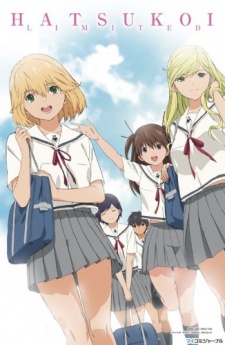
Hatsukoi Limited
📺Anime Details
📝Editorial Analysis
The cafeteria at lunchtime—steam rising from bentō boxes, the low hum of overlapping conversations, a girl’s laugh cutting through the chatter just as another girl looks away, fingers tightening around her chopsticks, her smile not quite reaching her eyes. That split second where affection is felt but not spoken, where proximity is everything and distance is measured in glances, not meters—that’s the quiet, pulsing heart of Hatsukoi Limited.
It doesn’t shout. It breathes. You don’t watch it for plot twists or world-ending stakes—you watch because it makes your chest tighten, then soften, then ache in quick succession. It’s the weight of unspoken things: the way a character adjusts her uniform collar after brushing shoulders with someone, how a shared umbrella becomes its own silent language, how laughter sometimes sounds like a shield. This isn’t romance as conquest or catharsis—it’s romance as atmosphere: humid, tender, slightly awkward, and deeply, unmistakably human. The ensemble cast doesn’t orbit a protagonist; they orbit each other, their feelings rippling outward like stones dropped into still water—no one untouched, no emotion fully resolved. You leave each episode not with answers, but with the lingering warmth of almost, the gentle sting of not yet, the quiet reverence for how much love can live in the space between words.
That emotional DNA—the slow burn of longing, the intimacy of daily ritual, the way relationships deepen not through grand declarations but through repeated, small, seen moments—is why Persona 5 Royal resonates so sharply. Its player review praises “the seamless transition between daily life…”—exactly what Hatsukoi Limited masters: school corridors, part-time jobs, rooftop confessions that never quite land, all woven into a rhythm where time itself feels like a character. The game’s structure—balancing social bonds with narrative urgency—mirrors the anime’s delicate equilibrium between comedic timing and emotional gravity. Both trust you to notice the tremor in a voice during a festival night, the significance of choosing which friend to walk home with, the quiet exhaustion behind a tsundere’s sharp retort.
Then there’s Persona 3 Reload, scoring identically (74) and sharing the same dimensional tags: Romance & Shoujo, JRPG Narrative. Its resonance lies not in combat or supernatural stakes, but in how it treats time as finite and feeling as urgent. In Hatsukoi Limited, seasons shift subtly—cherry blossoms fall, uniforms change, voices deepen—and every transition carries the quiet pressure of growing up while loving. Persona 3 Reload mirrors that: its calendar ticks forward relentlessly, relationships bloom in narrow windows, and every “bond” level-up feels earned not through quests, but through showing up—again and again—at the right moment, with the right silence, the right question. Neither work lets love be abstract. It’s tied to weather, to schedules, to the physicality of shared space—like passing a notebook back and forth, or holding an umbrella just a little too long.
Even Baldur’s Gate 3, with its higher score (81) and identical dimensional framing, shares this core pulse—not through fantasy lore, but through relational texture. Its top match isn’t about spells or stats, but Romance & Shoujo, a pairing that surprises until you remember how Hatsukoi Limited treats romance: as layered, contradictory, embodied. In BG3, a flirtation isn’t just dialogue—it’s body language coded into animations, hesitation built into pause menus, history echoing in reused lines. Like the anime’s large-breasted characters whose physical presence isn’t fanservice-as-distraction but presence-as-expression, BG3 makes desire tactile, situational, contextual. When a player review highlights “Stunning Soundtrack” as emotionally anchoring, it echoes how Hatsukoi Limited uses light piano motifs under hallway walks—music that doesn’t underscore drama, but holds space for feeling.
This pairing isn’t for people who want tidy endings or flawless protagonists. It’s for the ones who cry when a character finally remembers to bring tea to someone’s sickbed. For the ones who replay a conversation in Persona 5 Royal just to hear how the voice cracks on the third line. For the ones who rewatch Hatsukoi Limited’s final school festival scene—not for the resolution, but for the way sunlight catches the dust motes swirling above three girls laughing, none of them quite sure what comes next, all of them alive in the uncertainty. They’re the kind of people who understand that love isn’t always about getting what you want—it’s about being seen, remembered, and held, even for just one perfect, ordinary, aching afternoon.
🎮6 Games That Match the Vibe





Match Dimensions Explained
❓Frequently Asked Questions
Why does Hatsukoi Limited match Baldur's Gate 3 despite being a Japanese romance visual novel?
Because both weave deep romantic relationships into a rich, choice-driven narrative where your decisions directly shape character bonds—like how Hatsukoi’s confession scenes hinge on timing and dialogue choices, just like BG3’s romance arcs with Astarion or Shadowheart that evolve across chapters based on your actions and approvals. They share that rare 'Romance & Shoujo' + 'JRPG Narrative' dimension, emphasizing emotional stakes alongside plot consequences.
Is there an anime or manga adaptation of Hatsukoi Limited?
No—Hatsukoi Limited is an original game with no official anime, manga, or light novel adaptations (yet). That said, fans often compare its intimate, school-based emotional pacing to Persona 5 Royal’s Tokyo high school life: think of Ann Takamaki’s confessions in the Velvet Room or Futaba’s late-game bonding scenes—those quiet, character-first moments are why they land in the same match cluster.
How does Hatsukoi Limited compare to Persona 3 Reload in terms of romance pacing?
Hatsukoi Limited leans into slower, more deliberate romantic development—like building trust with a shy classmate over weeks of shared lunches—whereas Persona 3 Reload mirrors that with Yukari’s or Mitsuru’s Social Link progression, where you earn trust through repeated hangouts, weather-dependent events, and timed dialogue windows during the Dark Hour. Both reward patience and attention to small emotional cues, not just stat grinding.
What’s the best game like Hatsukoi Limited if I want something bittersweet but stylish, with killer music?
Go straight to Persona 5 Royal—it nails that exact vibe: moody, cinematic school life layered with heartfelt romance (like Ryuji’s loyalty arc or Ann’s rooftop confessions), all wrapped in one of gaming’s most iconic soundtracks. Reviewers even call out its 'stunning soundtrack' and 'seamless daily life → dungeon loop'—exactly the blend of shoujo tenderness and JRPG polish that Hatsukoi Limited fans love.