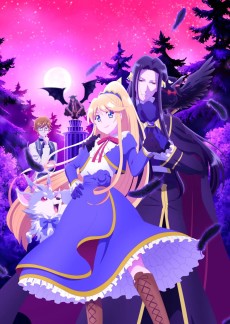
I'm the Villainess, So I'm Taming the Final Boss
Aileen Lauren d’Autriche’s wedding plans have been suddenly canceled— by her own fiancé! The shock of this jolted her into remembering she’s been reincarnated in an otome game as the villainess. As she recalls, her fate is one of doom, but maybe she can avoid it by marrying the final boss, the Demon King Claude. Her new game plan— seduce the Demon King and live happily ever after.
(Source: Crunchyroll)
📺Anime Details
📝Editorial Analysis
The scent of crushed rose petals and ozone—right before lightning splits the sky over the d’Autriche estate gardens. Aileen stands barefoot on cold marble, silk slippers abandoned, clutching a torn wedding invitation in one hand and a hastily scribbled note from Claude—“I do not require a bride. I require a sovereign who does not flinch at her own reflection.”—in the other. Her laugh rings sharp, unsteady, alive, as thunder cracks and rain begins to fall—not in sorrow, but in permission. That moment isn’t about romance or escape. It’s the exact second she stops performing villainy and starts rehearsing herself.

What makes I'm the Villainess, So I'm Taming the Final Boss vibrate with such rare warmth is how it treats agency like breath: effortless, constant, and quietly revolutionary. This isn’t a story about avoiding fate—it’s about rewriting the grammar of consequence. Every crossdressing scene, every magic duel staged like a salon debate, every time Aileen disarms Claude not with flirtation but with precision (“Your ‘demonic aura’ is just suppressed empathy, Your Majesty—let’s calibrate it”) makes you feel lighter, not because stakes are low, but because intelligence is trusted as emotional currency. You don’t root for her to win love—you root for her to keep thinking aloud, unapologetically, while the world assumes she’s scheming. It’s playful, yes—but play with teeth, with history, with the quiet fury of being misread—and then refused.
That same electric recalibration lives in Disco Elysium - The Final Cut, where a detective stumbles through a city that eats ideology for breakfast, yet chooses—again and again—to speak his own mind even when his skill checks scream “Lie. Conform. Collapse.” The description calls it “groundbreaking” for its skill system; the player review quotes capital’s cruel irony—but what mirrors Aileen isn’t the politics or the despair. It’s the refusal to let narrative authority go unchallenged. When Aileen rewrites her ending by negotiating sovereignty instead of submission, she echoes Harry Du Bois arguing with his own Skill Tree: “I am not my trauma. I am the sentence I choose to write next.” Both reject pre-scripted doom not with brute force, but with linguistic audacity—a vocabulary of selfhood no system anticipated.
Then there’s Assassin's Creed™: Director's Cut Edition, buried under dated textures but humming with something older: the weight of place as memory. Its description frames it as redefining action through “next-gen” physics and graphics—but the real resonance is in how Acre, Damascus, and Jerusalem aren’t backdrops. They’re witnesses. Just like the d’Autriche manor isn’t just set dressing—it remembers Aileen’s past life’s lies, Claude’s childhood exiles, the way courtiers shift posture when she enters a room without her tiara. The player review admits the models are aged—but calls it “no issue,” because what matters is presence. That’s the shared pulse: both works treat environment as archival consciousness. When Aileen walks the same corridor where her past-life self once plotted ruin, and pauses—not to mourn, but to adjust the tapestry’s knot—she’s doing what Altaïr did atop Solomon’s Temple: reading the city’s scars as instruction, not obstacle.
Who loves this pairing? Not just fans of otome or RPGs—but people who crave intellectual tenderness: those who’ve ever corrected a textbook footnote in the margin, who hum counter-melodies to their own anxiety, who collect receipts—not of purchases, but of moments they chose themselves. It’s for the reader who underlines sentences not to memorize them, but to argue with them later. For the player who reloads not to win, but to hear a different line of dialogue—the one where the boss says “You’re not taming me. You’re translating me.” That’s the real magic: not spells or stealth, but the sheer, glorious stubbornness of staying legible—to yourself—inside a story that tried to erase your voice before you even spoke.
🎮5 Games That Match the Vibe

Match Dimensions Explained
❓Frequently Asked Questions
Why is Disco Elysium listed as similar to 'I'm the Villainess, So I'm Taming the Final Boss' when it's not a romance visual novel?
Great question—it’s because both lean hard into *romance & shoujo* as a core narrative dimension, even if Disco Elysium wraps it in noir and political thriller packaging. You’ll find genuine romantic tension with characters like Kim Kitsuragi (whose quiet loyalty and slow-burn emotional resonance mirrors how the Final Boss softens for the heroine), plus shoujo-style emotional intimacy in dialogue choices that prioritize empathy, vulnerability, and relationship-building over combat or stats.
Is there an anime or game adaptation of 'I'm the Villainess, So I'm Taming the Final Boss' that captures the same villainess + Final Boss dynamic?
The official anime adapts the core premise well—but if you're craving *interactive* control over that exact dynamic (flirting while scheming, disarming the boss with wit instead of weapons), Disco Elysium delivers in spades: your detective’s internal monologues often mirror the heroine’s self-aware, fourth-wall-adjacent narration, and late-game trust-building with Kim—especially during the ‘Rusty Compass’ quest where he quietly shields you from consequences—feels like a grounded, mature echo of taming the Final Boss through mutual respect and emotional honesty.
How does Assassin's Creed: Director's Cut Edition compare to Disco Elysium for someone who loves the political intrigue and dark fantasy vibes of 'I'm the Villainess'?
Assassin’s Creed leans into *political thriller* and *dark fantasy* more literally—think Templar conspiracies echoing the noble houses’ machinations in Villainess, and Altaïr’s morally gray assassinations mirroring the heroine’s calculated manipulations. But unlike Disco Elysium’s dialogue-driven, introspective taming of power (like convincing Kim to defy orders), Assassin’s Creed resolves tension through parkour, stealth, and blade work—so it’s less ‘taming the boss’ and more ‘outmaneuvering the system’ with visceral action.
What’s the best game like 'I'm the Villainess' if I want that smug, clever-villainess energy but also deep political worldbuilding?
Go straight to Assassin’s Creed: Director’s Cut Edition—it nails the ‘smug, strategic villainess’ vibe through Altaïr’s icy confidence and layered deception (e.g., infiltrating Solomon’s Temple while playing both sides), all set against a richly textured, faction-ridden Levant where every NPC has agendas. The score (74) reflects how well its political thriller dimension holds up—not as fluffy romance, but as a sharp, consequence-driven power game where your intellect is your greatest weapon, just like the heroine’s.