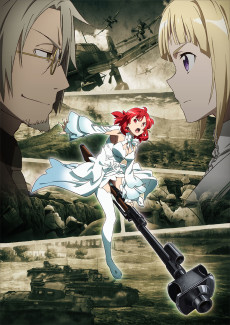
Izetta: The Last Witch
If I am promised to the princess, then I will fight for her sake.
In 1939 C.E., the imperialist nation of Germania invaded a neighboring country. All at once, that war spread throughout Europe, and the era was dragged into a spiral of a great war.
Then, in 1940, Germania's attack turned towards the Principality of Eylstadt, a small Alps country abundant with beautiful water and greenery.
(Source: Official Website)
📺Anime Details
📝Editorial Analysis
The wind whips across the snow-dusted alpine meadow just outside Eylstadt’s capital—cold, thin, carrying the metallic tang of distant gunfire—and Izetta stands motionless, barefoot in the frost, her breath a slow, steady plume. Her hand lifts. Not to cast, not yet—but to hold. To hold the weight of the princess’s hand in hers, to hold the silence before the dive-bombers scream overhead, to hold the unbearable fragility of a small country caught between gears of empire. That stillness isn’t calm. It’s tension, coiled like a spring beneath velvet.

What makes Izetta: The Last Witch ache so deeply isn’t its magic—it’s the way that magic is domesticated by duty. This isn’t sorcery as spectacle or power fantasy. It’s whispered oaths over tea, spells measured in breath and sacrifice, witchcraft folded into the starched collar of a military uniform and the worn leather of an aviator’s gloves. You feel the gravity of choice—not just who lives or dies, but what dignity survives when your homeland is drawn on a map as “strategic buffer” or “resource corridor.” The anachronism isn’t decorative; it’s emotional dissonance made visible—the whirr of biplanes against the hiss of steam-train diplomacy, the clink of teacups under artillery tremors. It makes you think about how love becomes strategy, how tenderness becomes resistance, how a single vow—“If I am promised to the princess, then I will fight for her sake”—can become the axis around which an entire war tilts.
That same emotional DNA hums in Assassin's Creed™: Director's Cut Edition, not because of parkour or hidden blades, but because of its political thriller spine and tactical warfare texture. The game’s description frames it as a redefinition of action—not through flash, but through consequence: every rooftop leap, every blade-strike, is embedded in layered factional maneuvering, where ideology wears chainmail and whispers in council chambers. A player review notes the dated models—but what lingers isn’t the graphics, it’s the weight of walking Jerusalem’s narrow alleys knowing each merchant, beggar, and guard is a node in a system you’re trying to dismantle from within. Like Izetta choosing not to obliterate Germania’s command center, but to intercept a single supply convoy—because victory here isn’t total annihilation, it’s preservation. Both ask: What do you protect when you can’t win? And what do you become while holding the line?
There’s also a quieter resonance with games that treat aviation not as speed, but as vulnerability. The anime’s biplanes aren’t sleek jets—they’re wood-and-canvas things that shudder in crosswinds, their cockpits open to rain and rifle fire. That tactile, almost fragile relationship with flight echoes in how Assassin's Creed™ handles movement: no auto-aim, no lock-on—just timing, positioning, reading angles and shadows like terrain. You don’t dominate space; you negotiate it. One player admits the textures are aged—but that roughness mirrors Eylstadt’s hand-stitched uniforms, its hand-drawn maps, its sense that everything precious is made, not manufactured. There’s reverence in the imperfection. In both, technology doesn’t erase human scale—it magnifies it.
This pairing sings to someone who keeps a notebook full of half-remembered lines from wartime letters, who pauses mid-game not to optimize a build, but to watch sunlight catch dust motes in a cathedral ruin, who feels the political not as policy but as the tremor in a diplomat’s voice when she signs a treaty she knows won’t hold. It’s for the viewer who watches Izetta kneel to mend a child’s torn coat after downing three fighters—and understands that act carries more weight than any explosion. For the player who spends ten minutes stalking a target not for the kill, but to hear him murmur his daughter’s name before the blade falls. These aren’t stories about winning wars. They’re about what remains unbroken in the hands of those who refuse to let go—even when the world is burning, even when the sky is full of engines, even when all they have is a promise, a prayer, and feet bare on frozen ground.
🎮2 Games That Match the Vibe
Match Dimensions Explained
❓Frequently Asked Questions
Why is Assassin's Creed: Director's Cut Edition listed as similar to Izetta: The Last Witch?
Because both lean hard into political thriller tension and tactical wartime stakes—like when Izetta single-handedly halts a tank column on the snowy battlefield of Eylstadt, Assassin’s Creed drops you into the gritty, morally gray espionage of the Third Crusade, where Altaïr’s stealth takedowns and intel-gathering mirror Izetta’s precision strikes against occupying forces. It’s not about magic vs. blades—it’s about lone operatives shaping war through skill, secrecy, and high-stakes choices.
Is there an anime or game adaptation of Izetta: The Last Witch?
No—there’s no official game adaptation of Izetta: The Last Witch (it remains an original anime-only property), and while fans have hoped for one, nothing exists beyond fan mods or doujin. That said, Assassin’s Creed: Director’s Cut Edition delivers that same grounded-yet-epic wartime atmosphere, with its focus on occupation resistance and quiet heroism—think Ezio’s early missions in Acre echoing Izetta’s defense of her homeland.
How does Assassin’s Creed: Director’s Cut Edition compare to Valkyria Chronicles in terms of wartime tone?
Valkyria Chronicles leans into hopeful, character-driven idealism—even amid war, it’s warm and colorful, with Welkin’s squad bantering over tea before deploying. Assassin’s Creed: Director’s Cut Edition is colder and more cynical: Altaïr operates in shadowy alleys, questioning authority and facing betrayal at every turn—much like Izetta’s isolation and the weight of being the *only* witch left. Both are tactical, but AC’s political thriller vibe hits closer to Izetta’s somber gravity.
What’s the best game like Izetta for someone who loves quiet, snow-covered battle scenes and solemn heroism?
Assassin’s Creed: Director’s Cut Edition nails that mood—especially sequences like Altaïr scaling snow-dusted ramparts of Jerusalem at dawn, moving silently past torchlit guards, just like Izetta standing alone on the frozen ridge overlooking the advancing Wehrmacht tanks. It’s not flashy magic, but it’s the same hushed intensity, moral weight, and tactile sense of place—plus that 64-score review even praises how the ‘dated’ textures somehow deepen the grit and realism.