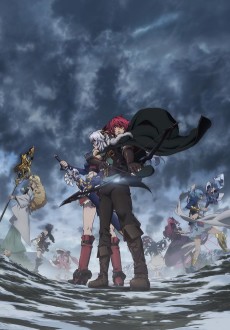
Lord Marksman and Vanadis
Tigrevurmud Vorn, the young lord of a remote region far from the kingdom's center, is commanded by the king to go fight the war against a neighboring country. The leader of the enemy is Eleonora Viltaria, one of the seven Vanadis given supernatural arms from a dragon.
The moment when an archer boy and the silver-haired beautiful war maiden meet, it is the beginning for the legend of a hero that will be told for generations to come.
(Source: Crunchyroll)
📺Anime Details
📝Editorial Analysis
The first arrow flies at dawn—cold light slicing across mist-shrouded hills as Tigrevurmud Vorn draws, releases, and watches the shaft thrum through still air—not toward a target, but away, fleeing the weight of a crown he never asked for. His fingers tremble, not from fear, but from the sheer, unmediated realness of consequence: one shot, one choice, and the ground beneath him shifts—not with magic, but with politics, loyalty, and the quiet, grinding friction of war fought by people who remember names, not just banners.

That’s the atmosphere: tactile medievalism. Not fantasy-as-escape, but fantasy-as-terrain—where armor chafes, arrows run low, and every alliance is measured in grain stores and wounded soldiers limping home. It’s the ache of responsibility settling into young shoulders, the way Eleonora’s silver hair catches firelight not as glamour, but as exhaustion—a Vanadis whose dragon-given power doesn’t erase fatigue, only delays its cost. This isn’t about destiny whispered by gods; it’s about logistics, diplomacy over dinner, and the hush before cavalry charges—where romance blooms not in moonlit gardens, but in shared silence during a rain-soaked watch shift. You feel the weight—of bows, of oaths, of land you must protect because no one else will.
That weight finds kinship in Assassin's Creed™: Director's Cut Edition. Its description calls it “next-gen… redefining the action genre”—but what lingers isn’t the parkour, it’s the texture: sun-baked stone under bare feet, the grit of sand in your mouth, the way Altaïr’s robes snag on crumbling archways. A player admits the models are “dated,” yet says “no issues with me”—because the feeling transcends polish: it’s the vertigo of standing atop the Dome of the Rock, surveying a city where every rooftop holds danger and every alley hides consequence. Like Tigre choosing which village to garrison first, Altaïr’s missions hinge on positioning, patience, and reading human movement—not just combat, but presence. Both make you feel like a strategist who breathes the same air as his soldiers.
Then there’s Disciples II: Gallean's Return, hailed by fans as “Best Disciples ever” for its “awesome atmosphere and gameplay.” Its compilation status—base game plus expansions—mirrors how Lord Marksman and Vanadis builds its world: layer by layer, faction by faction, each Vanadis’ territory a distinct biome of politics and peril. The player review doesn’t praise flash—it praises atmosphere. And that’s the resonance: the slow burn of campaign maps where fog lifts to reveal enemy encampments, where morale dips after losses, where magic feels less like spells and more like weather—unpredictable, costly, elemental. Eleonora’s dragon-imbued arm isn’t a cheat code; it’s a storm front. So is Gallean’s return: inevitable, devastating, woven into the land’s bones.
Even Dragon Age: Origins, despite its lower score, pulses with the same heartbeat. Its description asks: “What will be said about the hero who turned the tide?”—exactly the question hanging over Tigre’s arc. A player notes the “pause attack mechanic is amazing… help a lot to strategist your tactic.” That pause—the breath before the order, the moment Tigre calculates wind, distance, and the enemy commander’s blind spot—is where both live. It’s not about reflexes, but deliberation. When the Warden chooses who stands at their back in the Frostback Mountains, it echoes Tigre weighing which Vanadis to trust—not for power, but for honor, for the kind of loyalty that survives betrayal.
This pairing isn’t for fans of spectacle alone. It’s for the reader who traces battle lines in margin notes, the player who saves before every dialogue choice because words have weight, the one who feels a pang when a named soldier dies—not because they’re plot armor, but because they brought bread to their family last week. It’s for those who love the grit beneath the glory—the callus on Tigre’s finger, the rust on a knight’s greave, the way a dragon’s roar doesn’t just shake the screen, but makes your coffee cup vibrate on the table. These aren’t stories about winning. They’re about enduring, choosing, and carrying the bow—long after the last arrow’s flown.
🎮5 Games That Match the Vibe

Match Dimensions Explained
❓Frequently Asked Questions
Why is Assassin's Creed: Director's Cut Edition listed as similar to Lord Marksman and Vanadis?
Because both lean hard into tactical warfare with dark fantasy flavor—think Tigre’s archery precision mirrored in Altair’s methodical, pause-and-plan assassinations atop Jerusalem’s rooftops. The dim, politically charged worldbuilding and emphasis on battlefield positioning (not just button-mashing) make it a tonal and mechanical match, even if the setting swaps medieval Europe for a myth-tinged Levant.
Is there an anime or game adaptation of Lord Marksman and Vanadis?
No official game adaptation exists—but Disciples II: Gallean’s Return hits that same sweet spot: a brooding dark fantasy world where you command factions like the undead Legions or Light-aligned Paladins, much like Tigre rallying Vanadis-led armies across war-torn kingdoms. Fans often say it’s the closest *spiritual* game counterpart, especially with its grim atmosphere and turn-based tactical depth.
How does Dragon Age: Origins compare to Lord Marksman and Vanadis in terms of strategy and story?
Both hinge on morally gray choices shaping wartime alliances—like choosing whether to trust a rival noble (à la Ellen or Ludmira) while managing party tactics mid-battle. DA:O’s pause-and-attack system lets you queue precise commands (e.g., ‘have Alistair shield the mage while Morrigan hexes the archer’), echoing how Tigre exploits terrain and timing in Vanadis-led skirmishes—just with more dwarven banter and less bow-based flair.
What’s the best game like Lord Marksman and Vanadis if I want political intrigue + battlefield tactics without heavy RPG grinding?
Go straight to Pirates Vikings & Knights II—it’s surprisingly sharp tactically despite the chaos: reading enemy class synergies (e.g., countering Viking berserkers with Knight shields or Pirate grappling hooks) mirrors Tigre’s quick-thinking battlefield adaptations. It skips deep lore dumps and stat screens, delivering fast-paced, faction-driven warfare with the same ‘honor vs. survival’ stakes—just with way more yelling and ale.