
Mobile Suit Gundam: The Witch from Mercury Season 2
The second season of Mobile Suit Gundam: the Witch from Mercury.
A.S.122...
An era when a multitude of corporations have entered space and built a huge economic system. After transferring to the Asticassia School of Technology from the planet Mercury, Suletta Mercury has experienced a school life filled with encounters and excitement, as both Miorine Rembran's bridegroom and a member of GUND-ARM, Inc.
It has been two weeks since the incident at Plant Quetta. Suletta passes her days at the school, anticipating her reunion with Miorine. Miorine, meanwhile, has stationed herself at the head office of the Benerit Group, monitoring her father's condition. The two are about to face new hardships and pressing decisions. Each with her own feelings in her heart, the girls will confront the mighty curse the Gundam brings.
(Source: GUNDAM.INFO, edited)
📺Anime Details
📝Editorial Analysis
The hum of the Asticassia hangar at dusk—cool metal, ozone from freshly charged GUND-ARM capacitors, the low thrum of a Persephone’s standby systems vibrating up through Suletta’s boots as she stands alone, helmet cradled in one hand, the other resting on Miorine’s folded coat draped over a maintenance crate. No dialogue. Just the flicker of distant orbital traffic through the dome, and the weight of two weeks since Plant Quet—not as a countdown, but as a pressure, silent and compressing.
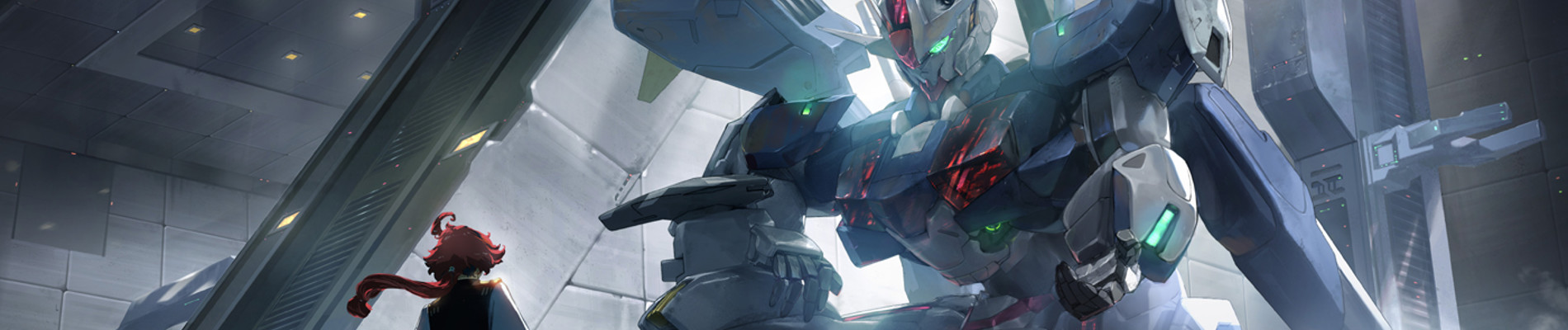
That’s the atmosphere: not dread, not fury—but anticipation with teeth. It’s the feeling of standing inside a calibrated system that’s already begun to tilt: corporate boardrooms masquerading as classrooms, wedding vows doubling as non-disclosure agreements, a school uniform stitched with surveillance-grade fiber optics. You don’t just watch Mobile Suit Gundam: The Witch from Mercury Season 2—you adjust your posture while watching it. Your shoulders tighten when a teacher’s smile lingers half a beat too long. You catch yourself parsing background chatter like encrypted comms. This isn’t sci-fi as spectacle; it’s sci-fi as architecture—every corridor, every contract clause, every shared glance between Suletta and Miorine built with load-bearing tension. It makes you think about consent as infrastructure, love as leverage, and how quietly power reshapes intimacy when it’s coded into the firmware of your world.
Which is why Team Fortress 2 resonates—not despite its absurdity, but because of it. Its description calls out “Nine distinct classes [with] a broad range of tactical abilities and personalities,” and that’s the key: each class performs a role so rigidly it becomes satire—Medic healing only to enable Übercharge, Spy feigning loyalty while planting sappers, Engineer building sentries that scan and judge. Like Asticassia’s social hierarchy, TF2’s balance isn’t neutral—it’s designed asymmetry, where identity, function, and trust are all pre-bundled, then weaponized. And that player review? “The community is gay, racist, sexist, gay, artistic, gay, furries, and love men.” That chaotic, contradictory, deeply human mess—where ideology, aesthetics, and desire collide in real time—mirrors the anime’s own refusal to sanitize its politics or its queerness. Both treat identity not as backstory, but as tactical terrain.
Then there’s Supreme Commander: Forged Alliance, whose description opens with “The last days of man are at hand… humanity’s hope for a brighter future is nothing but a bitter memory.” That phrase—bitter memory—lands like a gravitic pulse. Because Season 2 doesn’t frame its conflicts as fresh eruptions. Everything bleeds from history: Mercury’s colonial extraction, the Benerit Group’s legacy of erased labor, even Suletta’s own body, engineered and inherited. The game’s scale—“4 Playable factions on a huge scale”—mirrors how the anime refuses to localize stakes. A classroom debate isn’t just about grades; it’s a proxy for interplanetary resource allocation. A duel isn’t sport—it’s treaty enforcement. And that player review praising its endurance—“an amazing RTS game even for its age and still looks great in 2026”—echoes how Season 2 treats time itself: past atrocities aren’t resolved; they’re recompiled, running in the background of every new decision, every kiss, every activation sequence.
You’d love this pairing if you’ve ever paused mid-episode to Google “GUND-ARM patent law” or spent twenty minutes debating whether the Persephone’s cockpit HUD uses AR overlays or neural lace integration. If you feel more emotionally keyed into the silence between negotiations than the explosions after them. If you’ve cried over a character’s legal waiver—or laughed, bitterly, because you recognized the boilerplate. This isn’t for people who want mecha to punch harder. It’s for those who feel the weight of the paperwork signed before the first shot fires—who understand that the most devastating weapons in both The Witch from Mercury Season 2 and these games aren’t plasma blades or quantum cannons, but contracts, protocols, and the terrifying, beautiful fragility of choosing who to stand beside when the system is already rigged—and you’re holding the override.
🎮1 Games That Match the Vibe
Match Dimensions Explained
❓Frequently Asked Questions
Why does Team Fortress 2 keep coming up in 'Games Like Mobile Suit Gundam: The Witch from Mercury Season 2' lists?
Because TF2 nails the same chaotic, personality-driven mecha-and-military-sci-fi energy — think Suletta’s nervous piloting contrasted with Miorine’s sharp command presence, mirrored in how Scout’s hyper-speed or Heavy’s tank-like dominance create wildly different tactical vibes on the battlefield. Its constant updates (like new maps and hats) echo the show’s evolving mobile suit designs and faction rivalries, and reviewers even highlight its 'fun and chaotic' feel — just like the high-stakes duels in Asticassia’s arena.
Is there a Gundam: The Witch from Mercury Season 2 video game adaptation?
No — there’s no official game based directly on Season 2 (or any season) of *The Witch from Mercury*. Instead, fans turn to spiritually aligned titles like *Supreme Commander: Forged Alliance*, where you command massive mech-scale units across ruined Earth-like battlefields — very much like the show’s post-war Spacian tensions and the scale of the GUND-Format conflicts. Its '4 playable factions on a huge scale' matches the political fragmentation seen between Benerit Group, Ochs, and the Martian forces.
Team Fortress 2 vs Supreme Commander: Forged Alliance — which is more like Witch from Mercury’s tone?
TF2 leans into the show’s character-driven rivalry and snappy, almost theatrical combat — imagine Suletta vs. Eric’s duels translated into Scout vs. Spy chaos, complete with voice lines and over-the-top class personalities. *Supreme Commander*, meanwhile, mirrors the show’s weightier, strategic stakes: commanding legions across continent-sized maps feels like overseeing the GUND-Format arms race or the slow-burn escalation toward the 'GUND-Format Incident'. Both fit — but TF2 for vibe, SC:FA for scale and consequence.
What’s the best game like Witch from Mercury Season 2 if I want that tense, high-stakes academic-rivalry-meets-mecha-warfare mood?
Go straight to *Team Fortress 2* — its class-based, objective-driven modes (like Payload or Control Point) recreate that exact pressure-cooker dynamic: small teams clashing in tight arenas, where one misstep (like Suletta’s early cockpit panic) can swing the match, and every character has a distinct voice and role — just like Asticassia’s student pilots. Reviewers call it 'fun and chaotic', and the community’s wild, expressive energy (hats, taunts, coordinated pushes) channels the show’s blend of intense competition and found-family camaraderie.