
My Roommate is a Cat
Mystery writer Mikazuki Subaru, who isn't good at dealing with people, finds them to be a disturbance when it comes to building his imaginary world. One day, he chances upon a stray cat and feels inspiration strike, so he brings the cat home as his muse.
Can watching the inexplicable behaviors of a cat form material for a novel?
📺Anime Details
📝Editorial Analysis
The quiet thump of a small body landing on warm paper—Subaru’s manuscript, half-covered in ink-stained coffee rings—then the slow, deliberate kneading of paws into the page, as if editing the prose with velvet pressure. That moment isn’t about plot or punchline. It’s the first time Subaru doesn’t flinch when something living chooses to exist on his boundary, not beyond it. His breath hitches—not in panic, but in startled recognition: this is real, and it’s happening here, in the silence he’d armored himself with.
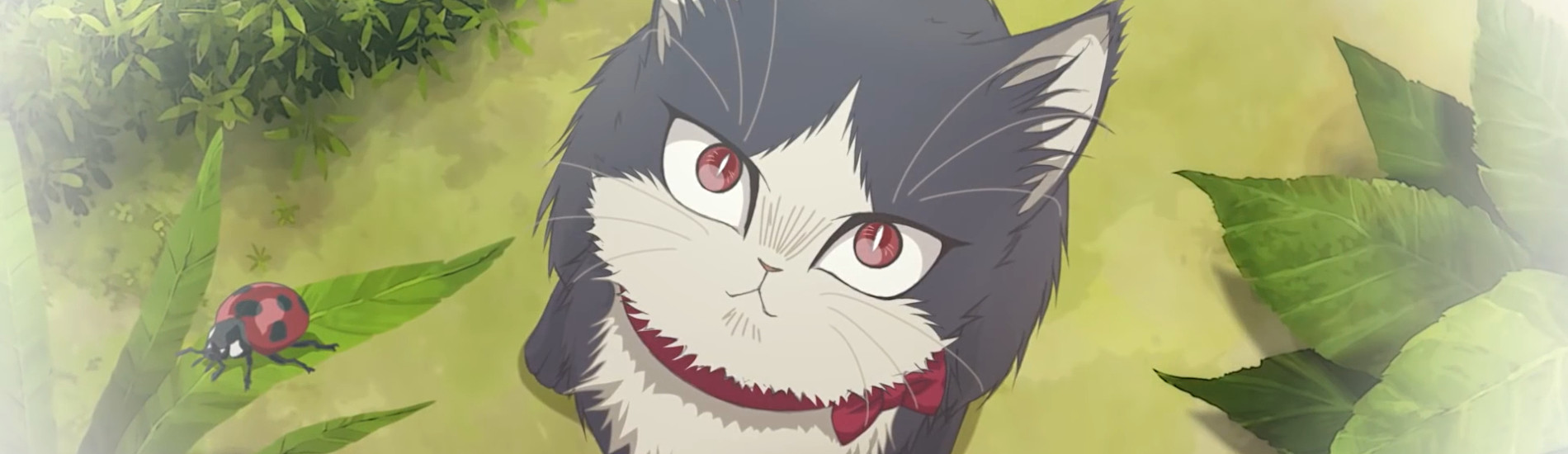
What makes My Roommate is a Cat breathe like no other slice-of-life is how it treats stillness as narrative weight. Not emptiness. Not stagnation. But presence: the weight of a cat’s stare held just a beat too long, the way Subaru’s fingers pause mid-typing when whiskers brush his wrist, the unspoken negotiation of shared space between two beings who speak entirely different languages. It’s healing that doesn’t shout—it accumulates in the rustle of a tail flicking near a sunbeam, in the gradual softening of Subaru’s shoulders as he stops writing about isolation and starts noticing within it. You don’t watch it to escape life—you watch it to remember how deeply ordinary moments can anchor you, how tenderness can be a verb practiced in silence, over weeks, over litter boxes, over drafts rewritten because a cat sat on the keyboard.
That same emotional DNA hums in Chains, where the physics-driven bubble-linking isn’t about speed or score—it’s about rhythm, about the gentle satisfaction of aligning color with intention, then watching clusters dissolve with soft, resonant pops. The player review nails it: “Reminds me of connect 4 in nutshell”—a game where victory isn’t conquest, but completion, a quiet cascade of alignment. Like Subaru learning to read the cat’s slow blink as trust, not indifference, Chains asks you to find meaning in micro-patterns, to feel the calm certainty of cause-and-effect in a world that usually feels chaotic. Its healing isn’t medicinal—it’s textural, built from the tactile pleasure of touch, the visual sigh of bubbles vanishing in sequence, the same way Subaru finds focus not by forcing words, but by watching fur ripple as the cat stretches across his lap.
There’s also the unspoken kinship with games that treat slowness as sacred architecture—not as filler, but as foundation. Chains’ “Healing & Slow Life” dimension isn’t a tagline; it’s the game’s pulse. Just as Subaru’s rehabilitation isn’t measured in grand declarations but in him leaving the apartment once to buy tuna, then twice, then without rehearsing the route in his head, the game’s progression feels earned in tiny, non-linear increments. You don’t “beat” a level—you settle into it, adjust your hand position, wait for the perfect chain to emerge from the gentle drift of bubbles. That patience mirrors Subaru’s own: the way he stops correcting the cat’s “wrong” behavior (knocking pens off desks, sleeping on rejection letters) and begins seeing each act as its own kind of grammar—illogical, vital, alive. The emotional resonance isn’t in the match-3 mechanics themselves, but in how the game holds space for your attention without demanding urgency—exactly how the anime holds space for Subaru’s quiet reawakening.
This pairing sings to the person who’s ever felt relief in the weight of a sleeping cat on their chest at 3 a.m., who’s stared at a blinking cursor until the light outside shifted from blue to gold, who measures progress not in milestones but in softened edges. It’s for the writer who keeps notebooks full of half-sentences and cat doodles in the margins. For the player who closes a game not because they “won,” but because their breathing slowed, their jaw unclenched, and they remembered—just for a minute—that being here is enough. Not fixed. Not finished. Just present, like sunlight pooling on tatami, like a purr vibrating through bone, like a chain of three bubbles dissolving into quiet light.
🎮2 Games That Match the Vibe

Match Dimensions Explained
❓Frequently Asked Questions
Why does Chains keep coming up in 'Games Like My Roommate is a Cat' lists?
Because Chains nails the same healing, slow-life vibe — think quiet mornings spent solving gentle puzzles while your cat naps nearby. Its soothing bubble-chaining mechanic and emotionally resonant narrative (scored 84 for Healing & Slow Life) mirror the cozy, low-stakes warmth of My Roommate is a Cat, especially scenes where you care for a silent but expressive companion without pressure or time limits.
Is there an anime or visual novel adaptation of Chains?
No — Chains is purely a match-3 arcade game with no anime or visual novel adaptation. Unlike My Roommate is a Cat (which *has* both an anime and manga), Chains stays focused on its physics-driven bubble-linking gameplay and emotional storytelling through minimalist UI and ambient progression — no voice acting, no branching dialogue, just calm, tactile puzzle-solving.
Chains vs. My Roommate is a Cat: which is better for unwinding after work?
If you want zero-pressure downtime, Chains wins — it’s literally designed for that: link 3+ same-color bubbles, watch them pop with soft feedback, and drift through stages at your own pace (player review calls it 'connect 4 in a nutshell'). My Roommate is a Cat has more narrative structure and character interaction, while Chains delivers pure, portable slow-life healing with no reading fatigue or decision fatigue.
What if I love the quiet companionship in My Roommate is a Cat but hate reading long text?
Then Chains is your perfect match — it conveys warmth and emotional resonance without a single line of dialogue or exposition. You ‘care’ for the experience through rhythm, color, and satisfying chain reactions (like watching your cat bat at a floating bubble), all within its healing/slow-life framework. No text walls, no choices — just presence, physics, and gentle progression.