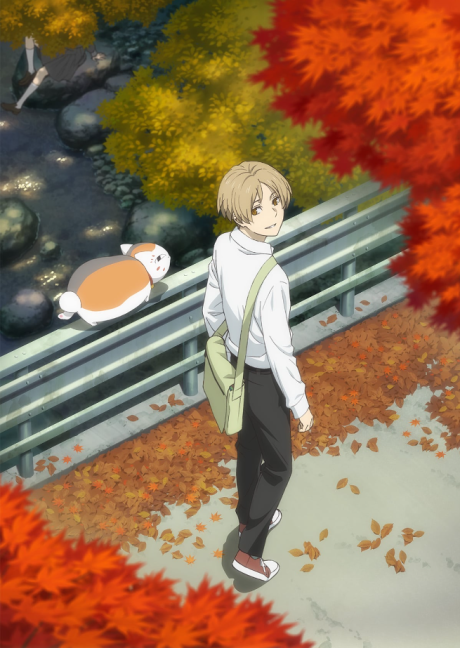
Natsume's Book of Friends Season 7
The seventh season of Natsume Yuujinchou.
📺Anime Details
📝Editorial Analysis
Rain falls on the old shrine gate—soft, steady, unurgent—as Natsume sits cross-legged on the worn wooden step, a cup of tea steaming faintly in his hands. A stray youkai, translucent and trembling like mist caught in light, hovers just beyond the eaves. Natsume doesn’t reach for the Book of Friends. He simply watches. Then, quietly, he slides the cup forward, just past the threshold. The youkai blinks. Doesn’t drink. But stays. And for three breaths—long enough for rain to bead on its shoulders and slide down like slow tears—the space between them holds no contract, no debt, no name to reclaim. Just presence. Just enough.

That’s the quiet gravity of Natsume's Book of Friends Season 7: not the thrill of revelation or the weight of destiny, but the profound relief of continuity. It’s the feeling of walking the same forest path for the seventh spring and recognizing how the light slants differently through the new leaves—not because anything dramatic changed, but because you did, quietly, without fanfare. This isn’t urban fantasy as spectacle; it’s urban fantasy as weather—a gentle, persistent atmosphere where healing isn’t a destination but the act of breathing in rhythm with someone else’s silence. It asks you to notice the warmth of a borrowed sweater, the way Tanaka’s gruff voice softens when he forgets Natsume is listening, the exact shade of green where the rice paddies meet the hills at dusk. There’s no rush to resolve. No villain to defeat. Just the deep, resonant hum of found family holding space—not fixing, not saving, just being there, season after season, like soil holding roots.
That emotional DNA pulses strongest in Stardew Valley. Its description says you inherit your grandfather’s old farm plot—not a legacy of power or prophecy, but of quiet stewardship. You begin with hand-me-down tools and a few coins: modest means, modest hopes. And the player review nails it: “Spent the first 2 years trying to do everything and never having enough time.” That frantic early scramble? It’s the inverse mirror of Natsume’s calm—it’s what happens before you learn to let go of urgency, before you realize healing isn’t measured in tasks completed but in mornings spent watching Willy mend nets by the dock, or in learning exactly when Leah waters her herbs at dawn. Both ask you to trade efficiency for attention—to feel the weight of a watering can, the texture of paper in a notebook, the pause before a youkai speaks.
Chains, too, carries that hush. Its description calls it “a relaxing arcade match 3 casual game” built on linking bubbles—a physics-driven, tactile rhythm of connection. No story, no characters—but the player review reveals its soul: “Reminds me of connect 4 in nutshell… link 3 or more of the same color and clear enough till you can proceed.” That repetition—calm, patterned, forgiving—is pure iyashikei. Like Natsume tracing the ink of a forgotten name in the Book, or folding origami with Shigeru under the veranda, Chains offers micro-rituals where meaning lives in the act, not the outcome. There’s no penalty for slowness. No timer screaming. Just the soft pop of alignment—and the quiet satisfaction of making something cohere, one gentle link at a time.
Even Persona 5 Royal, with its slick Tokyo neon and Phantom Thieves theatrics, shares a quieter thread: its emotional narrative dimension and Romance & Shoujo tag align with Natsume’s core truth—that intimacy is forged in the mundane. The player review praises “the seamless transition between daily life” and the soundtrack’s emotional swell. That duality—school bell to midnight confrontation, bento box to burning resolve—is echoed in Natsume’s own rhythm: helping Natori with paperwork by day, then stepping into moonlit woods where names hold weight like stones. Both understand that love isn’t only confessed in grand gestures—it’s in Ann’s careful lunch packing, in Futaba’s hesitant smile after a shared walk home, in Natsume’s hand resting, unthinking, on Nyanko’s head as they watch fireflies rise.
This pairing sings for the person who cries at grocery lists written in a loved one’s handwriting—who saves train tickets, replays voicemails from grandparents, who feels grief and gratitude in the same breath. For the one who finds holiness in laundry folded just so, who understands that healing isn’t loud, and belonging isn’t earned—it’s offered, again and again, like tea left just past the threshold, steaming softly in the rain.
🎮4 Games That Match the Vibe



Match Dimensions Explained
❓Frequently Asked Questions
Why does Stardew Valley keep coming up when I search for games like Natsume's Book of Friends Season 7?
Because both lean hard into quiet healing and slow-life intimacy—think Natsume tending to injured youkai in the forest shrine, or you watering crops at dawn while villagers like Maru or Sebastian slowly open up over shared meals and seasonal festivals. Stardew’s low-stakes daily rhythm, layered romance options (like the gentle, shoujo-tinged bond with Emily or Sebastian), and emphasis on found family mirror the emotional texture of Season 7’s quieter moments with Tanuma and the stray spirits.
Is there a mobile game adaptation of Natsume's Book of Friends Season 7?
No official mobile adaptation exists—but Chains captures that same soothing, contemplative energy: its bubble-linking mechanic feels like quietly arranging talismans or weaving protective wards, with soft colors and unhurried pacing. Players describe it as 'connect 4 in a nutshell', which fits how Season 7 lingers on small, meaningful gestures—like Natsume carefully tying a ribbon around a lost spirit’s wrist—rather than big action set pieces.
Stardew Valley vs. Persona 5 Royal—which is more like Natsume’s Book of Friends Season 7?
Stardew Valley wins hands-down for vibe match: both center on gentle healing, slow-burn trust, and community belonging—not flashy heists or high-stakes rebellion. While Persona 5 Royal has strong shoujo-adjacent romance (e.g., Ann’s arc) and emotional depth, its urban intensity and combat focus clash with Season 7’s hushed forest walks and tea-sharing scenes. Stardew’s 84-score in Healing & Slow Life vs. P5R’s 58 there says it all.
What’s the best game like Natsume’s Book of Friends Season 7 if I just want to feel calm and emotionally safe?
Chains is your go-to—it’s literally built for calm: no timers, no penalties, just linking soft-colored bubbles while ambient music plays, echoing how Season 7 lets you sit with Natsume and Nyanko on the porch, watching clouds drift. One player said it ‘reminds me of connect 4 in a nutshell’, which nails the low-pressure, meditative flow—exactly like rewatching Natsume’s quiet afternoons restoring balance, not drama.