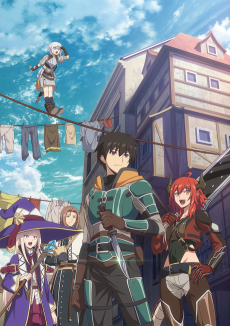
Ningen Fushin: Adventurers Who Don’t Believe in Humanity Will Save the World
📺Anime Details
📝Editorial Analysis
The tavern’s hearth flickers low—just enough to catch the glint of a half-empty dice cup, the worn edge of a gambler’s sleeve, the quiet exhaustion in Ren’s eyes as he watches an elf trace constellations on a damp tabletop with her fingertip. No fanfare. No grand speech. Just smoke curling toward rafters blackened by decades, and the weight of a vow spoken not in firelight but in the silence after it. That’s where Ningen Fushin lives—not in the roar of battle or the glitter of magic, but in the hollows between choices: the pause before a bet, the breath held mid-revenge, the way a monster girl’s laugh sounds both ancient and unbearably young.
What makes this anime ache like old leather and cold iron isn’t its fantasy scaffolding—it’s the melancholy precision of its worldbuilding. Every anachronism feels deliberate: a steam-powered lathe beside elven runes, a gambling den where stakes include memory and mercy, not just coin. The ensemble cast doesn’t bond—they orbit, collide, recalibrate. There’s no “found family” montage; there’s shared trauma parsed over ale and arithmetic. You don’t feel uplifted—you feel recognized, like someone finally named the quiet dread of surviving when you’ve stopped believing people are worth saving. It’s weary, yes—but also resolute, unflinching, tender in ways that sneak up on you, like the way Ren counts his coins not for greed, but to measure how much trust he can still afford.
That same emotional architecture pulses through Into the Breach. Its player reviews call it “a JRPG narrative told through grid-based sacrifice”—and that’s exactly what Ningen Fushin does with its episodic structure: each mission is a tight, consequential puzzle where one misstep unravels three lives, and every victory leaves scars no healing spell can erase. Like Ren weighing whether to save a village or expose a corrupt guild, Into the Breach forces you to choose which building to shield, which civilian to abandon—not because you’re heartless, but because you’re calculating the cost of care in a broken system. Both demand moral arithmetic, not moral certainty.
Then there’s Stray Path, tagged with JRPG Narrative and Melancholic Exploration. Real players describe its tone as “walking through ruins where every door opens onto a different kind of grief.” That’s the elf’s library scene—not the lore, but the dust motes catching light as she reads aloud from a crumbling treaty no one remembers signing. Stray Path’s world doesn’t explain itself; it lets silence speak first. So does Ningen Fushin: its magic isn’t flashy—it’s frayed, bureaucratic, sometimes cruelly efficient. Its monster girls aren’t tropes—they’re survivors who’ve learned to wear charm like armor, and their vulnerability lands because the show refuses to soften the edges of their weariness. You explore both worlds not for loot, but for context: why this ruin? Who failed whom? What promise was buried here?
And ELDEN RING NIGHTREIGN—not the spectacle, but the melancholic exploration dimension, the one where players write in forums about “wandering for hours just to find a single unbroken teacup in a collapsed chapel.” That’s the anime’s third-act detour into the abandoned observatory: no boss fight, no exposition dump—just Ren adjusting a cracked lens, watching stars blur through glass warped by time, while a former assassin sits cross-legged nearby, sharpening a knife she hasn’t used in months. No dialogue needed. The weight is in the stillness. The resonance isn’t in scale—it’s in how both works treat desolation as a language, and solitude as a form of communion.
This pairing isn’t for fans of “epic” or “hopeful.” It’s for the ones who replay Slay the Spire not to win, but to sit with the rhythm of loss—the way a single bad draw echoes like a betrayal—and then rewatch Ningen Fushin’s gambling arc, where Ren loses everything except his ability to read a tell in someone’s knuckles. It’s for players who linger in Space Simulation Toolkit’s void not for discovery, but for the quiet gravity of drifting past derelict stations whose logs end mid-sentence. They’re drawn to stories where redemption isn’t a destination—it’s a decision made in the dark, with imperfect tools, and the only proof it mattered is that you kept breathing afterward.
🎮27 Games That Match the Vibe























Match Dimensions Explained
❓Frequently Asked Questions
Why does Into the Breach feel like the closest match to Ningen Fushin’s tone despite being a tactical roguelike?
Because both hinge on weary, morally ambiguous protagonists making grim choices under crushing pressure—like Captain Vellum’s quiet resignation in Into the Breach mirrors Kaito’s cynical pragmatism in Ningen Fushin, especially during those tense, turn-based city-defense sequences where saving civilians feels futile but necessary. The JRPG Narrative dimension shines through its sparse, impactful dialogue and world-building via environmental storytelling, just like Ningen Fushin’s tavern conversations that slowly peel back layers of distrust.
Is there an anime or manga adaptation of Ningen Fushin that explains why games like Stray Path capture its vibe so well?
No official anime or manga exists yet—but Stray Path nails the same melancholic exploration and narrative weight precisely because it drops you as Ren, a disillusioned ex-adventurer wandering rain-slicked ruins and abandoned shrines, uncovering fragmented logs about fallen guilds (like the 'Crimson Oath' arc) that echo Ningen Fushin’s themes of broken faith and reluctant heroism. Its JRPG Narrative + Melancholic Exploration combo makes every fog-draped cave feel like a character in itself.
How is ELDEN RING NIGHTREIGN different from Slay the Spire when both are matches for Ningen Fushin?
Slay the Spire leans into sharp, systemic irony—like Silas’s sarcastic card descriptions mocking heroic tropes—mirroring Ningen Fushin’s dark humor and meta-commentary on adventuring clichés, while ELDEN RING NIGHTREIGN drowns you in oppressive silence and decaying grandeur (think the Ashen Cathedral boss fight), matching Ningen Fushin’s heavier, more existential despair. Both hit 85 on Roguelike & Dungeon, but NIGHTREIGN trades Slay’s punchy pacing for slow-burn dread and environmental storytelling.
What’s the best game like Ningen Fushin if I want that ‘quiet, exhausted hope’ feeling after finishing the main quest?
Stray Path—it’s the only match with both JRPG Narrative *and* Melancholic Exploration, and its post-game ‘Wanderer’s Epilogue’ lets you walk endless coastlines at dusk, listening to ambient wind and distant chimes while reviewing journal entries from NPCs who’ve moved on without you. That bittersweet, low-stakes closure—like Kaito watching the sunrise alone after the final battle—is unmatched by Into the Breach’s urgent time loops or Slay the Spire’s escalating stakes.