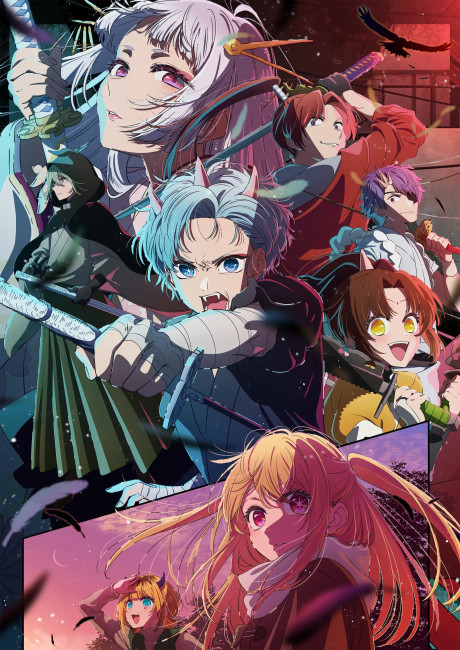
Oshi no Ko Season 2
The second season of [Oshi no Ko].
Aqua’s desire for revenge takes center stage as he navigates the dark underbelly of the entertainment world alongside his twin sister, Ruby. While Ruby follows in their slain mother’s footsteps to become an idol, Aqua joins a famous theater troupe in hopes of uncovering clues to the identity of his father — the man who arranged their mother’s untimely death, and the man who once starred in the same troupe Aqua hopes to infiltrate.
(Source: HIDIVE)
📺Anime Details
📝Editorial Analysis
The silence after Aqua’s first bow on stage—not the applause, not the lights, but the silence—that’s where Oshi no Ko Season 2 lives. It’s the hush that follows a line delivered with perfect control, yet vibrating with something unsaid: grief sharpened into precision, love folded into calculation, a twin’s breath held just a half-beat too long beside him. You feel it in your molars. That silence isn’t emptiness—it’s pressure building behind glass.

What makes this season ache so distinctly isn’t its reincarnation premise or idol backdrop—it’s how intimately it weaponizes performance as emotional containment. Aqua doesn’t emote; he stages emotion, rehearsing sorrow like choreography, calibrating rage like lighting cues. Ruby sings under spotlights while her voice cracks—not from strain, but from the sheer weight of carrying their mother’s ghost as repertoire. This isn’t melodrama. It’s psychological claustrophobia dressed in sequins and velvet curtains. You don’t watch it—you audit it. Every smile is a ledger entry. Every tear is forensically examined for motive. The entertainment industry isn’t a setting here; it’s a mirror, warped and reflective, showing how trauma calcifies into craft, how love curdles into strategy, how vengeance wears the mask of discipline.
That same suffocating, morally granular tension lives in Prince of Persia—not the sand-swept spectacle, but the reboot described as “a new prince, new lands and a brand new story completely separate” from past iterations. Like Aqua shedding his childhood self to infiltrate the theater troupe, this Prince abandons legacy to build identity from scratch—no inherited crown, no pre-written heroism, just raw, untested will against a world that rewards deception. The player review calls it “the 3rd reboot,” emphasizing rupture over continuity—exactly how Aqua severs himself from innocence, adopting method acting as survival. Both reject nostalgic comfort; both force their protagonists to perform competence while hollowed out inside. The darkness isn’t in monsters—it’s in the quiet realization that the most dangerous role you’ll ever play is yourself, rewritten.
Then there’s Mass Effect (2007)—specifically that game, not the trilogy. The review insists: “None of the follow-ups really captured what this game did.” That specificity mirrors Oshi no Ko Season 2’s laser focus on one fracture point: the father’s identity. Not world-ending stakes, not galactic politics—but the devastating intimacy of a single unanswered question echoing across years. Commander Shepard’s early missions aren’t about saving civilizations; they’re about assembling fragments—data logs, witness accounts, half-remembered transmissions—to reconstruct a truth buried under layers of institutional silence. Just as Aqua pores over archival footage of his father’s old performances, cross-referencing gestures, vocal tics, timing—Shepard parses dialogue trees not for romance options, but for tells. Both are forensic narratives where every interaction is evidence, every ally a potential leak, every moment of tenderness a risk to the mission. The “Adult & Dark Seinen” dimension isn’t tone—it’s structure: choices that calcify, relationships that harden into liabilities, revelations that don’t liberate but constrain.
Who lives for this? The person who watches Ruby’s idol audition and feels their throat tighten—not at her talent, but at the terrifying effort of her joy, how brightly she must shine to keep the shadows at bay. The one who replays a Mass Effect conversation not to optimize Paragon points, but to hear how Shepard’s voice drops half a register when lying to Liara. The one who pauses Prince of Persia mid-parkour, not to admire the animation, but to study how the Prince’s breathing changes when he’s alone in a ruined chamber—how stillness becomes its own kind of violence. They don’t crave escapism. They crave recognition: the shiver when fiction names the exact weight of a secret you’ve carried too long, the relief of seeing grief rendered not as collapse, but as craft, as rigor, as something you can—just barely—hold in your hands and examine, like a shard of broken mirror reflecting back not who you were, but who you’ve become in the breaking.
🎮4 Games That Match the Vibe


Match Dimensions Explained
❓Frequently Asked Questions
Why does Prince of Persia keep coming up in Oshi no Ko Season 2 discussions?
Because both lean hard into that bittersweet, emotionally charged romance-and-tragedy vibe — like when Aquamarine collapses backstage after her 'Mikazuki' performance, it hits with the same visceral weight as the Prince’s desperate time-reversal gambits to save Elika. The game’s Adult & Dark Seinen dimension and its Shoujo-tinged emotional intimacy (especially in quiet, character-driven cutscenes) mirror how Season 2 balances idol glamour with psychological depth.
Is there a Mass Effect anime or visual novel adaptation inspired by Oshi no Ko Season 2?
No — Mass Effect (2007) isn’t adapted from Oshi no Ko, nor vice versa. But fans keep linking them because Commander Shepard’s morally gray choices and squad-bonding moments (like the quiet, rain-soaked conversation with Liara on the Citadel) echo Ai’s layered relationships and the show’s Emotional Narrative focus — both prioritize character weight over plot convenience.
Prince of Persia vs Mass Effect (2007): which one captures Oshi no Ko Season 2’s tone better?
Prince of Persia edges it out for tone — its melancholy grandeur, romantic tension between the Prince and Elika, and those haunting, slow-motion platforming sequences (like falling through crumbling ruins) mirror Season 2’s aesthetic pacing and emotional gravity. Mass Effect (2007) nails the emotional stakes and adult themes too, but its galactic scale and action emphasis feel less intimate than Aquamarine’s backstage solitude or Ruby’s quiet resolve.
What’s the best game like Oshi no Ko Season 2 if I want that ‘quiet, heavy, emotionally raw’ feeling?
Go straight to Prince of Persia — especially the desert temple sequences where the Prince walks alone amid shattered pillars, lit only by dying light. That hushed, reverent sorrow matches scenes like Ruby staring at her mother’s old photo in the empty apartment. Its 74 Metacritic score reflects how well it lands that exact blend of Romance & Shoujo tenderness and Adult & Dark Seinen weight — no filler, just feeling.