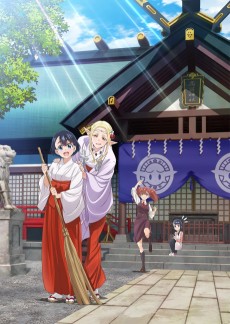
Otaku Elf
Takamimi Shrine has an unusual resident – Elda, an ancient elf who’s obsessed with video games! The shrine’s teenage attendant, Koito Koganei, keeps this reclusive otaku well supplied with energy drinks and junk food. Even though she loves 100%-ing her games, Elda has duties to attend to, and Koganei is bound and determined to make this otaku elf fulfill them! It’ll just take an offering or two to bribe—um, we mean convince Elda to put down her new game…
(Source: HIDIVE)
📺Anime Details
📝Editorial Analysis
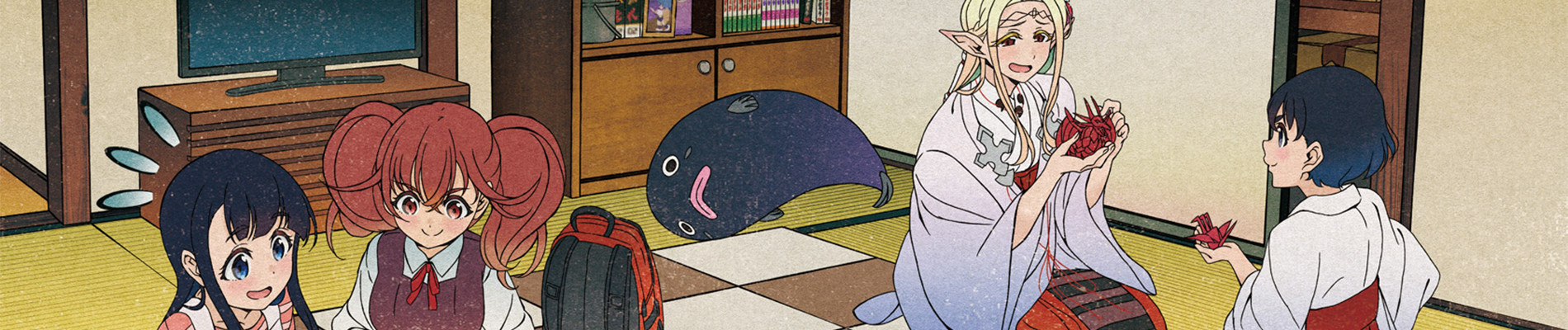
The glow of Elda’s monitor pulses like a shrine lantern at midnight—soft, insistent, warm. Her fingers hover over the controller, paused mid-boss fight, while outside the shrine gate, cherry blossoms drift silently onto the mossy stones. Koito stands just beyond the threshold, holding two cans of melon soda and a half-eaten bag of shrimp chips—not as offerings to a deity, but as bribes to an elf who’d rather 100% a JRPG than sweep the torii. That quiet tension—between sacred duty and compulsive play, between stillness and pixelated motion—is where Otaku Elf lives.
This isn’t just slice-of-life; it’s still-life with heartbeat. The anime doesn’t rush. It lingers on the crinkle of a chip bag, the hum of a cooling laptop fan, the way Elda’s ears twitch when Koito says “DLC” like it’s a sacred chant. There’s no grand apocalypse, no romantic confession arc—just the profound, tender weight of showing up for someone whose world is rendered in polygons and power-ups. It makes you feel the relief of being understood without explanation, the softness of belonging in a space where your obsessions aren’t quirks to fix—but rhythms to sync with. It asks: What if devotion looks less like prayer beads and more like save-scumming? What if healing isn’t about fixing, but keeping the light on—for someone who only emerges when the game saves?
That emotional DNA thrums strongest in Prince of Persia, whose description names Healing & Slow Life and Melancholic Exploration as core dimensions. Not action-first, not lore-dense—it’s the pace that resonates: the Prince moving through sun-drenched ruins not to conquer, but to relearn time, breath, gravity. Like Elda navigating shrine rituals with the same cautious curiosity she brings to a new control scheme, the game treats movement as meditation. A player review notes it’s “a new prince, new lands and a brand new story completely separate from the sands”—and that deliberate fresh start, untethered from legacy or expectation, mirrors how Otaku Elf treats Elda: not as a relic of myth, but as a person discovering her own rhythm in real time. Both invite you into a world where melancholy isn’t despair—it’s the quiet hum beneath joy, the space where growth happens between cutscenes.
Then there’s the unspoken kinship with games that honor ritual as rhythm: the daily grind of shrine upkeep mirroring the gentle repetition of farming sims or crafting loops—not as drudgery, but as grounding. But among the matches given, Prince of Persia stands apart because its melancholic exploration mirrors Elda’s own quiet navigation—not of deserts, but of human expectation. She doesn’t rebel against duty; she negotiates it, one energy drink at a time. Like the Prince tracing forgotten corridors, she moves through obligation with the same focused calm she brings to a puzzle room—not escaping, but reclaiming agency within structure.
Who would love this pairing? Not just fans of elves or otaku tropes—but people who’ve ever hidden behind a screen not to disappear, but to breathe. The viewer who finds peace in Koito’s unwavering patience—the one who sees Elda’s gaming not as escapism, but as translation: her way of parsing awe, consequence, and connection. The player who pauses mid-jump in Prince of Persia, not to retry, but to watch dust motes swirl in a sunbeam—and feels, suddenly, held. These are stories for those who know healing isn’t always loud. Sometimes it’s the shared silence after a boss falls. Sometimes it’s two girls eating snacks on temple steps, watching the sky turn violet, while a controller rests, warm and idle, in one hand. Safe. Seen. Slow.
🎮5 Games That Match the Vibe




Match Dimensions Explained
❓Frequently Asked Questions
Why is Prince of Persia listed as similar to Otaku Elf?
Because both lean hard into melancholic exploration and quiet, healing moments—like Otaku Elf’s late-night ramen shop scenes or tending to injured spirits, Prince of Persia has those same hushed, reflective stretches: walking through crumbling sun-dappled ruins, rewinding time after a fall not just for gameplay, but to linger in the stillness before consequence. The 2024 reboot’s emphasis on slow life (tending gardens, restoring shrines) mirrors Otaku Elf’s rhythm of care over combat.
Is there an anime or manga adaptation of Otaku Elf?
No—Otaku Elf is an original indie game with no official anime, manga, or light novel adaptations yet. That said, fans often compare its cozy-yet-wistful tone to series like *Mushishi* or *Flying Witch*, which makes sense why Prince of Persia (85 score, 'Melancholic Exploration' vibe) shows up in 'games like' lists—it fills that same emotional niche without needing licensed media.
How does Prince of Persia compare to Spirit Island in terms of vibe?
Spirit Island is all about frantic, high-stakes elemental defense—shouting invocations, burning blights, coordinating with other spirits—while Prince of Persia is the opposite: solitary, deliberate, and grounded in physical movement and quiet consequence. If Otaku Elf feels like sipping matcha while watching cherry blossoms fall, Spirit Island is a thunderstorm; Prince of Persia? That same gentle rain, but with sandstone arches and a rewindable heartbeat.
What’s the best game like Otaku Elf if I want something soothing but with light adventure?
Prince of Persia (2024) is spot-on—it’s got healing mechanics (restoring ancient shrines), slow-life pacing (gardening, journaling, talking to villagers like Zara or the Archivist), and zero forced combat escalation. Unlike heavier titles on the list, it matches Otaku Elf’s core mood: tender melancholy with purpose, like helping a wounded falcon recover or walking silent corridors where light pools like tea in a cup.