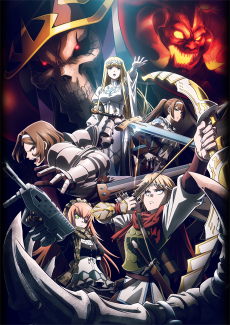
OVERLORD: The Sacred Kingdom
Theatrical follow-up to Overlord IV. The film will cover the "Holy Kingdom" arc.
After twelve years of playing his favorite MMORPG game, Momonga logs in for the last time only to find himself transported into its world playing it indefinitely. Throughout his adventures, his avatar ascends to the title of Sorcerer King Ains Ooal Gown.
Once prosperous but now on the brink of ruin, The Sacred Kingdom enjoyed years of peace after construction of an enormous wall protecting them from neighboring invasions. But, one day this comes to an end when the Demon Emperor Jaldabaoth arrives with an army of villainous demi-humans.
Fearing invasion of their own lands, the neighboring territory of the Slane Theocracy is forced to beg their enemies at the Sorcerer Kingdom for help. Heeding the call, Momonga, now known as the Sorcerer King Ains Ooal Gown, rallies the Sorcerer Kingdom and its undead army to join the fight alongside the Sacred Kingdom and the Slane Theocracy in hopes to defeat the Demon Emperor.
(Source: Crunchyroll, edited)
📺Anime Details
📝Editorial Analysis
The first time the camera lingers on the Sacred Kingdom’s wall—not as a symbol of strength, but as a cracked, moss-choked spine sagging under decades of deferred maintenance—you feel it in your ribs. Not dread, not awe, but exhaustion. The kind that settles after reading a royal decree written in fading ink, signed by a queen whose advisors have already begun whispering about succession while her archers train with blunted arrows and half-rations. This isn’t the gleaming fantasy of conquest—it’s the slow, grinding weight of institutional decay, where magic doesn’t dazzle; it calcifies into bureaucracy, and war isn’t declared—it leaks through border patrols, grain shortages, and the hollow echo of a cathedral bell rung for a funeral no one can afford to attend.

What makes OVERLORD: The Sacred Kingdom vibrate with such unsettling specificity is how it weaponizes bureaucratic melancholy. It’s not just politics—it’s the emotional residue of systems that outlive their purpose: the way a noblewoman’s ceremonial bow hides trembling hands, how a demon envoy’s polite smile doesn’t quite reach eyes that have seen three generations of human treaties dissolve like salt in rain. You don’t root for victory here—you track the fracture points: a tax ledger left open on a desk, a child sketching Ainz Ooal Gown’s sigil in charcoal on a crumbling chapel wall, the quiet click of an arrow nocked not in defiance, but in resignation. This is fantasy stripped of heroic velocity—replaced with gravity, fatigue, and the chilling intimacy of collapse witnessed from inside the rotting rafters.
That same gravity pulses through Act of War: Direct Action, not in its flashy “tomorrow’s war” premise, but in its real-time strategy bones—where every supply line is a fraying nerve, every intel report a half-truth buried in red tape. Its description calls it a “frightening tale of suspense, international intrigue and geopolitical military conflict”—and yes, the player review dismisses the dialogue as “dumb and a bit cringe,” but then pivots sharply: “it’s like C&C 3.” That’s the key—not the script, but the tactical texture. In both OVERLORD: The Sacred Kingdom and Act of War, victory isn’t won in climactic duels, but in the silent calculus of attrition: diverting troops to suppress a bread riot instead of reinforcing the northern pass, rerouting fuel convoys to keep radar stations online while artillery batteries go dark. You don’t hear battle music—you hear the low hum of a generator straining, the rustle of parchment as someone quietly alters a casualty report. The emotional DNA isn’t adrenaline—it’s dreadful competence, the kind that comes from knowing exactly how much can break before the whole structure collapses.
There’s also something deeply resonant in how both treat power—not as spectacle, but as administrative burden. Ainz doesn’t unleash a meteor storm to end the Holy Kingdom arc; he deploys administrators, rewrites land deeds, audits temple coffers. Likewise, Act of War forces you to manage civilian morale alongside troop deployment—because a panicked populace sabotages your own supply lines faster than any enemy shell. The player review’s offhand comparison to C&C 3 lands because both understand that in late-stage empire, the most dangerous threat isn’t the invader at the gate—it’s the quartermaster who falsifies inventory logs, the diplomat who misreads a treaty clause, the general who prioritizes prestige over logistics. That shared weariness of governance—the sheer effort required to hold entropy at bay—is what makes them breathe the same air.
This pairing isn’t for fans of triumphant last stands or radiant chosen ones. It’s for the viewer who pauses mid-episode to Google “Byzantine tax reform” because the scene of a provincial governor burning harvest records feels historically inevitable. It’s for the player who spends twenty minutes optimizing convoy routes in Act of War, not to win faster, but because the weight of consequence—one missed delivery, one delayed reinforcement—lands with physical pressure. They’re drawn to stories where magic and missiles alike are just tools in a larger, sadder arithmetic: the math of survival, not glory. Where the most haunting moment isn’t a skeleton king raising his hand—but the soft thud of a royal seal dropped onto a surrender document written on recycled parchment, its wax still warm, its meaning already obsolete.
🎮3 Games That Match the Vibe

Match Dimensions Explained
❓Frequently Asked Questions
Why is Act of War: Direct Action listed as similar to OVERLORD: The Sacred Kingdom?
Because both lean hard into gritty, politically charged military storytelling with real-time tactical command—think issuing orders to squads during tense urban raids in Act of War’s ‘Black Tower’ mission, mirroring OVERLORD’s emphasis on unit coordination and battlefield consequence. Critics noted Act of War’s campaign has that same 'weighty, high-stakes thriller' vibe (70 Metacritic), even if its dialogue leans cringe—like C&C 3 meets Tom Clancy.
Is there a TV show or movie adaptation of OVERLORD: The Sacred Kingdom?
No—there isn’t, and none are in development. Unlike Act of War: Direct Action (which was explicitly pitched as 'ripped from today's headlines' and inspired by real-world geopolitical tensions), OVERLORD: The Sacred Kingdom remains a standalone game with no licensed adaptations. Its closest media cousin is actually Act of War’s own cinematic, cutscene-driven approach—not a show, but a game trying to *feel* like one.
How does Act of War: Direct Action compare to OVERLORD: The Sacred Kingdom in terms of squad control?
Act of War gives you direct RTS-style command over distinct units—like ordering the elite 'Task Force Talon' to breach a compound while coordinating sniper overwatch—very similar to how OVERLORD handles unit types (e.g., archers vs. berserkers) and terrain-based flanking. Both demand split-second decisions under fire, though Act of War lacks OVERLORD’s dark fantasy tone—it swaps necromantic hordes for M1A2 Abrams tanks and encrypted comms chatter.
What’s the best game like OVERLORD: The Sacred Kingdom if I want tense, realistic military suspense instead of fantasy?
Go straight to Act of War: Direct Action—it nails that grounded, near-future political thriller mood: think covert ops in Dubai, hacking satellite feeds mid-firefight, and morally gray missions where your commander’s voice crackles over radio with urgent intel. It’s not fantasy, but it delivers the same strategic weight and narrative urgency—just swap undead minions for Delta Force operators and cursed relics for EMP weapons.