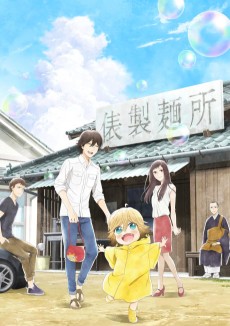
Poco's Udon World
Souta Tawara is a web designer working in Tokyo. When he visits his family's Udon place in his hometown Kagawa Prefecture, he discovers a young boy. Upon confronting the boy, Souta soon learns his secret and decides to quit his job in order to take care of the boy, Poko. The daily adventures of the two slowly enfold as Poco energetically navigates his way through Kagawa, the "Udon Kingdom," along with Souta.
📺Anime Details
📝Editorial Analysis
The steam rises in slow, lazy curls from the udon pot—thick, fragrant, almost alive—as Souta stirs with quiet focus, his shoulders loose, his breath steady. Poko sits cross-legged on the worn wooden floor nearby, small fingers kneading a lump of dough with fierce, unselfconscious concentration. Outside, the Kagawa sun slants golden through the shop’s paper screen, catching dust motes and the faint, warm sheen of wheat flour on Poko’s cheek. There’s no crisis, no ticking clock—just heat, rhythm, and the soft shush-shush of dough yielding under tiny palms. That’s the heartbeat of Poco's Udon World: not magic as spectacle, but magic as warmth, as continuity, as something that settles into your bones like broth into rice.

What makes it unique isn’t its kemonomimi or shapeshifting—it’s how those elements vanish into the background, absorbed into the texture of daily life. The fantasy isn’t otherworldly; it’s domestic. Poko’s secret doesn’t fracture reality—it deepens it. Every bowl served, every walk past the stone bridge, every shared silence on the engawa at dusk carries a quiet weight: the weight of returning, of choosing stillness, of tending something fragile and real. It’s healing not because it erases pain, but because it insists on presence—on noticing the way light hits the surface of miso soup, or how a child’s laugh echoes differently off old cedar beams. This is iyashikei stripped bare: no whimsy, no escapism—just the profound, gentle act of showing up.
That same emotional gravity lives in Prince of Persia, not in its acrobatics or ancient curses, but in its Healing & Slow Life dimension—a phrase lifted straight from its match profile. The game’s new iteration trades sandstorms for sun-baked ruins, yes—but player reviews highlight how this reboot “introduces us to a new prince, new lands and a brand new story completely separate from the sands.” That separation matters. Like Souta leaving Tokyo, this Prince isn’t defined by legacy or speed; he’s defined by relearning. His journey unfolds in deliberate, grounded rhythms—climbing not just walls but emotional thresholds, pausing not to rest, but to witness. The adult tone—the Dark Seinen shading—doesn’t mean grimness; it means reckoning with time, consequence, and the quiet courage it takes to rebuild something tender in a world that’s already broken once. When Souta kneads dough beside Poko, and the Prince traces a hand over cracked temple stone at dawn, both are doing the same thing: honoring what remains.
And then there’s the food—not as backdrop, but as anchor. In Poco's Udon World, udon isn’t cuisine; it’s lineage, geography, memory pressed into chewy strands. The “Udon Kingdom” isn’t a joke—it’s a lived truth, where terroir is tasted in broth depth and kneading pressure. That reverence for craft-as-care mirrors how games embed meaning in tactile repetition: the precise timing of a parry, the weight of a crafted tool, the ritual of preparing a meal in a survival sim. But here, the match isn’t about mechanics—it’s about intention. The player review doesn’t mention combat or puzzles; it notes the newness of the story, the deliberate severing from past expectations. Just as Souta walks away from his Tokyo job not for adventure, but for attunement, the Prince steps into unfamiliar lands not to conquer, but to listen—to wind in ruined archways, to the echo of footsteps in empty courtyards, to the quiet hum of something ancient and patient, waiting to be understood again.
This pairing sings for the person who’s spent years chasing intensity—only to realize their deepest relief comes from holding a warm mug, watching rain blur streetlights, or tracing the grain of wood with their thumb. It’s for the adult who remembers childhood summers in rural places where time didn’t tick but breathed, and who now craves stories that treat slowness not as absence, but as fullness. Not the teen chasing dragons, but the thirty-something relearning how to knead dough without rushing. Not the player grinding for loot, but the one who pauses mid-climb just to watch sunlight pool in a forgotten courtyard—and feels, unmistakably, held.
🎮4 Games That Match the Vibe


Match Dimensions Explained
❓Frequently Asked Questions
Why is Prince of Persia listed as similar to Poco's Udon World when one’s about time-bending action and the other’s a quiet slice-of-life?
Great question—it’s all about the shared 'Healing & Slow Life' and 'Adult & Dark Seinen' vibe, not gameplay. Like Poco’s tender scenes of Taku cooking udon with his grandfather in the sunlit kitchen, Prince of Persia (2023) has long, quiet moments—like the Prince tending wounded villagers in dusty courtyards or sharing silent meals with Zola—that ground its epic stakes in warmth and emotional weight. Critics noted how both use stillness and domestic ritual (cooking, healing, caregiving) as narrative anchors amid larger tensions.
Is there an anime or manga adaptation of Prince of Persia that captures the same gentle, grounded feel as Poco's Udon World?
No official anime or manga adaptation exists for the 2023 Prince of Persia reboot—but that’s actually why it *works* as a match: like Poco’s Udon World (which itself has no anime), this Prince of Persia leans into intimate, character-driven storytelling without flashy adaptations. Its slow-burn trust-building between the Prince and Zola—say, her teaching him herbal poultices in a shaded garden, or him patiently mending a broken loom—mirrors how Poco’s story unfolds through small, tactile acts of care rather than spectacle.
How does Prince of Persia compare to Nier: Automata in terms of healing-focused, low-stakes daily life moments?
Nier: Automata’s ‘healing’ moments are often metaphorical or tragic—like 2B wiping blood off her blade after a quiet lull—while Prince of Persia (2023) delivers literal, unhurried healing: the Prince grinding herbs with a mortar and pestle beside Zola, or bandaging a child’s scraped knee while she hums an old tune. Both sit in the ‘Adult & Dark Seinen’ space, but only Prince of Persia consistently layers ‘Slow Life’ mechanics—like tending a rooftop herb garden or repairing village roofs—into its core loop, just like Taku kneading dough at dawn in Poco’s Udon World.
What’s the best game like Poco’s Udon World if I want something soothing but with subtle emotional weight—not cutesy or childish?
Go straight to Prince of Persia (2023)—it’s the rare AAA title that nails that exact balance: mature, grounded, and deeply soothing without ever feeling saccharine. Think of how Poco’s Udon World uses the rhythm of boiling broth and folding dough to convey love and loss—Prince of Persia mirrors that with scenes like the Prince quietly sweeping temple steps at sunrise, or sharing roasted figs with an elder who tells stories of his late wife. With an 83 Metacritic score and explicit ‘Healing & Slow Life’ design, it’s built for exactly that mood.