
Ponyo
A young boy named Sosuke rescues a goldfish named Ponyo, and they embark on a fantastic journey of friendship and discovery before Ponyo's father, a powerful sorcerer, forces her to return to her home in the sea. But Ponyo's desire to be human upsets the delicate balance of nature and triggers a gigantic storm. Only Ponyo's mother, a beautiful sea goddess, can restore nature's balance and make Ponyo's dreams come true.
(Source: Disney)
📺Anime Details
📝Editorial Analysis
The salt-sting of wind on your cheeks as Sosuke stands barefoot on the rocky shore, clutching Ponyo in his small hands—her tiny gold-scaled body pulsing with warmth, her wide eyes reflecting not fear, but recognition. Not of him, exactly—but of something older, deeper: the quiet hum between land and sea, child and creature, breath and tide. That moment isn’t about rescue. It’s about witnessing—a boy seeing life not as resource or spectacle, but as kin.
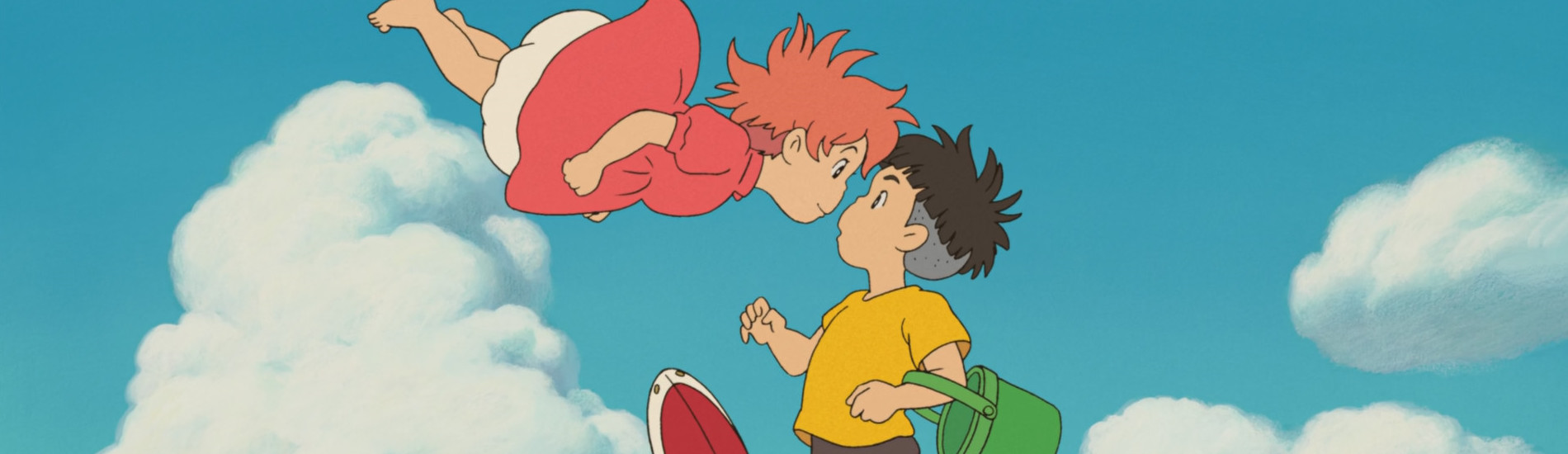
What makes Ponyo ache so tenderly isn’t its magic—it’s how that magic breathes. It doesn’t roar or dazzle; it seeps. The storm isn’t apocalyptic spectacle—it’s nature grieving, swelling with sorrow and longing when balance fractures. The coastal town isn’t backdrop—it’s a living hinge where rainwater pools in gutters like liquid memory, where lanterns glow amber against grey waves, where every bicycle ride down a winding hill feels like gliding with gravity, not against it. You don’t watch Ponyo—you settle into it, heart rate slowing to match the rhythm of lapping water, thoughts softening like sand under wet feet. It makes you feel small, yes—but not insignificant. Vital. Like your quiet attention matters to the world’s quiet pulse.
That same hushed reverence lives in Prince of Persia, where healing isn’t a menu option—it’s a gesture: pressing your palm to cracked earth, watching green unfurl like a held breath released. Its melancholic exploration mirrors Sosuke’s walks along the waterline—not searching for answers, but keeping pace with change. The game’s description calls it “an all-new epic journey,” yet its soul is in stillness: the way light catches dust motes in a ruined courtyard, the weight of silence before a vine begins to climb stone. A player review notes it’s “the 3rd reboot… completely separate from the sands”—and that’s key. Like Ponyo, it refuses nostalgia-as-escape. Instead, both choose presence: Ponyo choosing human form not for power, but for touch; the Prince choosing restoration over conquest, his magic measured in breath, not blast radius. Their worlds aren’t saved by force—they’re re-tuned, note by fragile note.
There’s also the shared grammar of scale. In Ponyo, the storm isn’t “gigantic” because it towers over skyscrapers—it’s gigantic because it lifts Sosuke’s tiny red bucket off the porch and sends it spinning like a lost thought. Likewise, Prince of Persia’s landscapes feel vast not through draw distance, but through intimacy: a single crumbling archway frames the sky like a sigh; a narrow bridge over churning water forces you to feel the sway in your own shoulders. Both works trust that awe lives in proximity—not spectacle. You don’t need dragons or demons when a goldfish’s gill-flutter can make your throat tighten.
Who loves this pairing? Not just fans of “whimsy” or “adventure.” It’s the person who pauses mid-walk to watch ants cross a sidewalk crack. The one who replays a game not for trophies, but to sit again on a virtual bench at dusk, listening to crickets and distant bells. The reader who underlines sentences about light on water. They’re drawn to stories where wonder isn’t found—it’s uncovered, gently, like lifting a flat stone to see what pulses beneath. They don’t crave control—they crave correspondence: the sense that their quiet attention, their steady breath, their willingness to kneel in the damp grass—matters to the world’s slow, sacred turning. That’s the real magic. Not transformation. Tuning. And when Ponyo finally walks ashore, barefoot, her steps leaving faint, shimmering prints that fade like mist—and when the Prince places his hand on the earth and feels the first tremor of green rise beneath his palm—you don’t cheer. You exhale. Deeply. Because you’ve been listening, too.
🎮5 Games That Match the Vibe




Match Dimensions Explained
❓Frequently Asked Questions
Why is Prince of Persia listed as a game like Ponyo?
Because both lean into 'Melancholic Exploration' and 'Healing & Slow Life'—like when Ponyo floats on the wave with Sosuke, Prince of Persia has those quiet, sun-dappled moments scaling ancient ruins or tending to wounded allies in the Oasis. The game’s gentle pacing, emphasis on environmental beauty over combat, and themes of renewal (e.g., healing the blighted lands with the Light of the Ancients) echo Ponyo’s tender, life-affirming magic.
Is there a Ponyo video game adaptation?
No—there’s never been an official Ponyo game, not even a Japan-only GBA title or mobile spin-off. Studio Ghibli has kept Ponyo strictly cinematic, which is why fans turn to spiritually aligned experiences like Prince of Persia instead: same sense of wonder, same reverence for nature’s quiet power, and that same hushed, heartfelt tone when the Prince restores a withered garden or calms a storm-tossed sea.
How does Prince of Persia compare to Spirit Island in terms of Ponyo vibes?
Spirit Island is all about fierce, elemental defense—think roaring spirits and chaotic board-game strategy—while Prince of Persia leans into Ponyo’s softness: slow walks through dewy orchards, healing vines that bloom under your touch, and dialogue where characters speak softly about memory and mercy. If Ponyo is a warm bath at sunset, Spirit Island is a thunderclap—and Prince of Persia is the steam rising gently off the water.
What’s the best game like Ponyo for feeling calm and hopeful after a stressful day?
Prince of Persia is your perfect match—especially its Oasis sequences where you glide across turquoise water, coax flowers from cracked earth using the Light of the Ancients, and watch time itself soften around you like honey. With its 85 Metacritic score and consistent praise for its 'soothing rhythm and melancholic beauty', it delivers exactly that gentle, restorative uplift Ponyo gives—no frantic timers, no fail states, just quiet awe.