
Re:ZERO -Starting Life in Another World- Season 3
The third season of Re:Zero kara Hajimeru Isekai Seikatsu.
A year has passed since Subaru’s victory at the Sanctuary. He savors a life of fulfillment while Emilia’s camp stands united for the royal selection—until a fateful letter arrives. Anastasia, a royal selection candidate, has invited Emilia to the Watergate City of Priestella. But as the party begins its journey, crisis stirs beneath the surface and Subaru meets a cruel fate once again.
(Source: Crunchyroll)
Note: The first episode has an extended runtime of ~90 minutes, and received an early premiere at Anime Expo on July 5, 2024.
📺Anime Details
📝Editorial Analysis
The first time Subaru’s breath catches—not from exertion, but from the silence after a scream cuts off mid-air in Priestella’s rain-slicked canal district. His fingers are already numb before he registers the blood on them. Not his. Someone else’s. And then the world stutters, not with a loop’s familiar lurch, but with something slower, heavier: the weight of memory folding inward like wet paper. That silence isn’t absence—it’s the sound of a mind refusing to accept what its eyes just confirmed.
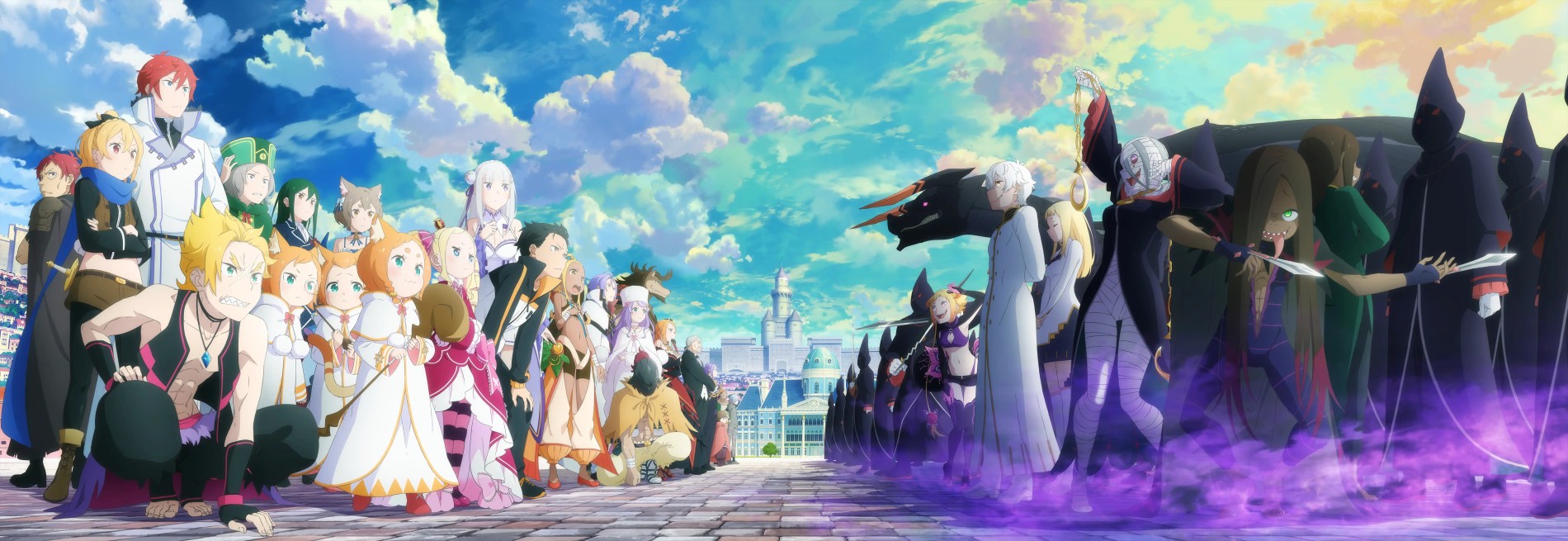
That’s the atmosphere: dread that tastes like familiarity. Not jump-scares or grand betrayals—but the suffocating certainty that every warm glance, every shared meal, every quiet promise made under Emilia’s silver hair carries the latent charge of imminent collapse. Season 3 doesn’t trade in shock for shock’s sake; it trades in recognition. You see Subaru hesitate before stepping into a sunlit courtyard—not because he fears ambush, but because he remembers how sunlight looked after the last time he watched someone’s throat open in that exact spot. The fantasy is secondary. The magic is incidental. What pulses beneath everything is the psychological erosion of living with too much memory, where love and loyalty become liabilities because you’ve seen—repeatedly—how easily they curdle under pressure, manipulation, or simply bad timing. It’s not about surviving death. It’s about surviving the aftermath of having witnessed your own helplessness so many times it starts to feel like gravity.
BioShock™ shares this same marrow-deep unease—not through time loops, but through body horror & occult fused with political thriller architecture. Its underwater city of Rapture isn’t just decayed; it’s ideology made flesh, twisted and leaking. Like Priestella’s canals hiding cultist rites beneath merchant guilds and royal pageantry, Rapture’s beauty is a veneer over systemic rot—and both worlds punish idealism with visceral, irreversible consequence. The player review calls it “revolutionary” not for its guns, but for how its narrative unfolds inside your nervous system: every plasmid’s grotesque mutation mirrors Subaru’s psychological fractures; every audio diary whispers the same truth he lives—you thought you were choosing, but you were already chosen by forces you didn’t name. The dread isn’t external. It’s the slow dawning that your own convictions have been weaponized against you.
Then there’s the memory manipulation—not as plot device, but as lived trauma. When Subaru wakes up remembering Anastasia’s invitation and the three ways it ends in slaughter, it’s not exposition. It’s disorientation rendered physical: blurred vision, delayed motor response, the way his voice cracks when he says “I know” before anyone’s spoken. That’s mirrored in games where cognition itself becomes unstable terrain. But among the matches provided, BioShock™ again resonates most acutely—not just for its body horror, but for how its adult & dark seinen tone treats memory as contested ground. Jack doesn’t just forget who he is; he feels the seams where identity was grafted on. Subaru doesn’t just relive deaths—he relives the shame of choices made in panic, the guilt of survival that cost others their peace. Both protagonists move through worlds that demand moral calculus while actively sabotaging their capacity to trust their own recollection. The horror isn’t in the blood. It’s in the moment you realize your most reliable witness—the self—is compromised.
Who would love these pairings? Not the casual viewer who watches anime for escapism. Not the player who boots up a game for clean power fantasies. This is for the person who re-watches the same five minutes of Re:ZERO -Starting Life in Another World- Season 3 not to catch foreshadowing, but to feel the tremor in Subaru’s hand as he reaches for Emilia’s wrist—knowing full well that touch could be the last thing she feels before the world resets. It’s for the one who plays BioShock™ not for the Big Daddies, but for the hollow echo in Andrew Ryan’s final monologue—the terrifying clarity of a man who built a utopia only to realize he’d designed its tomb. These are for people who seek stories where vulnerability is the central mechanic, where every act of courage is shadowed by exhaustion, and where the most devastating twist isn’t “who did it?” but “why did I believe I could stop it?” They don’t want hope served neat. They want it scraped raw, handed back with salt and blood still on it—and they’ll recognize that same unflinching honesty when it appears in another medium, another world, another kind of wound.
🎮3 Games That Match the Vibe

Match Dimensions Explained
❓Frequently Asked Questions
Why is BioShock listed as similar to Re:ZERO Season 3 despite having no isekai or anime elements?
It’s the *emotional whiplash* and psychological unraveling that matches — like Subaru’s repeated, gut-wrenching deaths and resets, BioShock drops you into Rapture with fragmented memories and forces you to piece together betrayal, guilt, and moral collapse scene by scene (think Andrew Ryan’s ‘A man chooses…’ monologue echoing Subaru’s ‘I’m not a hero’ breakdowns). The body horror of splicers and the oppressive, decaying setting mirror the visceral dread of the Sanctuary arc and the Witch’s Cult’s occult rituals.
Is there a Re:ZERO Season 3 visual novel or game adaptation coming out soon?
No — there’s no official Re:ZERO Season 3 game or visual novel in development or announced. The only licensed games are older titles like *Re:ZERO: Lost in Memories* (a mobile RPG) and *Re:ZERO: The Prophecy of the Throne* (a PS4/PC visual novel covering Seasons 1–2), neither of which include Season 3 content or mechanics like the Return by Death loop.
BioShock vs. Doki Doki Literature Club! — which one captures Re:ZERO Season 3’s tone better?
BioShock wins for Season 3’s specific vibe: both lean hard into *unreliable perception*, but while DDLC fractures reality through meta-horror and playful deception, BioShock mirrors Season 3’s grim political scheming, cult-like indoctrination (think the Witch’s Cult vs. Fontaine’s propaganda), and visceral consequences — like seeing your own corpse pile up in Rapture’s halls just like Subaru’s repeated, bloody collapses in the Sanctuary.
What’s the best game like Re:ZERO Season 3 if I want that oppressive, paranoid, ‘no one is safe’ feeling?
BioShock is the top pick — its dim-lit, collapsing city of Rapture forces you into constant suspicion (who’s a Big Daddy? Who’s a traitor? Is Atlas really helping you?), just like Season 3’s Sanctuary arc where every ally feels fragile and every corridor could hide a trap. The ‘Would you kindly…’ twist isn’t just a plot point — it’s the *mechanical embodiment* of Subaru’s powerlessness before fate, echoing his helplessness during the Witch’s Cult’s manipulations.