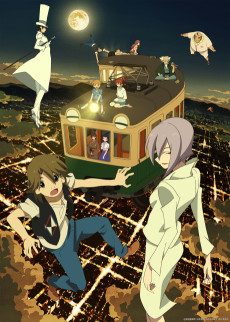
The Eccentric Family 2
📺Anime Details
📝Editorial Analysis
The steam rises off the Kamo River at dawn—not thick and industrial, but thin, silver, curling like breath held too long—just as Yasaburō sits on the stone steps, barefoot, watching a heron fold its wings over water that holds both carp and kami, both commuters and tanuki. He doesn’t speak. He doesn’t need to. His silence isn’t emptiness—it’s listening. That’s the heart of The Eccentric Family 2: not spectacle, not revelation, but the quiet, aching weight of continuity—the way myth doesn’t roar; it settles, like silt in slow water, inside the cracks of apartment walls and the rustle of bamboo groves behind Kyoto Station.
This isn’t urban fantasy as escape. It’s urban fantasy as residence—a world where shapeshifting isn’t power, but inheritance; where being tanuki means carrying generations of jokes, debts, and unspoken grief in your ribs. The feeling isn’t wonder—it’s tenderness, laced with melancholy so soft it almost disappears until you notice how often characters pause mid-sentence, how often laughter trails off into something quieter, how often a character’s tail flicks not with mischief, but exhaustion. It’s philosophy worn like a well-worn kimono—threadbare at the elbows, warm at the collar. You don’t solve the mystery of the yōkai here—you learn to share tea with them, to smell rain on their fur, to recognize sorrow in the way a tsundere fox turns her face away—not from anger, but because looking directly would make the feeling too real.
That same resonance hums in Legendary, not in its heist plot or Pandora’s Box premise, but in its animation: “incredible… better than most games of the more modern era.” Like The Eccentric Family 2, Legendary treats myth not as lore-dump spectacle, but as bodily presence—its creatures move with weight, texture, history in their joints. The “jank” mentioned in the player review? It mirrors the anime’s deliberate imperfections—the slightly-too-long hold on a glance, the awkward pause before a confession, the way a tanuki’s transformation wobbles just enough to feel earned, not polished. Both refuse slickness. They choose grain over gloss—because myth isn’t clean. It’s lived-in. It’s real.
Then there’s Hellblade II: Senua’s Saga, scoring identical marks (76) on the same dimensions: Mythology & Folklore, Body Horror & Occult. But here, the connection isn’t visual—it’s sonic and somatic. Senua doesn’t just hear voices; she carries them in her breath, her pulse, the tremor in her hands. Yasaburō carries his family’s ghosts the same way—not as flashbacks, but as the way his shoulders slump when passing the old tanuki shrine, the way he instinctively checks his reflection twice, not for vanity, but to confirm he’s still himself, not dissolved into lineage. Both works treat the occult not as external threat, but as interior weather—a climate of memory and responsibility that reshapes the body from within. The horror isn’t gore—it’s the quiet dread of forgetting your own name while holding someone else’s.
Even Black Myth: Wukong Benchmark Tool, with its lower score (71) but identical dimensional anchors, pulses with this same frequency. A benchmark tool—not a game, not even a demo—yet players engage with it as ritual: testing frames, watching light catch on fur, measuring how Wukong’s tail sways under wind physics. That obsessive attention to embodied detail—how myth moves in muscle and shadow—is pure The Eccentric Family 2. The anime doesn’t animate transformation as magic trick; it animates it as adjustment—a shift in posture, a blink delayed by a fraction, the way fabric settles differently after skin becomes fur. The benchmark tool does the same: it’s not about scale or combat—it’s about presence. Does the fur ripple right? Does the light know this creature has been waiting, not for battle, but for recognition?
You’d love these pairings if you’ve ever watched a sunset over a city river and felt time bend—not backward, but sideways, into layers: the concrete, the carp, the ghost of a fox who lived here in 1893, the boy sitting now, thinking about his father’s silence. If you crave stories where mythology isn’t a weapon or a quest log, but the quiet hum beneath daily life—if you ache for art that treats tenderness as the most dangerous, most sacred magic of all. Not heroes. Not villains. Just beings, breathing, remembering, trying—so gently—not to forget how to be human, even when they’re not.
🎮3 Games That Match the Vibe
Match Dimensions Explained
❓Frequently Asked Questions
Why does Legendary feel like The Eccentric Family 2’s spiritual cousin?
Because both lean hard into layered Japanese and global folklore—not just as backdrop, but as living, breathing systems shaping identity and conflict. In Legendary, Deckard’s encounters with sealed mythic beings echo the Tanuki clan’s shifting forms and ancestral tensions, especially in scenes where ancient spirits erupt from ornate, decaying shrines—just like the tense shrine confrontation in Episode 12 where Yōzō confronts his grandfather’s spirit. The janky-but-earnest PS3-era animation even mirrors the show’s hand-drawn, slightly uncanny movement during transformation sequences.
Is there a video game adaptation of The Eccentric Family 2?
No—there’s never been an official game adaptation, not even a mobile title or visual novel. The closest you’ll get is how Hellblade II: Senua’s Saga channels that same tonal weight: its hallucinatory visions, whispered folklore, and visceral body horror (like Senua’s skin cracking to reveal glowing runes) mirror the show’s quiet dread and spiritual unraveling—especially during Yajiro’s fever-dream sequences in the riverbank arc.
How does Black Myth: Wukong Benchmark Tool compare to Legendary for Eccentric Family fans?
Black Myth leans heavier on spectacle and martial choreography—think Sun Wukong’s staff spins echoing the Tanuki’s acrobatic chaos in the Kyoto chase—but Legendary wins on intimate, melancholic folklore: Deckard’s quiet moments deciphering cracked oracle bones feel closer to Noroi’s solemn scroll-reading than Wukong’s thunderous boss fights. Both hit 71–76 scores and share Mythology & Folklore + Body Horror & Occult dimensions, but Legendary’s slower, more tactile pacing matches the show’s hushed emotional beats better.
What’s the best game like The Eccentric Family 2 if I want that bittersweet, rain-soaked, folklore-heavy vibe?
Hellblade II: Senua’s Saga—it nails that exact mood: mist-laced Nordic forests, whispered ancestral voices, and skin-splitting visions that feel less like horror and more like sorrow made physical. When Senua kneels in a flooded stone circle, her breath ragged and runes blooming across her arms, it hits the same gut-punch as Yōzō standing alone under the rain-slicked eaves of the old Tanuki lodge in Episode 8—quiet, sacred, and devastatingly tender.