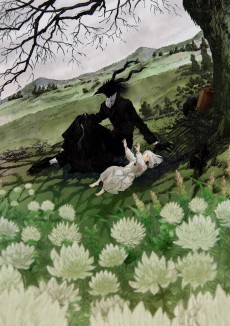
The Girl from the Other Side
Once upon a time, in a far, faraway place, there were two lands. The world was divided into an inner land and an outer land. People feared the outer land, inhabited by eerie beings, the carriers of curse. One day, on the border to the inner land inhabited by humans, one such being finds a girl on heaps of abandoned dead bodies. The girl says her name is Shiva and shows affection to the "being" who found her, calling him "Teacher."
This is a story of two people—one human, one inhuman—who linger in the hazy twilight that separates night from day.
(Source: Crunchyroll)
Note: Originally released as a movie-length OVA. As streaming on Crunchyroll, it is split into 3 'normal' length episodes.
📺Anime Details
📝Editorial Analysis
The silence after Shiva falls asleep in Teacher’s arms—her small body curled against his inhuman form, the candlelight trembling over cracked floorboards, the distant wind whispering through the broken window—is not empty. It is weighted. Not with dread, not with tension, but with the quiet, aching fullness of something irreplaceable being held, knowing it cannot last. That moment isn’t about plot. It’s about breath held—not in fear, but in reverence for fragility.
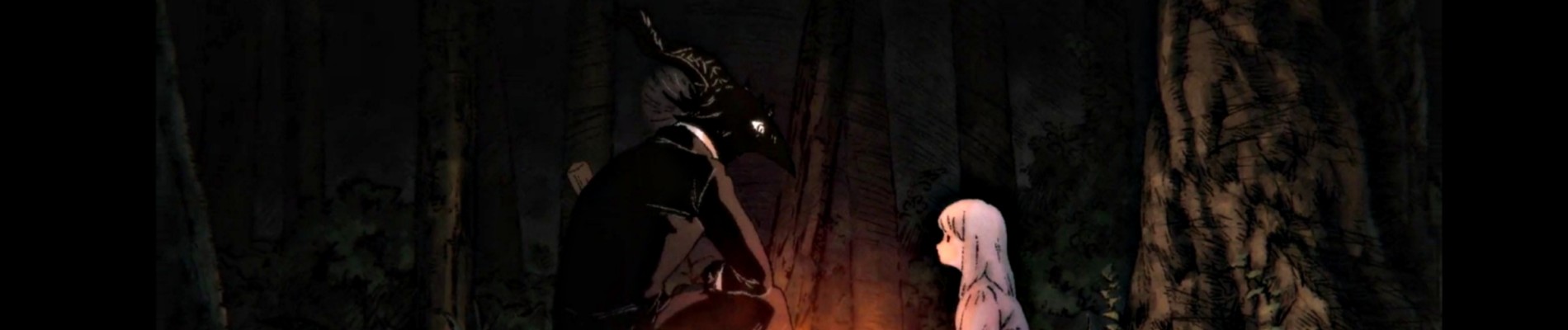
What makes The Girl from the Other Side unlike anything else isn’t its fantasy scaffolding—the gods, the demons, the curse—but how it treats time, space, and touch as sacred, finite substances. This is melancholic exploration made flesh: every walk across the borderlands feels like stepping deeper into memory; every shared meal, every mended coat, every lesson taught under a bruised twilight sky carries the hush of ritual. There’s no grand battle music, no triumphant score swelling—it’s all rustle, sigh, scrape of wood on stone, the low murmur of a voice trying to name things that have no names. You don’t watch it—you inhabit its stillness. And in that stillness, you think—not about good versus evil, but about what it means to care across an unbridgeable divide; how love becomes an act of quiet defiance against entropy, against dogma, against the very architecture of the world.
That emotional DNA pulses strongest in Prince of Persia, whose own description names Healing & Slow Life and Melancholic Exploration as core dimensions. The player review calls it “a new prince, new lands and a brand new story”—and that’s key: this isn’t spectacle-driven mythmaking. Like Teacher teaching Shiva letters by tracing them in dust, the Prince moves with deliberate, almost ceremonial slowness—climbing, pausing, listening, healing wounds not just of the body but of place and memory. The game’s rhythm mirrors the anime’s: no sprinting past sorrow, no skipping the weight of a hand on a sun-warmed wall. Both ask you to linger, to feel the grain of loss beneath beauty, to understand that healing isn’t erasure—it’s tending.
There’s also a quieter resonance with games that treat environment as scripture—where forests aren’t backdrops but witnesses, where ruins aren’t set dressing but echoes of failed covenants. The anime’s rural setting isn’t pastoral charm; it’s theological geography—the inner land’s rigid walls, the outer land’s decaying orchards, the mist-choked river between them—all charged with unspoken doctrine. That same environmental reverence lives in how Prince of Persia renders its world: sand doesn’t just shift—it remembers. Architecture doesn’t just stand—it testifies. You don’t conquer terrain; you move through its history, footfall by footfall, just as Teacher walks the same path each day to check the boundary markers, not as duty, but as devotion.
This pairing isn’t for fans of lore dumps or power fantasies. It’s for the person who rewatched the scene where Shiva draws Teacher’s face in the dirt—not because it’s cute, but because they felt the tremor in her fingers, the way her small thumb smudges the nose just slightly, turning perfection into something tenderly, devastatingly alive. It’s for the player who didn’t rush the Prince’s first climb up the vine-covered temple wall, but stopped halfway to watch light fracture through crumbling arches—and felt, unmistakably, the same hush that falls when Shiva whispers “I’m not afraid” into Teacher’s chest. These are works for those who carry silence like a second language—who know that the most profound truths aren’t shouted, but breathed; not solved, but sustained; not won, but tended, day after slow, luminous day.
🎮6 Games That Match the Vibe



Match Dimensions Explained
❓Frequently Asked Questions
Why is Prince of Persia listed as similar to The Girl from the Other Side?
Because both lean hard into melancholic exploration—like wandering the quiet, rain-slicked ruins in Prince of Persia’s Zerzur while remembering Shiva’s lonely walks through the fog-draped borderlands. The game’s Healing & Slow Life pillars mirror the manga’s tender pacing and emotional weight, especially in moments where you pause to tend to a wounded companion or sit silently beside them, just like Shiva and Teacher sharing tea under the willow tree.
Is there a video game adaptation of The Girl from the Other Side?
No—there’s no official game adaptation yet. But fans who love its tone often reach for Prince of Persia (2024), since its narrative rhythm, painterly melancholy, and focus on quiet connection (e.g., healing your companion during lulls in combat) echo the manga’s heart without copying it. It’s the closest thing we’ve got that *feels* like stepping into that world.
Prince of Persia vs. Spirit Island—which is better for that slow, sorrowful, fairy-tale atmosphere?
Go with Prince of Persia—it nails the fairy-tale sorrow with its hand-painted vistas, intimate character animations (like the Prince gently lifting his injured ally), and deliberate pacing that mirrors Shiva’s cautious steps across the threshold. Spirit Island is deeply atmospheric too, but its energy is more urgent and mythic; Prince of Persia’s Melancholic Exploration tag and Healing mechanics align way closer to the hushed, tender gravity of The Girl from the Other Side.
What’s the best game like The Girl from the Other Side if I want something gentle and bittersweet, not action-heavy?
Prince of Persia (2024) is your best bet—it’s built around slow life moments: tending wounds, sharing silent glances, exploring decaying gardens at dusk, and choosing dialogue that deepens trust instead of escalating conflict. Its 84 Metacritic score reflects how well it balances emotional weight with accessibility—no frantic combat breaks the spell, just like how Shiva’s story unfolds in soft, deliberate strokes.