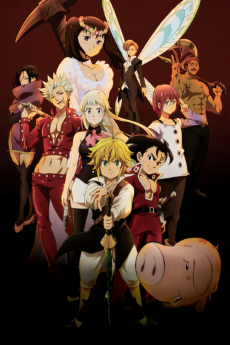
The Seven Deadly Sins: Cursed by Light
📺Anime Details
📝Editorial Analysis
The smell of burnt incense and old blood hangs in the air—not from a battlefield, but from a quiet shrine at dusk, where Meliodor kneels, fingers tracing the cracked stone of a forgotten god’s altar. His voice is low, steady, not pleading but remembering, and the camera lingers on the tremor in his knuckles as he presses his forehead to cold marble. No explosion follows. No demon lunges. Just that breath held too long, that silence thick with centuries of unspoken oaths—and the sudden, sharp crack of a single tile splitting under his weight. That’s The Seven Deadly Sins: Cursed by Light: not spectacle first, but weight. The kind that settles in your molars.
This isn’t shōnen adrenaline masquerading as depth—it’s mythic fatigue made tactile. You feel the drag of legacy in every pause between sword swings, the exhaustion behind the jokes, the way laughter cracks like dry clay when it comes too fast. It’s heavy hope—hope that’s been buried, dug up, and still refuses to stay dead. There’s no clean moral binary here; gods are capricious, demons wear grief like armor, and “light” isn’t purity—it’s a weapon, a burden, a flickering candle in a cathedral full of broken statues. You don’t just watch characters fight—you feel the cost of their stamina, the ache in their shoulders after standing too long in rain-soaked armor, the way magic doesn’t glow—it grinds, like rusted gears turning inside bone.
That same gravity lives in Black Myth: Wukong, where player reviews note its Dark Fantasy and Mythology & Folklore dimensions—not as backdrop, but as architecture. Like Meliodor kneeling before fractured divinity, Wukong confronts celestial bureaucracy not with rebellion alone, but with recognition: this isn’t good vs. evil, it’s memory vs. erasure, ritual vs. ruin. The score (78) isn’t just high—it’s earned in the hush before a boss exhales, in the way dust motes hang motionless in temple light while you wait for the next strike. Same emotional DNA: reverence worn thin by time, power that feels less like triumph and more like survival with witnesses.
Then there’s Assassin’s Creed™: Director's Cut Edition, tagged with Dark Fantasy and Tactical Warfare, its player review confessing: “Being an older game now, some of the models and textures are quite dated but no issues with me…” That line isn’t nostalgia—it’s devotion to texture. Like Cursed by Light’s deliberate pacing—its long takes on weathered faces, its refusal to cut away from a character blinking slowly in exhaustion—this version of Assassin’s Creed values presence over polish. You don’t sprint past history; you walk its uneven cobblestones, feel the grit in your boots, hear the muffled prayers from alleyways. The tactical warfare isn’t about flawless combos—it’s about choosing where to stand, when to breathe, how much of yourself to expose. Just like Meliodor’s quiet prayer isn’t about faith restored—it’s about choosing to kneel despite knowing the altar won’t answer.
And REMNANT II®, also scoring 71 in Dark Fantasy and Tactical Warfare, mirrors the anime’s ensemble rhythm: no lone hero, only interlocking flaws. You don’t level up solo—you adapt your build around who’s in your party, whose weakness you cover, whose rage you temper. That’s the core tension of Cursed by Light’s cast: Escanor’s strength isn’t heroic—it’s destabilizing. Diane’s loyalty isn’t simple—it’s laced with ancient shame. Their bonds aren’t forged in victory, but in shared miscalculation, in catching each other mid-fall—not because they’re perfect, but because they remember how to hold weight.
Who loves this? Not just fans of “epic battles” or “cool powers.” It’s the viewer who rewatches the shrine scene three times—not for plot, but to catch the exact second Meliodor’s eyelid twitches when wind stirs the ash. It’s the player who reloads a REMNANT II checkpoint not to win faster, but to listen again to their teammate’s ragged breathing after a narrow dodge. It’s the person who walks away from Black Myth: Wukong’s final boss not exhilarated—but hollowed out, quietly humming an old hymn they didn’t know they remembered. They don’t seek escape. They seek resonance: the kind that hums in your ribs long after the screen goes dark.
🎮5 Games That Match the Vibe


Match Dimensions Explained
❓Frequently Asked Questions
Why does Black Myth: Wukong feel so similar to The Seven Deadly Sins: Cursed by Light’s boss fights?
Because both lean hard into mythological spectacle and over-the-top, cinematic combat—like when Sun Wukong shatters a mountain with his staff in Black Myth: Wukong, it echoes Meliodas’ demon king awakening sequence in Cursed by Light: explosive VFX, slow-mo emphasis on power surges, and enemy arenas that transform mid-fight. It’s not just the flash—it’s how both games tie lore directly into attack animations and stage-breaking mechanics.
Is there an anime adaptation of REMNANT II like there is for The Seven Deadly Sins?
No—REMNANT II is purely a video game with no anime, manga, or live-action adaptation. Unlike The Seven Deadly Sins (which has multiple anime seasons and films), REMNANT II builds its dark fantasy world through environmental storytelling, cryptic NPC dialogue, and lore logs—not animated cutscenes or voice-dubbed arcs.
How does Assassin’s Creed Director’s Cut compare to Kingdom Come: Deliverance II in terms of tactical combat feel?
Both score 71 and share the ‘Tactical Warfare’ dimension, but they differ sharply: Assassin’s Creed leans on parkour-driven hit-and-run takedowns (e.g., rooftop assassinations with hidden blade counters), while Kingdom Come: Deliverance II forces you to read swings, parry timing, and manage stamina like a real sword duel—think defending against a bandit captain’s feint-and-thrust combo instead of chaining combos.
What’s the best game like The Seven Deadly Sins: Cursed by Light if I want that same hype, high-energy ‘battle arena’ vibe?
Black Myth: Wukong is your best bet—the fight against Erlang Shen in the Cloudy Mountain Temple mirrors Cursed by Light’s energy: multi-phase boss patterns, screen-shaking finishers, and camera zooms that lock onto character expressions mid-combo. It’s got that same ‘anime battle anime’ rhythm, just swapped for Chinese mythology instead of Celtic-inspired demon kings.