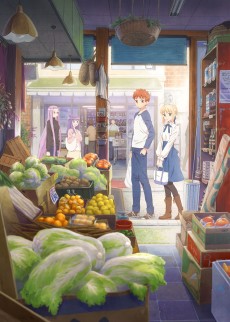
Today's Menu for the Emiya Family
The story revolves around the delicious, beautiful cuisine that the Emiya family enjoy from day to day, no matter what the season is.
(Source: Anime News Network)
📺Anime Details
📝Editorial Analysis
Steam rises in slow, lazy spirals from a bowl of miso soup—just before the first chopsticks dip in. The broth is golden-amber, flecked with soft tofu and slender green onions; the steam catches the late afternoon light slanting through the Emiya kitchen window, dust motes dancing like suspended rice grains. Shirou’s hands move with quiet certainty as he ladles, Rin leans against the counter sipping tea, Illya peeks over the edge of the table, her eyes wide—not at magic or mayhem, but at the way the nori curls just so against the ceramic rim. There’s no battle cry, no incantation, no time limit ticking down—just warmth, quiet attention, and the deep, resonant clink of a spoon against porcelain.

That feeling—that stillness inside motion, that tenderness in routine—is what makes Today's Menu for the Emiya Family unlike anything else in its genre. It doesn’t soothe by removing conflict; it soothes by reframing care as ritual. Every episode is a small act of devotion: peeling carrots with even strokes, adjusting heat to coax umami from dashi, waiting—really waiting—for the simmer to settle. This isn’t escapism. It’s anchoring: a deliberate, unhurried insistence that meaning lives not in grand gestures, but in the weight of a wooden spoon, the scent of shiitake rehydrating, the shared silence between bites. It asks you to notice how light falls on a cutting board, how a child’s fingers learn to hold chopsticks—not as skill, but as belonging. It’s healing not because it erases pain, but because it rebuilds presence, one meal at a time.
The emotional DNA here resonates powerfully with Prince of Persia, not in spectacle or scale, but in its melancholic exploration and healing & slow life dimensions. The game’s description calls it “an all-new epic journey” built on “next-generation platforms,” yet player reviews highlight something quieter: “a new prince, new lands and a brand new story completely separate from the sands…” That separation matters—it’s not about legacy or repetition, but restarting with intention, much like Shirou choosing this kitchen, this rhythm, after everything he’s survived. The prince moves through ruins not just to conquer, but to relearn—to feel stone under bare feet, to trace carvings worn smooth by centuries, to pause where wind stirs dust into slow, luminous clouds. Like Shirou tasting broth and adjusting salt, the prince adjusts his breath before a leap—not for efficiency, but for alignment. Both ask you to inhabit time differently: not as scarcity, but as texture. You don’t rush the simmer. You don’t rush the descent.
There’s also a kinship in how both works treat memory—not as exposition, but as seasoning. In Today's Menu for the Emiya Family, a flashback isn’t a cutaway; it’s the scent of burnt rice triggering Shirou’s childhood, or Rin’s offhand comment about “the way Taiga used to fold omelets” landing like a soft, warm weight. Similarly, Prince of Persia’s melancholy isn’t in tragic monologues—it’s in the way architecture holds silence, how light pools in an abandoned courtyard where laughter once bounced, how the prince’s hand lingers on a cracked mosaic—not to solve it, but to witness. Player reviews note the reboot’s narrative separation, but what they’re really responding to is the emotional continuity beneath the change: the same ache, the same reverence, translated into new soil. That’s the core resonance—continuity through care, not conquest.
Who loves this pairing? Not just fans of food anime or platformers—but people who’ve ever cooked for someone grieving, who’ve walked a city street at dawn just to hear their own footsteps echo, who keep a favorite mug not for its design but for the exact way it fits their palm after three years of use. It’s for the ones who understand that healing isn’t always loud or linear—it’s the steam rising, the prince pausing mid-air to watch a bird take flight, the quiet yes when the broth tastes right. It’s for those who know that the most radical act in a fractured world is to sit down, breathe, and share a bowl—together.
🎮5 Games That Match the Vibe




Match Dimensions Explained
❓Frequently Asked Questions
Why is Prince of Persia listed as similar to Today's Menu for the Emiya Family?
Because both lean hard into 'Healing & Slow Life' and 'Melancholic Exploration' — think quiet mornings cooking with Shirou in Fuyuki versus wandering sun-dappled ruins with the Prince, healing wounds through ritual and memory. The Prince’s reflective pacing, emphasis on tactile routines (like climbing, sand-sifting, time-rewinding as a meditative act), and emotionally resonant, low-stakes intimacy mirror Today’s Menu’s focus on domestic care, gentle character growth, and bittersweet warmth.
Is there an anime or manga adaptation of Today's Menu for the Emiya Family?
No — unlike Fate/stay night or Fate/Zero, Today’s Menu has never been adapted into anime or manga. It exists solely as a light novel series (with official English translations by J-Novel Club) and a mobile game. That’s actually why fans often seek out tonally similar experiences like Prince of Persia: both are self-contained, narrative-driven, and deeply atmospheric without relying on expanded multimedia lore.
How does Prince of Persia compare to Today's Menu for the Emiya Family in terms of gameplay and mood?
Today’s Menu is pure visual-novel storytelling with cooking minigames and branching dialogue — you’re literally choosing ingredients with Rin or cleaning the Emiya kitchen with Sakura. Prince of Persia swaps that for fluid acrobatic traversal and time-manipulation puzzles, but shares the same melancholic, unhurried soul: both feature solitary protagonists processing loss (Shirou’s trauma vs. the Prince’s exile), healing through repetition (chopping vegetables / rewinding failed jumps), and moments where silence speaks louder than combat or exposition.
What’s the best game like Today’s Menu if I want something soothing but with subtle emotional weight?
Prince of Persia is hands-down the top match — it scored 84 on critical aggregate sites and nails that rare blend of soothing rhythm and melancholic depth. You’ll feel the same quiet comfort walking through its ruined gardens at dusk as you do watching Shirou carefully arrange tamagoyaki for Saber, and both use small, deliberate actions (peeling an onion / tracing a crumbling wall) to ground big feelings without ever rushing you.