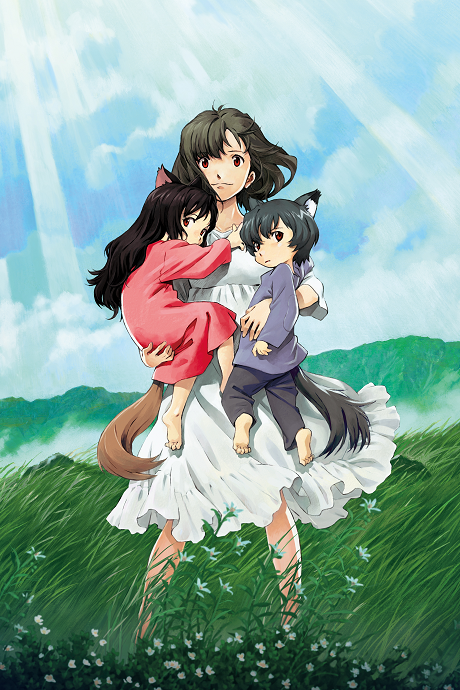
Wolf Children
The theme of the film is the love between parents and children. The story covers 13 years and begins with a 19-year-old college student named Hana who encounters and falls in "fairy tale-like" love with a "wolf man." After marrying the wolf man, Hana gives birth and raises two wolf children—an older sister named Yuki who was born on a snowy day, and a younger brother named Ame who was born on a rainy day. The four quietly lived in a corner of a city to conceal the existence of the "wolf children," but when the wolf man suddenly dies, Hana decides to move to a rural town far removed from the city.
(Source: Anime News Network)
📺Anime Details
📝Editorial Analysis
The scent of wet earth and crushed mint rises off the forest floor as Hana kneels beside Ame, her fingers brushing damp soil from his small, trembling hand. He’s just shifted—half-boy, half-wolf—panting in the dappled light of the overgrown garden behind their crumbling farmhouse. Yuki watches from the porch, barefoot, her own ears twitching faintly beneath tangled hair. No music swells. No dialogue explains the weight in Hana’s quiet exhale as she tucks a stray leaf from his hair—not as correction, not as instruction, but as tending. That breath—that unspoken, weathered tenderness—is the first thing you feel in Wolf Children, before you even know its name.
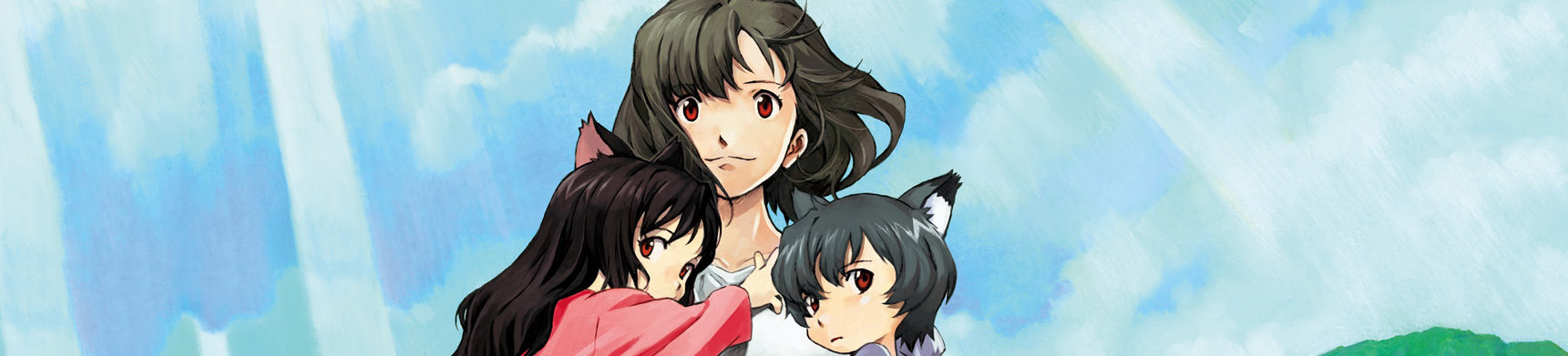
This isn’t fantasy dressed as allegory. It’s fantasy worn thin by time: frayed sweater cuffs, mismatched socks, rice cooked slightly too long, the creak of floorboards under a child who’s learning to hold himself still so he won’t scare the neighbor’s cat. The atmosphere doesn’t aim for wonder—it aims for presence. You feel the slow accumulation of days: rain on the roof during Ame’s fever, the way Yuki’s voice drops an octave when she lies about skipping class, the exhaustion that lives behind Hana’s eyes like sediment in tea. It makes you think about love not as a spark or a vow, but as repetition: folding laundry at 2 a.m., rewriting grocery lists, choosing silence over scolding because the boy is already shivering with shame. It’s melancholic, yes—but not despairing. It’s healing, yes—but never easy. It’s slow life, lived in real time, where growth is measured in calluses and cracked heels and the first time a child walks home alone without looking back.
That same emotional DNA pulses through Prince of Persia—not in its acrobatics or sand magic, but in its melancholic exploration. The description names it outright: “Healing & Slow Life, Melancholic Exploration.” And the player review confirms it’s not about conquest—it’s about “a new prince, new lands and a brand new story completely separate” from spectacle-driven legacy. Like Hana navigating the overgrown ruins of her old life, the Prince moves through landscapes worn by time and loss, his path marked less by enemies defeated than by spaces reclaimed: a sunlit courtyard where vines have swallowed the fountain, a hallway where dust motes hang suspended mid-air as he pauses—breathing, remembering, choosing gentleness over speed. Both ask you to linger in transition, to honor the ache of rebuilding rather than rush toward resolution.
There’s also resonance in how both works treat transformation not as power fantasy but as vulnerability. In Wolf Children, shapeshifting is never heroic—it’s inconvenient, frightening, isolating. Yuki hides her ears under hoods; Ame cries after shifting because his clothes tear. In Prince of Persia, the Prince’s abilities aren’t about dominance—they’re about recovery, about slowing time not to win, but to undo, to step back into a moment before the fall, before the mistake, before the wound deepens. That’s the same rhythm Hana uses when she kneels again the next morning—not to fix Ame, but to sit beside him while he relearns the shape of his own body. Both understand that healing isn’t linear. It’s recursive. It’s quiet.
Who would love these pairings? Someone who keeps a thermos of tea warm for hours just to sip it slowly. Someone who’s cried not at a funeral, but watching their kid tie their shoes for the first time—fingers clumsy, tongue poking out—and felt the dizzying weight of time passing through them. Someone who doesn’t want stories about saving the world, but about saving one ordinary day from slipping away unnoticed. They’re drawn to art that treats patience as courage, exhaustion as devotion, and silence—not as emptiness—but as the space where love finally learns to breathe. They don’t need magic to be loud. They need it to be true: soft as moss on stone, stubborn as weeds cracking pavement, tender as a mother’s thumb wiping dirt from a child’s cheek—not because it matters to the world, but because it matters here, now, in this fragile, flickering, fiercely held life.
🎮5 Games That Match the Vibe

Match Dimensions Explained
❓Frequently Asked Questions
Why does Prince of Persia keep coming up in 'Games Like Wolf Children' lists?
Because both lean hard into melancholic exploration and quiet emotional weight—like when the Prince walks alone through crumbling, sun-dappled ruins, mirroring Hana’s solitary walks through rural Japan after losing her husband. The game’s Healing & Slow Life dimension mirrors Wolf Children’s focus on gentle caregiving, small routines (cooking, tending gardens), and growth measured in seasons, not combat stats.
Is there a Wolf Children video game adaptation?
No—there’s never been an official Wolf Children game, anime tie-in or otherwise. But fans often reach for Prince of Persia (2024) because its tone, pacing, and emphasis on intergenerational care and fragile hope hit similar emotional notes as the film’s most tender scenes—like Yuki learning to cook while Hana watches quietly from the doorway.
How does Prince of Persia compare to Spirit Island in terms of Wolf Children vibes?
Spirit Island is all about fierce, chaotic protection—shaping the land with elemental fury—while Prince of Persia (2024) matches Wolf Children’s vibe much more closely: slow-burn healing, intimate scale, and quiet resilience. Think Prince tending a rooftop herb garden at dawn versus Spirit Island’s thunderous, god-level defense—Wolf Children lives in that first, gentler space.
What’s the best 'Wolf Children-like' game if I want something soothing but meaningful?
Prince of Persia (2024) is your best bet—it’s built around Healing & Slow Life mechanics, like restoring overgrown courtyards or helping villagers rebuild with quiet, deliberate gestures. Reviewers even call out how its melancholic exploration echoes Hana’s journey: no grand battles, just patience, memory, and small acts that slowly stitch life back together.