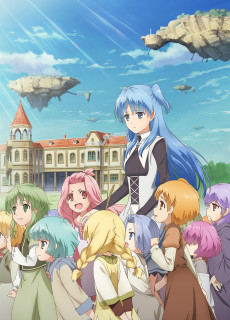
WorldEnd: What are you doing at the end of the world? Are you busy? Will you save us?
Five hundred years have passed since the humans went extinct at the hands of the fearsome and mysterious ‘Beasts’. The surviving races now make their homes up on floating islands in the sky, out of reach of all but the most mobile of Beasts.
Only a small group of young girls, the Leprechauns, can wield the ancient weapons needed to fend off invasions from these creatures. Into the girls’ unstable and fleeting lives, where a call to certain death could come at any moment, enters an unlikely character: a young man who lost everything in his final battle five hundred years ago, the last living human awakened from a long, icy slumber.
Unable to fight any longer, Willem becomes the father that the girls never had, caring for and nurturing them even as he struggles to come to terms with his new life, in which he feels the pain of helplessly waiting for his loved ones to return home from battle that his ‘Daughter’ once felt for him so long ago. Together, Willem and the girls gradually come to understand what family means and what is truly worth protecting.
📺Anime Details
📝Editorial Analysis
The silence after the last Beast falls—not the triumphant kind, but the hollow, ringing quiet where a girl’s breath hitches just once before she wipes her sword on her skirt, already thinking about the laundry pile waiting in the barracks. Her name isn’t spoken aloud in that moment. Neither is the word survivor. Just the wind through the frayed edges of the floating island’s crumbling edge, and the distant, unblinking glow of the ancient weapon’s core—still humming, still warm, still waiting.
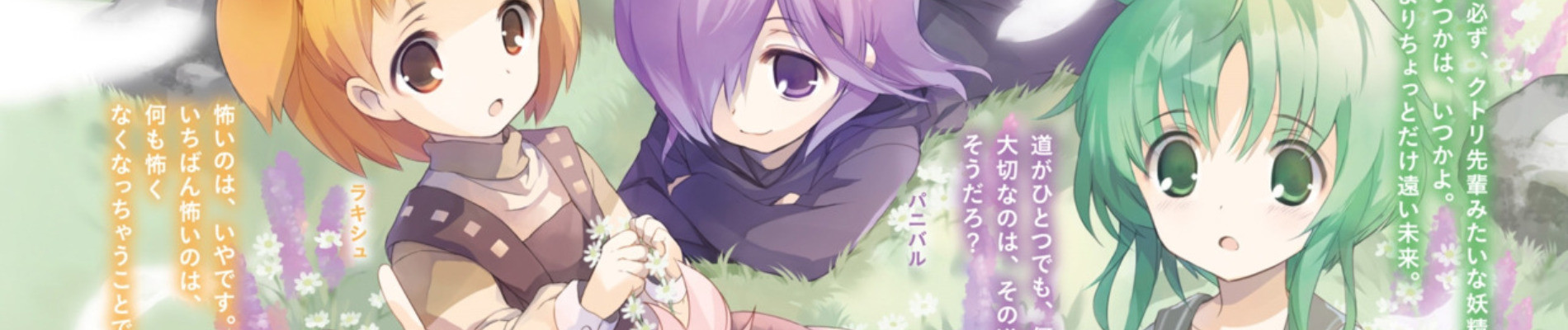
That silence is WorldEnd’s heartbeat. Not despair, not hope—but tenderness under pressure: the way a younger Leprechaun tucks a stray flower behind another’s ear before patrol; how a shared cup of tea steams between two girls who know one may not return from the next sortie; the weight of a hand resting, just for three seconds, on a shoulder—not as comfort, but as witnessing. This isn’t post-apocalyptic spectacle. It’s the slow, daily arithmetic of love in a world that has already ended: five hundred years past extinction, yet every sunrise is borrowed, every laugh is a defiance measured in heartbeats. The magic isn’t in the weapons—it’s in the way memory manipulation doesn’t erase grief, it fractures it into quieter, more persistent forms: a lullaby half-remembered, a name almost spoken, a parental gesture mirrored without knowing why. You don’t feel sad watching WorldEnd—you feel tender, fragile, attentive, like holding something irreplaceable with bare hands.
Which makes the resonance with certain games startling—not because they share lore or aesthetics, but because they replicate that same emotional physics. Take Chains: a match-3 arcade game where “link adjacent bubbles of the same color into chains” against “increasingly difficult physics-driven” constraints. A player writes it “reminds me of connect 4 in nutshell”—a simple, rhythmic act of connection, repeated until the structure gives way or holds. That’s WorldEnd’s emotional architecture: small, deliberate linkages—between girl and weapon, sister and sister, memory and present—that must be sustained despite invisible forces pulling everything apart. The tension isn’t in grand battles, but in the precision of care: lining up three red bubbles just so, just as a Leprechaun lines up her stance before the Beast descends—not for victory, but to buy one more day for the others to laugh, to mend, to forget, even briefly.
Then there’s the found family pulse—the way safety isn’t found in strength, but in shared vulnerability. WorldEnd’s girls aren’t warriors first; they’re children rehearsing adulthood while their elders vanish into duty or dementia, their identities dissolving like mist over the island’s rim. Their bond isn’t forged in fire, but in the quiet accumulation of mundane acts: folding uniforms, mending wings, whispering stories no one remembers the origin of. That same rhythm lives in games where survival isn’t about domination, but continuance: where crafting isn’t optimization, but ritual; where each repaired tool echoes the careful stitching of a torn sleeve, each gathered resource mirrors the way a girl saves half her ration for the one who slept through breakfast. The emotional DNA isn’t in the stakes—it’s in the repetition, the intimacy of maintenance, the way love persists not as flame, but as embers tended in wind.
Who carries this? Not the person seeking catharsis, but the one who recognizes grief as something you live inside, not overcome. The viewer who watches WorldEnd and feels their throat tighten not at death, but at the sight of a child braiding another’s hair too carefully, too slowly, as if trying to stitch time itself. The player who opens Chains, not to win, but to feel the soft click of alignment—the tiny, perfect satisfaction of three colors meeting—because that’s the closest thing to peace they’ve been allowed all week. These pairings are for the ones who understand that the most devastating tragedies aren’t loud—they’re the ones measured in teacups, in breaths held, in chains quietly, stubbornly, held.
🎮4 Games That Match the Vibe



Match Dimensions Explained
❓Frequently Asked Questions
Why does Chains keep coming up in WorldEnd fan forums?
Because both lean hard into quiet, melancholic world-ending vibes—Chains’ minimalist bubble-linking feels like performing small, ritualistic acts while the world quietly unravels, much like Yuu’s daily routines with the girls at the base. Players often mention how Chains’ soothing but persistent pressure (e.g., gravity-affected bubbles slipping just out of reach) mirrors WorldEnd’s emotional weight—calm on the surface, heavy underneath.
Is there an anime or visual novel adaptation of Chains?
No—Chains is purely a mobile match-3 game with no anime, manga, or visual novel spin-offs. It’s intentionally stripped down: no characters, no dialogue, just color, physics, and progression. That’s actually why fans of WorldEnd’s tone love it—it delivers the same contemplative, end-times atmosphere without words, unlike WorldEnd’s dense VN storytelling.
How does Chains compare to Doki Doki Literature Club! in terms of emotional impact?
Totally different flavors: DDLC hits with sudden, meta-narrative whiplash and character-driven horror, while Chains builds emotion slowly through repetition and subtle escalation—like watching the same sunset fade a little more each level. Reviewers call Chains ‘connect 4 in a nutshell,’ but its gentle physics and escalating tension (e.g., bubbles bouncing unpredictably as stages progress) create a quiet, cumulative sorrow that’s closer to WorldEnd’s slow-burn ache than DDLC’s sharp turns.
What’s the best game like WorldEnd if I want something calming but still emotionally heavy?
Chains is your best bet—it’s got that rare balance: zero stress from combat or time limits, but deep emotional resonance through its survival & crafting-adjacent rhythm (clearing chains to ‘survive’ each stage) and its 77 Metacritic score for emotional narrative. Fans say it captures the feeling of tending to small, meaningful tasks—like Yuu fixing tea or calibrating sensors—while the world dims around you.