Castle Town Dandelion
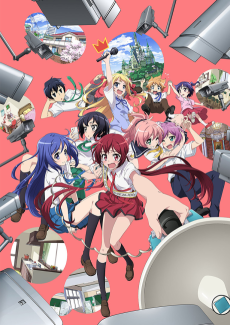
In the story, the everyday lives of the nine super-powered siblings of the royal family are monitored by more than 200 surveillance cameras and broadcast nationwide. The people of the nation who are watching the broadcast will have the ability to elect the next monarch. The story focuses on Akane, the third-oldest sister who can manipulate gravity. She is shy and desperately does not want to be caught on camera.
(Source: Anime News Network)
📺Anime Details
📝Editorial Analysis
The camera whirs—just once—as Akane stumbles backward on the rain-slicked school steps, her gravity power flaring unintentionally, lifting her skirt a fraction too high. She freezes. Not from embarrassment alone, but from the weight of being watched: 217 lenses, blinking somewhere in the eaves, the gutters, the clock tower—and every citizen of this quiet, sun-dappled kingdom holding their breath, voting in real time. Her fingers dig into her thighs. Her breath hitches—not in panic, but in that quiet, suffocating recognition: she is never just herself. She is data. She is performance. She is love made public.

That’s the heart of Castle Town Dandelion: not spectacle, not stakes, but the tremor beneath domestic calm—the way intimacy curdles when privacy evaporates. It doesn’t scream about surveillance; it lives in the pause before a laugh, the extra half-second Akane holds her umbrella just so, the way her siblings’ powers flicker like nervous tics whenever a lens glints in the corner of frame. This isn’t dystopia as oppression—it’s dystopia as domesticity. The royal family bakes pies, argues over chores, hides crushes, and negotiates bedtime—all while their emotional labor streams live. What you feel isn’t dread, but tenderness laced with exhaustion: the ache of wanting to be seen and unseen, loved and left alone. It makes you think about how much of your own self you perform for invisible audiences—how many small rebellions you stage just to keep one corner of your soul unrecorded.
That same fragile, resonant tension lives in Persona 5 Royal—not in its heists or its neon-lit rebellion, but in the seamless transition between daily life and existential weight. The player review nails it: “The seamless transition between daily life…” That’s Akane’s entire rhythm—her morning routine, her classroom fumbles, her whispered confessions to a potted plant—all threaded through with the quiet pressure of consequence. Like Akane, Joker navigates a world where every conversation is both mundane and charged, where building bonds feels like threading needles under surveillance. The stunning soundtrack doesn’t just accompany—it holds space, like the gentle piano motif that underscores Akane’s solo walks home: soft, persistent, refusing to let the ordinary feel trivial.
Then there’s Drakensang, whose player review recalls “good memories” and a quiet, almost mournful appreciation for something rare: a grounded, lived-in fantasy where magic feels like weather, not fireworks. That’s Castle Town Dandelion’s tonal cousin—no grand battles, no throne-room speeches, just nine siblings navigating power like it’s a slightly inconvenient inheritance: a sibling’s teleportation mishap during laundry day, a brother’s age-regression episode mid-soccer practice. Drakensang’s charm lies in its tactile realism—the clink of armor, the weight of a journal entry—and Castle Town Dandelion mirrors that in its domestic texture: the steam rising off miso soup at breakfast, the static hum of a surveillance feed bleeding into the background score, the way Akane’s gravity field makes her hair float just so when she’s stressed. Both treat the extraordinary as furniture—present, functional, quietly shaping the room.
And Heroes of Might & Magic V, praised by its fan as “nuking both HoMMIII and HoMMII from orbit,” shares something deeper than strategy: it’s about legacy as infrastructure. The game’s world isn’t built for epic soliloquies—it’s built for stewardship, for managing resources, for watching crops grow between wars. So is Castle Town Dandelion’s kingdom: the monarchy isn’t seized; it’s maintained, like pruning a garden. The cameras aren’t tools of control—they’re irrigation systems, feeding public affection back into the soil of legitimacy. When Akane finally lets her guard down—not in a climax, but in a single unguarded moment folding origami with her youngest sister—the resonance isn’t triumph, but continuity. Like HoMM V’s best campaigns, it’s about what endures after the fanfare fades.
This pairing sings to the viewer who cries during grocery lists in anime, who replays dialogue trees not for plot, but for the tremor in a voice actor’s sigh. To the player who saves before calling a friend in a dating sim—not because they fear rejection, but because they want to savor the possibility of connection, unedited, unstreamed. To anyone who’s ever held their breath, just once, waiting for the camera to stop rolling—then exhaled, relieved, when it didn’t… and kept living anyway.
🎮28 Games That Match the Vibe












Match Dimensions Explained
❓Frequently Asked Questions
Why does Castle Town Dandelion keep getting matched with Persona 5 Royal despite being a cozy life sim?
It’s all about that 'dual-life rhythm'—just like how Persona 5 Royal flips between Tokyo school days and Phantom Thieves heists, Dandelion layers quiet town routines with sudden magical disruptions (like the mysterious dandelion clock tower activating at midnight). Both lean hard into meaningful daily choices, relationship-building with distinct characters (Ann Takamaki’s charm vs. Dandelion’s warm, grounded cast), and a soundtrack that shifts tone to mirror emotional pivots—hence why players consistently flag that narrative cadence in reviews.
Is there an anime or manga adaptation of Castle Town Dandelion?
No—unlike Persona 5 Royal, which got *Persona 5: The Animation*, *Persona 5 Royal: The Animation*, and multiple manga spin-offs (including *Persona 5 Royal: A Magical Valentine*), Castle Town Dandelion remains exclusively a game with no official adaptations. Fans often compare its quiet, seasonal storytelling to the *K-On!* or *Encouragement of Climb* anime vibes—but those are just stylistic parallels, not licensed ties.
How is Castle Town Dandelion different from Heroes of Might & Magic V?
Totally different genres—but they share that 'strategic warmth' in world-building. HoMM V is a turn-based fantasy strategy game where you command armies across provinces like Eronia and recruit heroes like Sandro or Krew, while Dandelion is a slow-paced life sim set in a single sun-dappled town. Still, both use layered narrative pacing: HoMM V’s campaign unfolds through scripted events and faction lore (like the Sylvan uprising), mirroring how Dandelion reveals town secrets gradually—say, uncovering the truth behind Old Man Hemlock’s greenhouse one season at a time.
What’s the best game like Castle Town Dandelion if I want something nostalgic but with deeper stakes?
Drakensang fits that vibe perfectly—it’s got that same hand-crafted, small-town intimacy (think the village of Gareth with its creaky tavern and guarded apothecary), but layers in mature, morally grey choices straight out of *The Dark Eye* pen-and-paper lore. You’ll recognize the pacing: long walks between locations, journal entries that slowly reframe what ‘safe’ means, and NPCs whose backstories unfold like Dandelion’s letter-writing system—just with more torchlight, dice rolls, and consequences that linger past sunset.