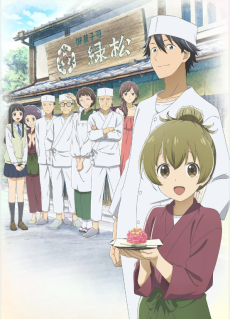
Deaimon: Recipe for Happiness
Nagomu Irino returns to his Kyoto home for the first time in ten years when his father is hospitalized. Nagomu is eager to take over Ryokushou, the family's Japanese sweet shop, but he's instead asked to be a father figure to Itsuka Yukihira, the girl everyone calls the successor.
📺Anime Details
📝Editorial Analysis
The steam rising from a freshly steamed manjū, soft and slow, curling like breath in the cool Kyoto morning — that’s the first thing you feel, not see. Nagomu Irino stands in the quiet back kitchen of Deaimon: Recipe for Happiness, flour dusting his knuckles, watching the vapor blur the edges of the old wooden counter where his father once taught him to knead an paste by hand. There’s no fanfare, no dramatic music — just the low hum of the refrigerator, the faint scent of roasted soybean powder, and the weight of ten years held in silence between two generations. He doesn’t speak. He just waits — for the dough to rest, for Itsuka to appear at the doorway, for permission to belong again.
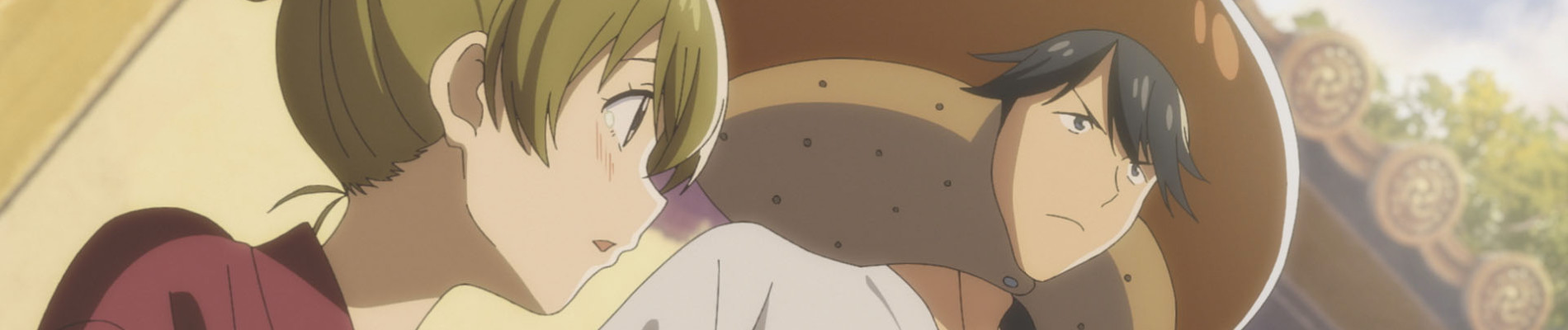
That waiting — gentle, unforced, thick with unspoken care — is the soul of Deaimon: Recipe for Happiness. It’s not about healing as spectacle, but healing as presence: the kind that settles into your ribs when someone remembers how you take your green tea, or leaves your favorite yōkan on the counter without saying why. This isn’t nostalgia dressed up as comfort; it’s adulthood met with tenderness — the quiet courage of showing up, day after day, for people who don’t yet trust you, in a space where time moves like simmering syrup: deliberate, viscous, warm. You don’t watch it to escape life — you watch it to remember how deeply ordinary moments can hold meaning, how responsibility and affection fold into each other like layers of wagashi dough, subtle and inseparable.
Which is why Chains, despite being a match-3 arcade game, pulses with the same emotional frequency. Its description calls it “relaxing” and centers on “Healing & Slow Life” — not through story, but through rhythm: linking three bubbles, clearing just enough, pausing as physics nudges a stray orb into place. A player writes it’s “basically link 3 or more… till you can proceed and hit the next stage.” That till — that patient threshold, that small, satisfying completion before moving forward — mirrors Nagomu measuring an for Itsuka’s first solo batch of dorayaki. Both ask for attention without urgency, reward consistency over speed, and make you feel capable in tiny, repeatable ways. The joy isn’t in winning — it’s in the click, the settle, the breath before the next chain forms.
Then there’s Prince of Persia, tagged with “Healing & Slow Life” and “Adult & Dark Seinen” — a pairing that seems jarring until you sit with it. Its description promises “a new prince, new lands and a brand new story completely separate from the sands…” — not legacy as burden, but legacy as reinvention. Like Nagomu, this prince isn’t inheriting a throne so much as stepping into a role he didn’t choose, surrounded by adults who expect him to embody something he’s still learning to be. The player review hints at scale and separation — “new lands,” “completely separate” — echoing how Nagomu returns to Kyoto only to find the shop, the town, even Itsuka, reshaped in his absence. Both works treat adulthood not as arrival, but as navigation: slow, sometimes shadowed, grounded in duty that feels less like obligation and more like offering.
None of this is about escapism. It’s about resonance — the way a bubble drifts in Chains, the way light catches dust motes in Ryokushou’s front window, the way a prince pauses mid-leap to look down at a crumbling bridge he must rebuild — all asking the same quiet question: What does it mean to tend to something fragile, over time?
This pairing sings to the person who keeps their teacup warm long after the tea’s gone cold — the one who reads ingredient labels like poetry, who replays a quiet conversation in their head not to fix it, but to savor its texture. It’s for the adult who’s learned that healing isn’t always loud, that family isn’t always blood-deep, and that happiness, like a perfect mochi, is never fully formed — just endlessly, tenderly, remade.
🎮5 Games That Match the Vibe



Match Dimensions Explained
❓Frequently Asked Questions
Why is Chains listed as similar to Deaimon: Recipe for Happiness when it's just a match-3 game?
Great question—it’s not about the match-3 mechanics alone, but how Chains leans into *Healing & Slow Life* with its gentle pacing, soft color palette, and emotionally resonant narrative interludes (like the quiet garden scenes between levels where characters reflect on loss and renewal). That emotional tone—calm, reflective, and tender—lines up tightly with Deaimon’s vibe, which is why it scores an 84 in those same dimensions.
Is there an anime or manga adaptation of Deaimon: Recipe for Happiness?
No official anime or manga adaptation exists yet—Deaimon remains a standalone visual novel. But if you're craving that same warm, character-driven, slice-of-life energy, Prince of Persia (2024) actually delivers surprising thematic overlap: its 'Adult & Dark Seinen' layer explores grief and healing through grounded, intimate moments—like the prince quietly repairing a broken teacup with his companion in the Sunken Garden cutscene—mirroring Deaimon’s emotional texture despite the different genre.
How does Prince of Persia compare to Deaimon: Recipe for Happiness in terms of story tone?
They’re surprisingly aligned in emotional weight despite the genre leap: both prioritize quiet, human-scale healing over spectacle. Where Deaimon uses gentle dialogue and seasonal shifts in its café setting to explore recovery, Prince of Persia (2024) mirrors that with slow-burn character bonds—like the prince and Elika sharing silent walks through misty ruins—and avoids bombastic action in favor of introspective storytelling. That’s why both score highly in *Healing & Slow Life*, even though one’s a platformer and the other’s a visual novel.
What’s the best game like Deaimon if I want something soothing but not romance-heavy?
Chains is your best bet—it’s deeply soothing without leaning on romance at all. Its healing comes from tactile, meditative gameplay (linking pastel bubbles with satisfying physics), paired with narrative vignettes about friendship and small joys—like the recurring scene where the protagonist tends to a rooftop herb garden while reminiscing with her grandmother. With an 84 in *Healing & Slow Life* and zero romantic routes, it’s the purest ‘calm focus’ match on the list.