
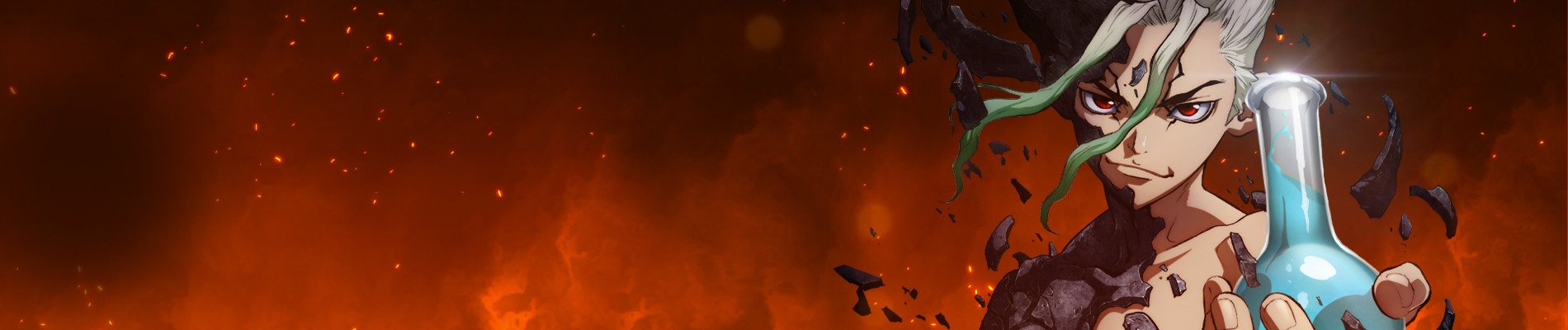
Dr. STONE
After five years of harboring unspoken feelings, high-schooler Taiju Ooki is finally ready to confess his love to Yuzuriha Ogawa. Just when Taiju begins his confession however, a blinding green light strikes the Earth and petrifies mankind around the world— turning every single human into stone.
Several millennia later, Taiju awakens to find the modern world completely nonexistent, as nature has flourished in the years humanity stood still. Among a stone world of statues, Taiju encounters one other living human: his science-loving friend Senkuu, who has been active for a few months. Taiju learns that Senkuu has developed a grand scheme—to launch the complete revival of civilization with science. Taiju's brawn and Senkuu's brains combine to forge a formidable partnership, and they soon uncover a method to revive those petrified.
However, Senkuu's master plan is threatened when his ideologies are challenged by those who awaken. All the while, the reason for mankind's petrification remains unknown.
(Source: MAL Rewrite)
📺Anime Details
📝Editorial Analysis
The first thing Taiju feels isn’t fear—it’s warmth. Sunlight, real and unfiltered, pours over his face as he blinks awake on cracked asphalt, the air thick with pollen and the green sigh of vines curling around rusted cars. His hand brushes Yuzuriha’s stone arm—cold, smooth, impossibly still—and in that silence, something clicks: not despair, but curiosity. Not “Why me?” but “What happened to the steel in that bridge? How did this moss eat concrete? Can I rebuild the hinge on that bicycle?” That warmth isn’t just solar—it’s the heat of a mind re-engaging with causality after millennia of stasis.
That’s the core feeling Dr. STONE radiates: reverent urgency. It’s not grim survival—it’s wonder sharpened by necessity. Every ruined skyscraper isn’t a tomb; it’s a parts catalog. Every petrified statue isn’t a loss—it’s a data point, a calibration for time itself. The show makes you think in materials: how cellulose becomes paper, how clay becomes kiln-fired ceramic, how static electricity can spark a battery. It’s science as tactile poetry—no lectures, just Taiju’s calloused fingers grinding quartz, Senku’s eyes locking onto a rusted bolt like it holds the key to gravity. You don’t just watch civilization reboot—you feel the satisfying click of a gear meshing, the hiss of steam lifting a piston, the snap of a properly tempered spring. It’s optimism forged in empirical fire.
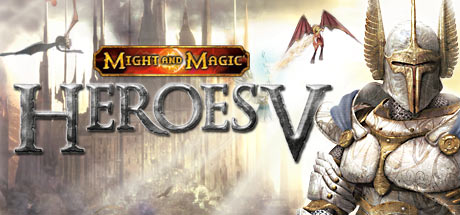
Which is why Heroes of Might & Magic V hits with such startling resonance. Its description calls it “a next-generation phenomenon, melding classic deep fantasy with next-generation visuals and gameplay”—but what players feel, according to that review, is the same electric clarity: “Best HoMM game ever made… this game nukes both HoMMIII and HoMMII from orbit.” That’s not nostalgia—it’s reconstruction energy. Like Senku dismantling ancient tech to reverse-engineer gunpowder, HoMMV doesn’t just iterate—it recontextualizes. You’re not inheriting a kingdom; you’re surveying ruins, identifying salvageable resources (iron veins, herb patches, crumbling watchtowers), then crafting your army’s identity from scratch—goblins upgraded with scavenged armor, mages trained in repurposed libraries. The survival isn’t about hoarding food—it’s about systemic literacy: knowing which terrain boosts which unit’s morale, how wind direction affects siege accuracy, how a single upgraded forge reshapes your entire campaign’s tempo. It’s the same joyful rigor as Senku calculating fermentation ratios for alcohol-based antiseptics—every decision is a hypothesis tested in real time.
And the ensemble cast? That’s where HoMMV’s JRPG Narrative dimension shines—not through cutscenes, but through faction interplay. When your Haven hero negotiates with a Sylvan envoy over shared aquifer rights, or your Dungeon commander repurposes abandoned dwarven mines into lava-fueled forges, you’re living Dr. STONE’s quiet truth: rebuilding isn’t solo genius—it’s orchestrated competence. Taiju’s strength isn’t intellect; it’s his hands holding scaffolding while Chrome calibrates lenses and Ruri refines alloys. Likewise, HoMMV’s player doesn’t “win” by out-DPSing foes—they win by aligning expertise: the necromancer’s bone-salvage efficiency, the knight’s terrain mastery, the alchemist’s potion yield—all feeding one resilient, adaptive system. No character is “just” muscle or magic; each is a specialized node in a living network. That’s the emotional DNA: trust earned through demonstrable skill, not exposition.
This pairing sings for the viewer who keeps a notebook open during anime—not to sketch characters, but to sketch schematics. For the player who pauses strategy games not to min-max stats, but to trace supply chains: “Where does this iron ore get smelted? Who maintains the water pumps? How many hours of labor does that enchanted armor actually represent?” It’s for anyone who’s ever stared at a broken toaster and felt not frustration, but invitation—the quiet thrill of seeing a world not as finished, but as infinitely editable. Not because it’s easy, but because every gear, every formula, every petrified hand reaching skyward is proof: causality still holds. And that, more than any confession or explosion, is the most human, hopeful thing of all.
🎮8 Games That Match the Vibe




Match Dimensions Explained
❓Frequently Asked Questions
Why is Heroes of Might & Magic V listed as a game like Dr. STONE?
Because both hinge on rebuilding civilization from scratch—Dr. STONE’s Senku uses science to restart tech, while HoMM V’s heroes rebuild shattered kingdoms after apocalyptic war, managing scarce resources, crafting siege engines, and evolving settlements from ruins to fortresses. The JRPG-style narrative in HoMM V even mirrors Dr. STONE’s character-driven arcs: you’ll watch Kaelen or Sandro grow from desperate survivors into visionary leaders, just like Senku and Ruri guiding their tribe through trial-and-error innovation.
Is there a Dr. STONE video game adaptation?
No official Dr. STONE game exists—but fans who love its vibe often pivot to Heroes of Might & Magic V, since it captures the same core thrill: using logic, limited tools, and step-by-step progression to rebuild society. One player review nails it: 'Best HoMM game ever made... nukes both HoMMIII and HoMMII from orbit'—which feels exactly like Senku declaring 'Science, baby!' before reverse-engineering gunpowder from scratch.
How does Heroes of Might & Magic V compare to Minecraft for Dr. STONE fans?
Minecraft gives open-ended sandbox freedom, but HoMM V delivers Dr. STONE’s *structured* scientific progression: instead of placing blocks, you’re researching spellbooks, upgrading mines, and evolving creatures like Griffins into Archangels—each upgrade feels like Senku’s lab notes coming to life. And unlike Minecraft’s solo survival, HoMM V’s campaign drops you into a world where every faction (like the Haven realm) has lore-rich characters making tough ethical calls—think Ryusui choosing between loyalty and truth.
What’s the best game like Dr. STONE if I want that ‘eureka moment’ vibe—smart problem-solving with real stakes?
Heroes of Might & Magic V is your pick—it’s all about eureka moments disguised as strategy: figuring out how to breach a castle wall with a catapult you just crafted, or realizing a forgotten spellbook lets you resurrect fallen allies mid-battle—just like Senku realizing bamboo + clay = kiln. With its 58 Metacritic score and fan praise calling it 'the best HoMM game ever made,' it nails that blend of cerebral planning and triumphant payoff Dr. STONE fans crave.