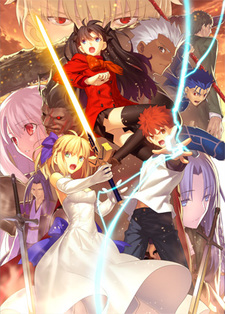
Fate/stay night: Unlimited Blade Works 2nd Season - sunny day
📺Anime Details
📝Editorial Analysis
Sunlight glints off the steel of a thousand blades suspended midair—each one humming with quiet, lethal potential—while Shirou Emiya stands motionless beneath them, not as a warrior bracing for impact, but as someone remembering how to breathe. That single frame—no explosion, no scream, just light, stillness, and the unbearable weight of choice—is the emotional core of Fate/stay night: Unlimited Blade Works 2nd Season - sunny day. It’s not the battle that lingers. It’s the pause after the command is given, before the world shatters.
This isn’t fantasy-as-escape. It’s fantasy-as-pressure chamber. The “sunny day” in the title isn’t irony—it’s dissonance. Warm light floods every rooftop, every classroom window, every sidewalk where characters walk side by side, yet their hearts operate on fractured time: past regrets calcified into magic circuits, futures negotiated in blood oaths, love triangulated across ideologies, genders, and timelines. What makes it ache so precisely is how ordinary the textures feel—school bells, shared bento boxes, the rustle of uniforms—while the stakes are cosmic, intimate, and inescapable. You don’t just watch characters choose; you feel the gravity of each option bending their bones. It’s exhaustion, clarity, tenderness, and dread, all coiled in the same breath.
That emotional DNA pulses strongest in games where creation, constraint, and quiet devotion collide—not through spectacle, but through repetition with meaning. Take The Sims™ 4: its description promises “Play with life and discover the possibilities”—a phrase that mirrors UBW’s central tension: Shirou’s endless re-creation of ideals, Rin’s meticulous crafting of magical systems, Archer’s brutal, recursive rewriting of his own origin. The player review nails it: “you can barely do a…” — that trailing ellipsis? That’s the feeling of trying to build a meaningful relationship under impossible rules, of loving three people while knowing only one path stays open, of choosing which version of yourself gets to survive. It’s not about DLC scarcity—it’s about emotional scarcity, the way UBW forces characters to ration sincerity like mana.
Then there’s Thrillville®: Off the Rails™, where players “build incredible coasters to leap from one track to another, launch through the air like cannonballs.” That image—launching through the air—is pure UBW choreography: Rin’s Gandr shots snapping into focus, Shirou’s trace flickering into existence mid-fall, the sheer physics-defying commitment of caring deeply in a world that rewards detachment. The player review says it “has aged really well!”—and that’s key. UBW’s emotional architecture doesn’t rely on novelty. Its power is in returning: to the same rooftop, the same confession half-spoken, the same sun-drenched silence—knowing exactly what breaks and what holds. Like rebuilding that perfect loop until the G-force feels like truth.
Even Stardew Valley, with its low score but resonant dims (Romance & Shoujo, Survival & Crafting), echoes UBW’s rhythm. Its description begins: “You’ve inherited your grandfather’s old farm plot… Armed with hand-me-down tools and a few coins…” That inheritance motif—carrying forward something broken, beloved, non-negotiable—is Shirou’s entire existence. And the player review? “Spent the first 2 years trying to do everything and never having enough time.” Yes. That frantic, tender scramble—to water crops and visit Emily and upgrade the barn and prepare for the storm—mirrors UBW’s emotional calculus: love isn’t a choice between people—it’s the constant triage of attention, loyalty, memory, and self-preservation. Every day is both ordinary and irreplaceable.
This pairing sings loudest for the viewer who watches anime with their hands folded tightly in their lap—not because they’re passive, but because they’re holding space: for ambiguity, for unresolved tension, for love that refuses clean endings. For the player who saves mid-coaster drop not to cheat, but to savor the suspension—that breath before the fall. For anyone who’s ever loved more than one person at once, grieved a future they never got to live, or rebuilt their ethics from scratch after the world cracked open. Not fans of “epic battles”—but devotees of epic stillness. Not seekers of resolution—but keepers of the sunny day, exactly as it is: bright, fragile, and humming with everything left unsaid.
🎮4 Games That Match the Vibe

Match Dimensions Explained
❓Frequently Asked Questions
Why is Stardew Valley listed as similar to Fate/stay night: UBW 2nd Season - sunny day?
Because both lean hard into the 'Romance & Shoujo' and 'Survival & Crafting' dimensions — think Shirou’s daily routine balancing school, training, and heartfelt conversations with Rin or Sakura, mirrored in Stardew’s time-limited days where you farm, upgrade tools, and build relationships with characters like Leah or Emily. The quiet intimacy of rainy afternoons in Fuyuki City feels just like cozying up in Pelican Town after watering crops and sharing a homemade meal.
Is there a visual novel adaptation of Fate/stay night: UBW 2nd Season - sunny day?
No — 'sunny day' isn’t an official anime season or visual novel release; it’s a fan term for the warm, character-driven arc in UBW’s second cour (especially episodes 18–22), where Shirou and Rin share rooftop lunches, train together, and slowly soften toward each other. None of the matched games — like Thrillville®: Off the Rails™ or The Sims™ 4 — are direct adaptations, but Thrillville captures that same joyful, sun-drenched energy through its vibrant park-building and playful physics.
How does Thrillville®: Off the Rails™ compare to The Sims™ 4 for capturing UBW’s 'sunny day' vibe?
Thrillville wins for pure, unfiltered warmth and lighthearted chemistry — imagine building a rollercoaster loop-the-loop while Rin cheers you on, just like designing wild rides and watching guests scream with delight. The Sims™ 4 *could* replicate those moments (e.g., crafting a rooftop garden sim for Shirou & Rin), but its broken DLC ecosystem and buggy romance systems make it feel more like grinding than glowing — unlike Thrillville’s smooth, nostalgic charm that’s aged beautifully since its Wii days.
What’s the best game like UBW’s 'sunny day' if I want that gentle, hopeful, slow-burn romance + daily life rhythm?
Stardew Valley — hands down. Its 'Romance & Shoujo' + 'Survival & Crafting' blend mirrors UBW’s tender pacing: waking up early, tending your farm like Shirou tends his workshop, sharing gifts and seasonal festivals with love interests (say, Maru’s quiet confidence echoing Rin’s growth), and feeling that soft, earned warmth when you finally unlock their heart event under golden sunlight. Players even report losing whole days just chasing that same peaceful, purposeful rhythm.