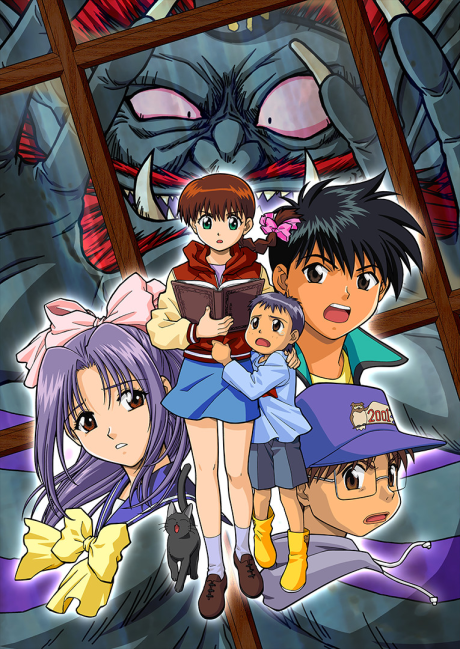
Ghost Stories
Kids and ghosts. When young Satsuki finds an old book of spells from her passed away mother, she gains the power to fight ghosts that are haunting her new school. With the help of her friends, and of a really wicked devil cat, she must protect everyone around her or be haunted for ever more.
(Source: Anime News Network)
📺Anime Details
📝Editorial Analysis
The chalk dust hangs thick in the air—not from erasers, but from the ghostly residue of a yōkai dissolving mid-scream as Satsuki slams shut her mother’s spellbook. Her small hands tremble, not from fear alone, but from the sudden, jarring weight of responsibility: this isn’t just her haunting—it’s the school’s breath catching, the fluorescent lights flickering like failing synapses, the quiet rustle of classmates pretending not to see what just peeled itself off the locker door and vanished into the ceiling tiles.

That’s the feeling Ghost Stories lives inside: uncanny tenderness. Not dread, not jump-scares—but the low hum of something ancient brushing against childhood routine. It’s in how the ghosts aren’t just monsters; they’re echoes with unfinished business, tied to lunchboxes, detention slips, and the particular loneliness of moving to a new town at twelve. The horror isn’t externalized—it’s domesticated, folded into the geometry of hallways and the soft thud of sneakers on linoleum. You don’t feel hunted—you feel witnessed, and suddenly, protectively awake. That duality—fragile and feral, playful and profoundly sad—is its emotional signature. It treats curses like homework assignments and afterlife bureaucracy like student council elections. There’s no grand apocalypse here—just the quiet, daily courage of kids holding open a door between worlds, armed with ink, intuition, and a devil cat who judges your life choices.
Which is why Postal III, for all its surface chaos, shares that same warped emotional gravity. Its description calls it “Good or Insane? The choice is yours”—and that’s the exact tonal pivot Ghost Stories makes every episode: sincerity wrapped in absurdity, trauma dressed in slapstick. The player review admits, “It's postal, so everything is weird”—and yes, Ghost Stories operates under that same unspoken contract: the rules are broken, the stakes are real, and the delivery is deliberately unhinged. When Satsuki chants a binding incantation while tripping over her own shoelaces, or when the devil cat hisses a curse in perfect iambic pentameter before licking its paw—that’s the same DNA as Postal Dude shrugging off dismemberment to debate municipal zoning laws. Both refuse to choose between heartbreak and farce. They let them bleed into each other until you can’t tell if you’re crying or choking on laughter.
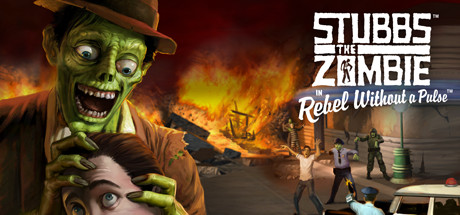
Then there’s Stubbs the Zombie in Rebel Without a Pulse, whose tagline—“Be the Zombie. Kick A and Take Brains.”—sounds like a playground chant gone feral. Its description weaponizes the body-horror/occult axis, but the player review reveals the truth: “I have always loved this game… No …” — trailing off, reverent, almost tender. That’s the key. Stubbs isn’t just gnawing; he’s remembering. His reanimation isn’t nihilistic—it’s nostalgic, even mournful, layered under cartoonish gore. Like Satsuki flipping through her mother’s worn spellbook, tracing the inked kanji like braille for grief, Stubbs moves through ruined architecture with the slow, aching precision of someone trying to reconstruct a life from fragmented muscle memory. Both treat the supernatural not as spectacle, but as emotional infrastructure: the ghost isn’t the threat—it’s the symptom. The zombie isn’t the monster—it’s the archive.
These pairings won’t land for someone seeking clean allegory or polished scares. They’re for the person who keeps a half-finished origami crane on their desk because it means something, even if they can’t say what. For the one who laughs too loud at funerals, who names their houseplants after dead poets, who feels the weight of a forgotten lunchbox left in a locker three years ago. They’re for viewers who recognize sacredness in the sloppy, the unresolved, the child-sized—and who know that the most terrifying, beautiful thing isn’t a ghost in the hallway, but the quiet certainty that someone will stand there, spellbook open, devil cat at their shoulder, ready to translate the unspeakable into something you can hold—just for now.
🎮24 Games That Match the Vibe








Match Dimensions Explained
❓Frequently Asked Questions
Why is Postal III listed as similar to Ghost Stories?
Because both lean hard into Body Horror & Occult themes—like Ghost Stories’ cursed monks battling spectral demons, Postal III throws you into a grotesque, apocalyptic wasteland where the Postal Dude and his pitbull Champ wade through mutated corpses and occult chaos. It’s not about subtlety—it’s about visceral, darkly comic dread, just like Ghost Stories’ oppressive atmosphere—but with way more profanity and parody.
Is there a Ghost Stories movie or TV adaptation?
Nope—no official film, show, or animated series exists. Ghost Stories remains purely a tabletop experience (and its digital adaptations stick close to that). That said, if you love its vibe, Stubbs the Zombie delivers that same blend of occult absurdity and body horror—just swap terrified monks for a wisecracking zombie tearing off heads in 1950s suburbia.
How does Stubbs the Zombie compare to Postal III for occult horror fans?
Stubbs leans into campy, over-the-top zombie mayhem—think ripping limbs off NPCs while juggling brains in a retro-futuristic town—whereas Postal III goes full unhinged satire with occult cults, demonic bureaucracy, and a pitbull named Champ who’s basically your emotional support hellbeast. Both hit Body Horror & Occult + Comedy & Parody, but Stubbs is more cartoonish; Postal III feels like a fever dream narrated by a conspiracy theorist.
What’s the best game like Ghost Stories if I want bleak, atmospheric tension—not comedy?
Neither Postal III nor Stubbs the Zombie fits that bill—they’re both firmly in Comedy & Parody territory, so they’ll undercut dread with absurdity (e.g., Stubbs doing jazz hands mid-brain-eating, or Postal III’s ‘Good or Insane?’ morality system turning cosmic horror into a punchline). If you crave pure bleakness like Ghost Stories’ silent monasteries and creeping despair, you’ll want something outside this match list—these two are the *opposite* of solemn.