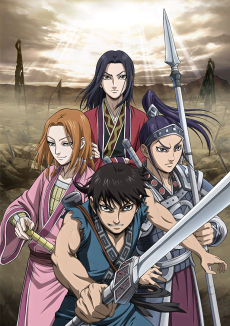
Kingdom Season 2
The second season of Kingdom.
A year after the devastating battle against the formidable Zhao, the State of Qin has returned its focus to pursuing King Ying Zheng's ambition of conquering the other six states and unifying China. Their next target is Wei, a smaller state which stands as a geographic stepping stone for the sake of conquest.
Xin, now a three hundred man commander of the swiftly rising Fei Xin Unit, continues to seek out lofty achievements in order to garner recognition for himself and his soldiers, motivated by those previously lost in battle. In the preliminary battles ahead of Qin's invasion of Wei, Xin finds competition in other young commanders who are of a higher social status than him. Back in Qin, the royal palace faces turmoil as opposing factions begin to make their move against Ying Zheng's regime.
With their hands full both abroad and at home, Zheng and Xin must lead the way in this era of unending war, resolved to etch their names in history by creating a unified China.
(Source: MAL Rewrite)
📺Anime Details
📝Editorial Analysis
The dust hasn’t settled. Not really. You’re standing with Xin in the aftermath of the Wei border skirmish—his armor dented, breath ragged, knuckles split raw from gripping his sword too tight—and all around him, men are dragging bodies into shallow trenches while officers bark orders over the low, wet groan of wounded horses. No triumphant music swells. No slow-motion close-up on a tear. Just the weight: the grit in your teeth, the sour tang of blood and sweat, the sheer exhaustion of ambition that hasn’t yet earned its glory. This is Kingdom Season 2—not as spectacle, but as grind.



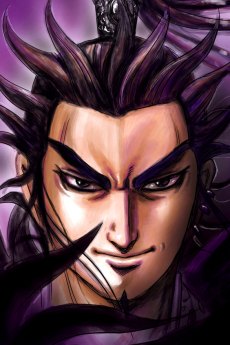

What makes it ache so deeply isn’t the scale of war—it’s the proximity to consequence. Every promotion feels earned through bruised muscle and miscalculated risk; every political maneuver in Qin’s court lands like a stone dropped into still water, rippling outward in quiet, dangerous ways. It’s adult, not because it’s grim or violent, but because it refuses to flinch from the cost of loyalty, the friction between duty and desire, the way power accrues not in speeches, but in the space between a commander’s hesitation and his next command. You don’t watch it hoping for catharsis—you watch it braced, thinking about how many lives hinge on one man’s judgment at dawn, how history isn’t written by kings alone, but by the three-hundred-man unit holding the ridge line just long enough.
That same gravitas hums in BioShock™, where ideology wears a gas mask and utopia bleeds rust. Its description calls it a “Political Thriller” with “Adult & Dark Seinen” dimensions—and yes, the underwater dystopia is alien, but the feeling is identical: the suffocating weight of systems built on grand vision and brittle logic, where every corridor forces you to reckon with who built this world, and what they sacrificed to do it. A player review hails it as “one of the most revolutionary games ever!”—not for its guns, but for how it makes philosophy visceral, how its moral choices land with the same gut-punch as Xin choosing to disobey an order he knows will get men killed, even if it serves the larger conquest. Both demand you hold two truths at once: the necessity of the mission, and the horror of its execution.
Then there’s Act of War: Direct Action, tagged as “Political Thriller, Tactical Warfare,” described as “a frightening tale of suspense, international intrigue and geopolitical military conflict.” Its real-time strategy pulse mirrors Kingdom Season 2’s battlefield choreography—not in flash, but in calculation: positioning units not for flair, but for survival; reading terrain like a map drawn in blood and dust; understanding that victory isn’t won by the strongest sword-arm, but by the clearest read of enemy intent before the charge begins. A player admits the dialogue is “dumb and a bit cringe”—but crucially, adds it’s “like C&C 3,” meaning it treats warfare as process, not poetry. That’s the resonance: both Kingdom Season 2 and Act of War treat strategy as physical labor—the kind that leaves your palms sweating, your throat tight, your eyes scanning the horizon for the flicker of enemy banners before the drums sound.
This pairing sings to the viewer who watches battle scenes not for the slash of steel, but for the silence before the order is given—the soldier adjusting his helmet strap, the general’s finger tracing a river on a worn parchment, the way a single misread wind shifts the arc of a thousand arrows. It’s for the player who replays a mission not to win faster, but to see if they can hold the line longer, absorb more friction, make the call that costs less in lives than in pride. Not teenagers dreaming of glory—but adults who’ve learned, in their own quiet ways, that ambition is never clean, that loyalty is a ledger, and that history doesn’t remember the roar of the crowd, but the grit in the throat of the man who stood just a little longer on the broken wall.
🎮4 Games That Match the Vibe


Match Dimensions Explained
❓Frequently Asked Questions
Why does Kingdom Season 2 feel so much like BioShock’s Rapture in its political decay?
Because both dive deep into crumbling utopias built on ideology—Kingdom S2’s fractured kingdoms mirror Rapture’s objectivist collapse, complete with propaganda broadcasts, morally ambiguous factions, and environmental storytelling that reveals betrayal through audio diaries (like Atlas’s recordings) and decaying architecture. BioShock even shares that same 'adult & dark seinen' weight, where every choice feels heavy and consequences linger.
Is there a Kingdom Season 2 video game adaptation in development?
No—there’s no official Kingdom Season 2 game adaptation, and nothing in the match list suggests one. The closest is Act of War: Direct Action, which shares the geopolitical thriller pulse (think the UN summit tension or the covert ops in Episode 7), but it’s a standalone 2005 RTS inspired by real-world headlines—not tied to Kingdom at all.
BioShock vs. Act of War: Direct Action—which better captures Kingdom Season 2’s tense, dialogue-driven conspiracy vibe?
BioShock wins hands-down for that slow-burn, voice-driven paranoia—its Andrew Ryan monologues and haunting radio transmissions echo Kingdom S2’s whispered alliances and ideological showdowns (like the Council’s secret negotiations). Act of War leans harder into tactical command and C&C-style unit control, missing the intimate dread and narrative density that makes Kingdom S2’s political chess so gripping.
What’s the best game like Kingdom Season 2 if I want that grim, morally gray ‘late-night conspiracy theory’ mood?
BioShock™—hands down. Its dimly lit halls, distorted propaganda broadcasts, and the constant unease of who’s really pulling strings (Fontaine? Ryan? Your own choices?) nail that exact vibe—especially when you’re replaying scenes like the Fontaine Futuristics reveal or the final confrontation, mirroring Kingdom S2’s twist-heavy, trust-no-one pacing. It’s got that 64-score ‘revolutionary’ weight players still cite for its adult & dark seinen tone.