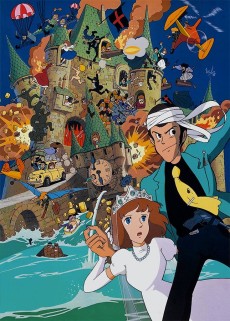
Lupin The 3rd: The Castle of Cagliostro
In the twilight of his career, master thief Lupin the Third's latest and greatest caper has hit a snag. What should've been bags of cash from a national casino turns out to be expert counterfeits! Together with his partner-in-crime Jigen, Lupin heads to the remote European nation of Cagliostro to exact revenge. Not everything goes as planned; the two encounter Clarisse, a royal damsel in distress being forced to marry the sinister Count Cagliostro against her will. Saving her won't be easy, however, as Lupin and Jigen -- together with Lupin's unpredictable ex-girlfriend Fujiko and the swordsman Goemon -- must fight their way through a trap-filled castle, a deadly dungeon, and an army of professional assassins! Can Lupin rescue the girl, evade the cuffs of his long-time nemesis Inspector Zenigata, and uncover the secret treasures of The Castle of Cagliostro?
(Source: Discotek Media)
📺Anime Details
📝Editorial Analysis
The clock tower’s gears groan like a dying beast as Lupin dangles from its crumbling face—wind whipping his jacket, moonlight glinting off the rusted iron—and below him, Clarisse’s white dress flares like a trapped bird’s wing as she stumbles across the rain-slicked courtyard. Not running away, but toward him: not because he’s safe, but because he’s the only one who moves. That split-second—the vertigo of height, the absurdity of grace under chaos, the quiet hum of ancient stone holding centuries of lies—is where Lupin The 3rd: The Castle of Cagliostro lives. Not in the heist, not in the chase, but in the suspended breath between danger and devotion.

This isn’t just adventure—it’s wistfulness with a switchblade. You feel the weight of old money in every cobblestone, the hush before a conspiracy exhales, the way laughter cracks open like thin ice over deep water. It’s melancholy dressed in a red jacket, yearning disguised as swagger, dignity smuggled inside a fugitive’s grin. There’s no moral scaffolding—just Lupin choosing, again and again, to risk everything for a girl he barely knows, not because it’s right, but because not choosing would be worse. The film doesn’t preach class struggle; it lets you taste the dust on the Count’s velvet drapes and smell the damp rot beneath the castle’s gilded floorboards. It makes you think about power not as force, but as architecture: walls, vaults, lineage, silence—all built to keep people small.
That same emotional DNA pulses in Assassin's Creed™: Director's Cut Edition, where player reviews call it a Political Thriller, Neon Noir, Adult & Dark Seinen experience—not for gore or grit, but for how it makes you navigate systems instead of smashing them. Like Lupin studying Cagliostro’s clockwork defenses, you learn the rhythms of patrols, the blind spots in ideology, the way authority hides behind ritual and routine. The game’s dated textures don’t dull its ache—they deepen it, like peeling paint on a palace wall, revealing something older, truer underneath. You don’t just climb towers; you read them, just as Lupin reads the castle’s secrets in the tilt of a hinge or the echo in a corridor.
Then there’s BioShock™, tagged Political Thriller, Adult & Dark Seinen, praised by players as “one of the most revolutionary games ever!”—not for its guns, but for how its world bends your ethics. Like Cagliostro’s counterfeit currency undermining national trust, Rapture’s philosophy collapses under its own logic. Both make you question what “freedom” means when it’s minted by men who’ve already decided who gets to spend it. When Clarisse whispers, “They say I’m the princess—but I’ve never seen the sky,” it lands with the same quiet devastation as BioShock’s “Would you kindly?”—a phrase that doesn’t command, but unmakes consent. Neither story needs villains with mustaches; the real antagonism is structure itself, polished and polite and utterly suffocating.
And yes—there’s joy in both. Not carefree joy, but defiant joy: Lupin cartwheeling off a balcony, Jack reloading with a smirk, the sheer audacity of believing one person’s choice can crack open a century-old lie. That’s why the pairing sings—not because they share mechanics or settings, but because they share moral vertigo: the dizzying, beautiful realization that even in a rigged game, you can still leap.
This is for the viewer who watches Lupin’s rooftop sprint and feels their pulse sync—not to the action, but to the refusal behind it. For the player who lingers at a Rapture mural not to admire the art, but to trace the cracks in the propaganda. For the adult who’s learned that hope isn’t naive—it’s the hardest trick of all, performed without a net, under watchful eyes, in a world that’s already printed the wrong money and called it truth. They don’t want heroes. They want people who remember how to blink in the light.
🎮3 Games That Match the Vibe

Match Dimensions Explained
❓Frequently Asked Questions
Why does Assassin's Creed: Director's Cut Edition feel like a spiritual cousin to Castle of Cagliostro?
Because both lean hard into suave, acrobatic espionage with political intrigue beneath the surface—think Lupin’s rooftop chases mirrored in Altaïr’s parkour across Acre’s sun-baked rooftops, and the film’s shadowy cabal echoing the Templars’ manipulations. The Neon Noir and Adult & Dark Seinen dimensions line up perfectly: it’s not just about stealing treasure, but uncovering lies while looking effortlessly cool.
Is there a Lupin the 3rd video game adaptation that captures Castle of Cagliostro’s tone?
No—there’s never been an official Lupin the 3rd game directly based on *Castle of Cagliostro*. But Assassin’s Creed: Director’s Cut Edition comes closest in spirit: its blend of dashing stealth, historical conspiracy, and elegant action (like scaling walls and slipping past guards) channels Lupin’s charm and precision better than any licensed title ever has.
How does BioShock compare to Assassin’s Creed for someone who loves Castle of Cagliostro’s mix of mystery and style?
BioShock trades Lupin’s sunlit heist energy for something more claustrophobic and philosophically heavy—but it nails the *Adult & Dark Seinen* and *Political Thriller* vibes that make Cagliostro resonate beyond pure fun. Where Assassin’s Creed mirrors Lupin’s physical grace and wit, BioShock echoes the film’s deeper layer: the illusion of freedom, hidden control, and that chilling moment when the ‘castle’ reveals its true, twisted architecture.
What’s the best game like Castle of Cagliostro if I want that ‘clever caper with heart and danger’ feeling?
Go straight to Assassin’s Creed: Director’s Cut Edition—it’s got the same rhythm of planning, improvising, and pulling off impossible escapes (like Lupin’s clocktower climb or Altaïr’s timed rooftop drop into a hay cart). And just like Fujiko’s double-crosses or Inspector Zenigata’s relentless chase, the game keeps tension high without losing its sense of stylish, human-scale stakes.