
Puella Magi Madoka Magica the Movie -Rebellion-
Were all the magical girls truly saved from despair? Now, the great "Law of Cycles" leads the magical girls to their new fate. Madoka Kaname, a girl who once led an ordinary life, sacrificed her very existence to set every magical girl free from their cruel destiny. Homura Akemi, another magical girl who was unable to keep her promise with Madoka, continues to fight in the world in which Madoka left her behind.
"I dream of the day when I can finally see your dear smile again."
Madoka Kaname has changed the world. In this new world, is what the magical girls see a world of hope... or despair?
(Source: Madman)
📺Anime Details
📝Editorial Analysis
The air in Homura’s bedroom doesn’t just breathe—it hesitates. Light slants through the window, dust motes hang suspended—not frozen, but waiting, as if time itself has folded its arms and asked, What now? That single, silent frame before the first distortion ripples across reality: that’s where Puella Magi Madoka Magica the Movie -Rebellion- begins—not with a bang or a spell, but with the unbearable weight of a promise kept too well. You feel it in your molars. A quiet dread, not of death, but of continuity: what happens when salvation becomes indistinguishable from erasure?
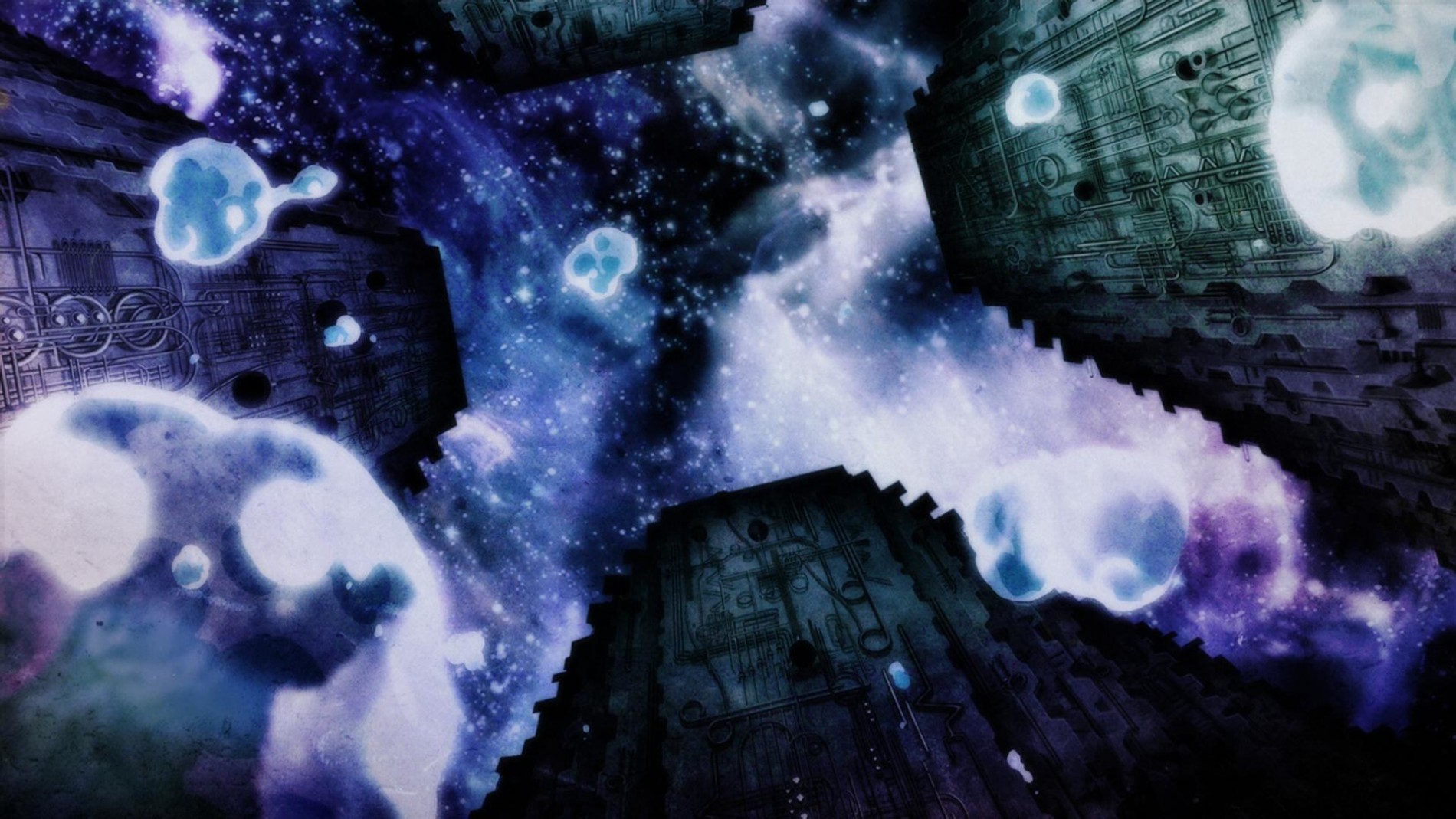
This isn’t despair as spectacle—it’s despair as architecture. The world of Rebellion hums with the low-frequency thrum of cosmic grief disguised as peace. Every pastel sky, every sun-dappled hallway, every gentle laugh from Sayaka or Mami carries the faint, metallic aftertaste of memory manipulation. You don’t just watch Homura’s unraveling—you inhabit the vertigo of someone who remembers the wound but not the scar, who loves a god she helped unmake, who holds a smile in her hands like something fragile and already broken. It makes you question comfort itself. Is safety real—or just the thinnest veneer stretched over an abyss that knows your name? The horror isn’t in the witches’ labyrinths anymore. It’s in the silence between heartbeats, in the way Madoka’s compassion feels less like mercy and more like reconfiguration—a divine edit so total it rewrites causality, identity, even grief’s grammar. You leave not shaken, but unmoored: wondering if love can be both anchor and algorithm.
That same unmooring lives in TimeShift™, where Dr. Aiden Krone’s reckless Time Jump births a “disturbing alternate reality”—not as backdrop, but as condition. Like Homura walking through a world that remembers her pain but not her cause, Krone navigates spaces warped by temporal logic he no longer controls. The player review calls it “a blast… but it takes a little work to get it into a playable state”—and that’s exactly the feeling: the system is broken on purpose, glitching not as flaw but as symptom. You’re not fixing time—you’re diagnosing it, just as Homura diagnoses the Law of Cycles not as salvation, but as containment. Both demand you operate inside a broken framework, trusting nothing—not physics, not memory, not even your own hands.
Then there’s Rise of the Argonauts, where Jason’s vow—to restore his fiancé’s life “at any cost”—echoes Homura’s decades-long spiral. His kingdom, respect, love—all obliterated in a single day, replaced by mythic obsession. The description says he’ll do anything. Not almost anything. Anything. That’s Homura’s line too—not drawn in ink, but in blood, time loops, and the slow corrosion of self. The player review notes it “does ancient history right,” but what it really does is honor the tragic grammar of devotion: how love, stripped of context and mercy, becomes ritual, then compulsion, then theology. Jason doesn’t seek power for glory—he seeks it because love has become synonymous with undoing. Just like Homura doesn’t rebel against Madoka’s law out of spite—but because to love her is to reject her heaven.
Even Loki, flawed and crash-prone, pulses with the same mythic dissonance. Its promise—a “fantasy voyage through the great mythologies”—mirrors Rebellion’s climax, where Madoka doesn’t ascend to godhood but becomes the mythos itself: a force outside narrative, rewriting rules mid-sentence. The player review calls the ending “anticlimactic since nothing happens”—but that’s the point. In Rebellion, the true horror isn’t spectacle; it’s the absence of rupture. The universe doesn’t shatter—it smiles, gently, and forgets it ever had teeth. Loki’s glitches, its hollow finale—they’re not failures. They’re echoes of that same eerie stillness: the moment after divinity settles, and all that’s left is the quiet hum of rewritten laws.
You’d love this pairing if you’ve ever stared at a sunset and felt suspicious of its beauty—if you replay a game not to win, but to catch the flicker where the illusion slips—if you keep rewinding a scene not to understand the plot, but to feel the weight of the choice before it lands. Not fans of “dark stories,” but people who recognize sacred exhaustion, who find awe in systems that love too much, who know the most terrifying magic isn’t in wands or spells—but in the soft, devastating certainty of a smile that shouldn’t exist, yet does.
🎮2 Games That Match the Vibe
Match Dimensions Explained
❓Frequently Asked Questions
Why does TimeShift™ get compared to Madoka Magica: Rebellion?
Because both dive headfirst into fractured time, reality-warping consequences, and body horror tied to occult forces—like when Homura’s witch form reshapes the world, TimeShift’s Dr. Krone literally unravels spacetime, warping environments and his own body in grotesque ways. The game’s dim ‘Time & Memory’ and ‘Body Horror & Occult’ tags line up *exactly* with Rebellion’s core themes, and players call it a ‘4-hour blast’ that nails that unsettling, high-stakes metaphysical tension.
Is there a video game adaptation of Madoka Magica: Rebellion?
No—there’s no official game adaptation of *Rebellion*. The closest you’ll get are thematic matches like *Rise of the Argonauts*, where Jason’s grief-fueled descent into mythic, morally gray power mirrors Homura’s tragic rebellion against fate. Its ‘Adult & Dark Seinen’ dimension and player-reviewed emphasis on ancient tragedy (‘this one does it right’) make it a spiritual cousin—not a port.
How does Rise of the Argonauts compare to Loki for Madoka fans?
If you loved *Rebellion*’s emotional weight and tragic heroism, *Rise of the Argonauts* hits harder—it’s grounded in adult loss and desperate, mythic sacrifice (Jason vowing to resurrect his murdered fiancée), while *Loki* leans into chaotic, glitchy action with shallow lore (players even call its ending ‘anticlimactic since nothing happens’). Both use mythology, but only *Rise* delivers the dark, character-driven gravity *Rebellion* demands.
What’s the best game like Madoka Magica: Rebellion if I want that haunting, reality-bending vibe?
Go straight to *TimeShift™*—it’s the only match with both ‘Time & Memory’ *and* ‘Body Horror & Occult’ dimensions, mirroring how *Rebellion* bends causality and transforms Homura’s body and soul into something uncanny. With an 82 score and players praising its intense, mind-bending 4-hour run (just check community patches first!), it’s the closest you’ll get to *Rebellion*’s vertigo-inducing aesthetic and existential stakes.